By Sainabou Sambou
In a significant development in the country’s efforts to address atrocities from the Yahya Jammeh era, former notorious “Junglers” operative Sanna Manjang pleaded not guilty Thursday to two counts of murder before the High Court in Banjul.
Justice S. K. Jobarteh dismissed a preliminary objection by the defense challenging the validity of the charges, paving the way for the accused to enter his plea. The ruling clears the path for the trial to proceed against Manjang, once described as one of the most feared members of the paramilitary death squad that carried out extrajudicial killings and enforced disappearances under former President Jammeh’s regime.
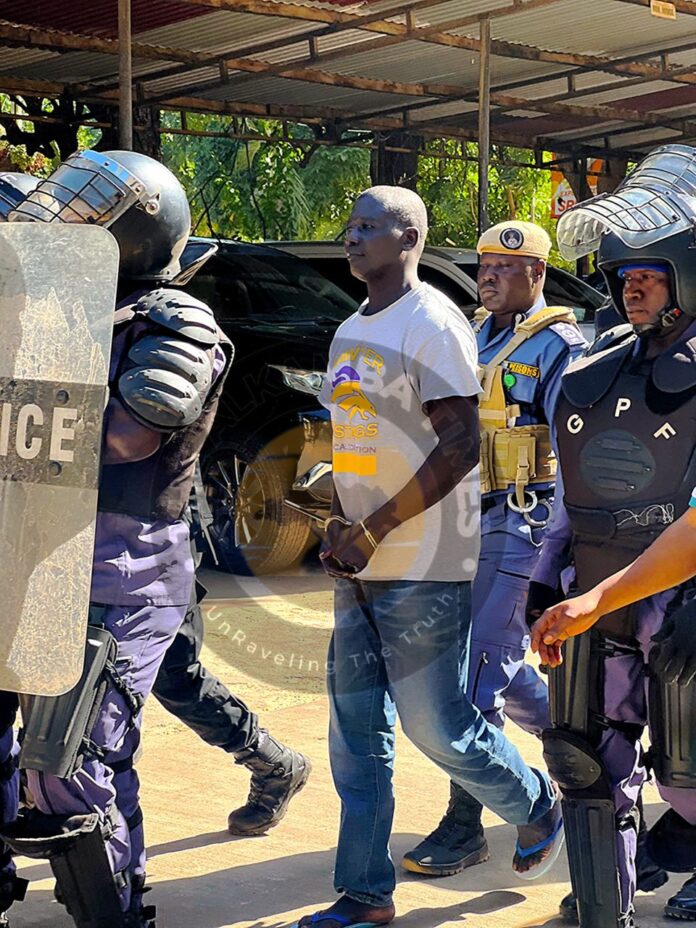
Manjang, who was dramatically arrested in late November 2025 in Senegal’s Casamance region during a joint Gambian Senegalese operation and extradited to The Gambia, faces charges stemming from alleged killings in 2006 at Kanilai in the West Coast Region.
In Count One, the State alleges that Manjang unlawfully caused the death of Kajali Jammeh, also known as “Le Cock,” by cutting his neck with a knife.
In Count Two, he is accused of unlawfully causing the death of Samba Wurry by stabbing him in the chest with a knife.
Both offenses are said to violate Section 187 of the Criminal Code, Cap 10, Volume III, Laws of The Gambia 2009.
Defense counsel S. K. Jobe and F. Jammeh represent Manjang. The prosecution team is led by E. R. Dougan, assisted by P. Gomez, F. Drammeh, M. Jammeh, and A. Badjie.
At the outset of proceedings on January 15, 2026, defense counsel Jobe raised a preliminary objection, arguing that the charges were incompetent. He contended that Section 344 of the recently enacted Criminal Offences Act 2025 had repealed the old Criminal Code under which Manjang was charged, rendering reliance on the repealed statute improper. Jobe cited Nigerian case law in support and urged the court to disregard the charges based on the outdated law.
Prosecutors countered that the alleged offenses occurred well before the Criminal Offences Act 2025 came into force, and that the repeal did not retroactively extinguish liabilities incurred under the prior legislation.
In a detailed ruling, Justice Jobarteh upheld the prosecution’s position. She emphasized that while Section 344 of the new Act expressly repeals the Criminal Code, this must be interpreted alongside the savings provision in Section 2(1)(c). That clause states that nothing in the Act affects the liability, trial, or punishment of any person for acts done or commenced before its commencement.
The judge stressed a core principle of criminal law: liability attaches at the time the offense is committed, not at the time of trial. Retrospective application of criminal statutes is generally prohibited, she noted, and the repeal does not invalidate prosecutions for pre-existing offenses.
“The repeal of the Criminal Code did not render the charges incompetent,” Justice Jobarteh concluded, dismissing the objection and affirming the validity of the proceedings under the former law.
Following the ruling, the court took Manjang’s plea. He entered not guiltypleas to both counts.
The case has drawn widespread attention as one of the first major trials involving a senior figure from the Junglers unit, which the Truth, Reconciliation and Reparations Commission identified as responsible for numerous human rights violations during Jammeh’s 22-year rule. Manjang’s arrest after years on the run marked a breakthrough in accountability efforts.
The matter was adjourned to February 9, 2026, at 1:00 p.m. for further proceedings.