By: Pa Ebrima Sawaneh, UK
Senegal is celebrating, and rightly so.
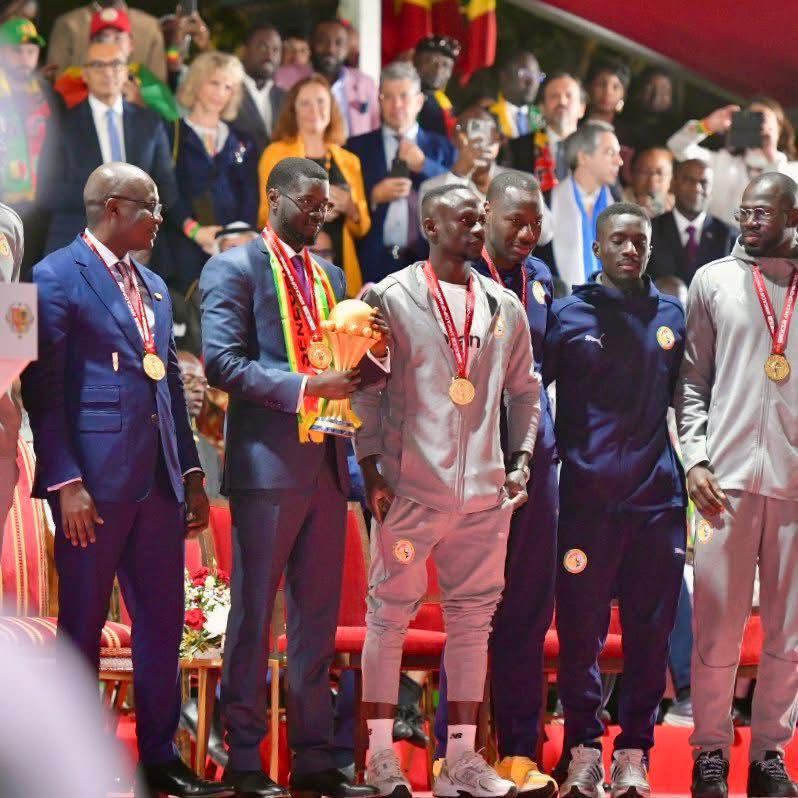
After winning the Africa Cup of Nations, President Bassirou Diomaye Faye has rewarded each member of the national team with a cash bonus of 75 million CFA francs and a 1,500 square meter plot of prime land on the Petite Côte, recognising their achievement as service to the nation. It is a grand gesture, and in many ways, it reflects how deeply football has become more than a sport in Africa. It is pride. It is identity. It is unity. It is national therapy.
But while we applaud Senegal’s triumph and the rewards that followed, we must also pause and ask an uncomfortable but necessary question.
When a nation rewards its heroes, who qualifies as a hero?
Because the truth is, footballers are not the only people serving their country.
I Love Football, But This Question Must Be Asked
I am a football lover. I celebrate our wins and suffer our defeats like any passionate supporter. I understand the emotion that comes with watching a national team lift a trophy and carry the hopes of millions. Football gives young people something to believe in. It gives the nation something to rally behind. It unites communities that may disagree on everything else.
So yes, reward the footballers. Celebrate them. Honour them.
But let’s be honest. Footballers already operate in an incentive-based environment. They earn match bonuses, tournament bonuses, allowances, and other benefits that come with the profession. Many of them also earn from club contracts, endorsements, and sponsorships.
Meanwhile, the everyday civil servant, the one who keeps the country running quietly, rarely receives such recognition, even when their contribution is directly tied to national progress.
My WAEC Experience Taught Me What Service Really Means
When I worked at WAEC, we spent many nights working far beyond normal office hours to ensure results were released in August. That was not just a target on paper. It was a national responsibility. Parents needed time to prepare for school reopening in September. Students needed clarity. Schools needed planning. The country needed order.
The normal 8 to 4 work schedule could never have achieved it. We had to put in the hours. We had to sacrifice. We had to deliver because that was our contribution to national development.
And we did it without fanfare.
No convoys. No public ceremony. No land allocations. No national headlines.
Just duty.
The Real Issue Is Not Rewarding Footballers, It Is Selective Recognition
Senegal’s rewards have reignited a conversation many people have avoided for too long. The issue is not that footballers are being rewarded.
The issue is that only footballers are being rewarded at that scale, while other sectors are treated as if sacrifice is simply part of the job and should not be celebrated.
If a football trophy deserves cash bonuses and prime land, what about the nurse who works through the night to keep patients alive?
What about the teacher who shapes future leaders with little support?
What about the NAWEC worker restoring power during storms?
What about the immigration officer representing the country at the borders?
What about the police officer maintaining public order with minimal tools?
What about the exam body staff ensuring national results are delivered on time?
What about the sanitation workers protecting public health quietly every morning?
These people may not lift trophies, but they lift the nation daily.
And The Gambia Has Seen Similar Moments
The Gambia may not have reached the same level of rewards as Senegal, but we have also witnessed moments where sports achievements triggered national recognition and celebrations.
And again, that is not wrong.
What is wrong is the imbalance in how we value national contribution. In many cases, the civil servant who works for 20 or 30 years retires with little more than a handshake, delayed benefits, or a thank-you-for-your-service message that does not match the sacrifice.
Yet we are quick to mobilise national resources when the reward is tied to a public celebration.
That is where the debate becomes legitimate.
What Message Are We Sending Young People?
In a society already battling youth frustration, unemployment, and a strong obsession with fame, we must be careful what we promote.
When the biggest national rewards are given only to those in entertainment and sports, the message becomes clear.
If you want to be valued, do not serve quietly. Be seen.
That mindset is dangerous for national development, and we wonder why “backway” is popular.
Because a country cannot be built by visibility alone. It is built by systems, institutions, disciplines, and people who show up even when nobody is clapping.
A Nation Must Build a Culture of Fair Honour
Imagine if we created a structured national recognition system that celebrates excellence across sectors, not just in sports.
A system where every year the nation honours the most outstanding teacher, the most outstanding nurse, the most outstanding civil servant, the most outstanding security personnel, the most outstanding public utility worker, the most outstanding youth volunteer, and the most outstanding local government worker.
Not just with certificates, but with meaningful rewards. Housing support, scholarships, land access, business grants, or national service bonuses.
Because motivation is not only money. It is dignity.
And dignity is what many public servants feel they are losing.
Let’s Celebrate Football, But Let’s Also Expand the Definition of Hero
Senegal has every right to celebrate its champions. That victory is historic, and the rewards are a political and symbolic statement. We honour those who raise our flag.
But if we truly believe in national development, then we must also honour those who raise the nation every day without cameras.
Football can unite us for 90 minutes.
But it is the quiet worker, the teacher, nurse, civil servant, and technician, who keep the nation alive for 365 days.
And they, too, deserve to be called heroes.