By: Sainabou Sambou
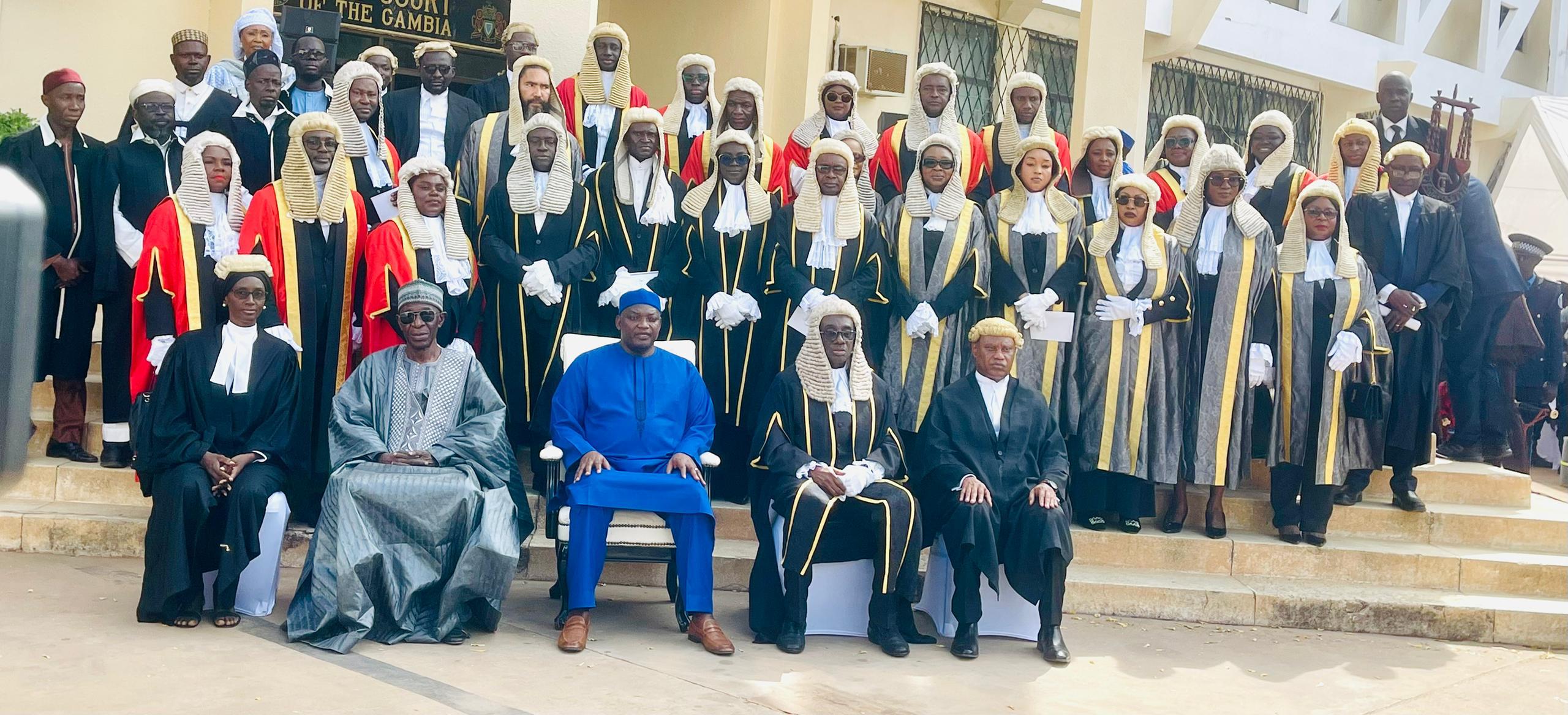
President Adama Barrow officially opened The Gambia’s 2026 Legal Year on Sunday, delivering a strong reaffirmation of his administration’s dedication to judicial independence, the rule of law, and ongoing reforms aimed at strengthening public trust in the justice system.
In his address at the ceremonial event, President Barrow described the administration of justice as a fundamental pillar of democracy and national progress. He stressed that sustained judicial modernisation is vital for maintaining peace, stability, good governance, and confidence in legal institutions.
The President spotlighted advancements under the Judiciary Sector Strategic Plan, including better case management, expanded access to justice, reinforced judicial independence, and enhanced training for judges and staff. He underscored the push toward digitalisation in courts, aligning with Commonwealth initiatives to embrace innovative judicial practices.
Barrow praised the creation of the Inter-Departmental Committee on Land Dispute Adjudication as a proactive step to tackle the rising volume and intricacy of land-related conflicts, with its forthcoming recommendations expected to promote fair and swift resolutions.
He hailed the Judicial Officers (Conditions of Service) Act, 2025, as groundbreaking legislation designed to protect judicial autonomy, boost pay and conditions, and elevate professional standards. The law, he said, will aid in recruiting and retaining skilled personnel while minimising corruption vulnerabilities.
In a practical gesture, the President announced the allocation of new vehicles for superior court judges to improve operational efficiency and uphold the dignity of their roles.
A major focus of Barrow’s speech was transitional justice. He confirmed the enactment—following ECOWAS endorsement—of the Special Accountability Mechanism Act and the Special Prosecutor’s Office Act, targeting prosecutions for serious human rights abuses from July 1994 to January 2017. He instructed the Attorney General to appoint a Special Prosecutor swiftly. The establishment of a dedicated High Court Special Division, he added, demonstrates the nation’s determination to address historical wrongs and foster reconciliation through legal channels.
On the international stage, Barrow noted The Gambia’s ongoing case against Myanmar at the International Court of Justice (ICJ) concerning alleged Rohingya genocide, with merits hearings commencing on January 12, 2026—the first such full proceedings in over a decade. He also highlighted the country’s role in supporting a UN General Assembly request for an ICJ advisory opinion on climate change obligations, which affirmed states’ binding duties under international law.
Domestically, The Gambia accepted 273 out of 309 recommendations at its fourth Universal Periodic Review in Geneva in January 2025—a marked improvement. Barrow said appointments to the Anti-Corruption Commission will soon be completed and reaffirmed backing for a comprehensive Justice Sector Policy, aided by the European Union.
Chief Justice Hassan B. Jallow detailed the Judiciary’s 2025 performance, reporting a 49% surge in new filings to 9,942 cases from 6,678 the prior year. Courts cleared 6,630 cases—a 19% rise—, yet the 2026 backlog stands at 8,682, highlighting the urgency of greater capacity and broader use of alternative dispute resolution.
Jallow outlined gains in training, infrastructure, recruitment, specialised court divisions, and impending new High Court Rules to replace 1928-era regulations. He flagged persistent hurdles, such as funding shortages, infrastructure constraints, and stalled digital projects due to suspended donor aid, and urged closer ties with the executive and legislature.
Gambia Bar Association President Neneh M.C. Cham emphasised the vital Bench-Bar partnership as twin guardians of justice and independence. She commended joint efforts, including the British High Commission-backed 100 Building Project for new Special Criminal Division premises at Mile 7, set for inauguration soon, and the collaborative revision of High Court Rules by A&E & Co. for greater efficiency.
Cham voiced concerns over chronic underfunding and infrastructure woes, urging prioritised government support for the courts as citizens’ ultimate recourse. She pressed for sustained TRRC accountability measures, the activation of the stalled Law Reform Commission, broader tech adoption, such as virtual hearings, and enhanced court security amid recent fire risks.
Representing the Attorney General, Solicitor General Hussein Thomasi reviewed the Ministry of Justice’s 2025 work, including over 100 prosecutorial advisories, heavy land dispute caseloads, registry cleansing under amended company laws, and strong ADR results resolving over 80% of 158 cases.
He noted the implementation of the IP Act, school-based innovation clubs, the new Civil Registration Bill, ongoing TRRC reparations payments, the development of a digital case system, and anti-trafficking progress through a new five-year plan and active High Court prosecutions.