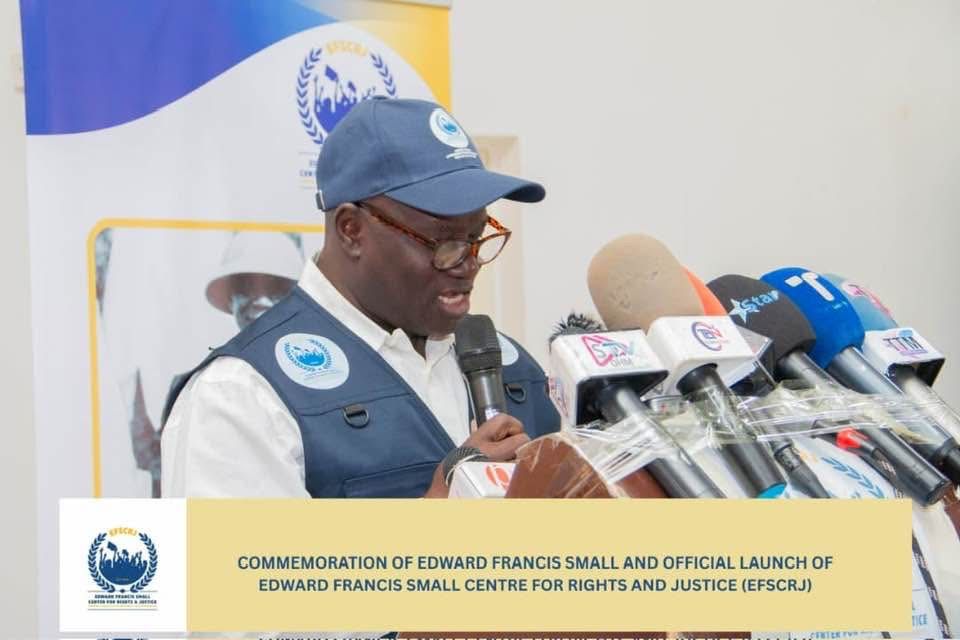
Prominent Gambian human rights defender and Executive Director of the Edward Francis Small Centre for Rights and Justice (EFSCRJ), Madi Jobarteh, has launched a scathing critique of the government’s reaction to the recent CEPRASS National Opinion Poll, branding it a lengthy but substanceless exercise in denial and deflection.
In a detailed public statement released from Banjul, Jobarteh accused the Ministry of Information of issuing a supposedly analytical response that ultimately said nothing meaningful. He argued that officials, caught off-guard by the poll’s damning findings on governance, corruption, unemployment, and leadership trust, resorted to rejection, distortion, and diversion rather than honest reflection.
The CEPRASS poll, conducted in late 2025 and released in early 2026, surveyed Gambian public opinion on critical issues, including corruption, job creation, trust in President Adama Barrow, and the state of democracy, ahead of the December 2026 presidential election. Jobarteh stressed that the poll’s purpose and scope were clearly communicated by the pollsters and widely understood by the public. He dismissed the government’s insistence that the survey was “not a total judgement on government performance” as both irrelevant and deliberately misleading.
“No one claimed it was a total judgment,” Jobarteh wrote. “This caveat exists only to undermine the poll, question the validity of citizens’ voices, and avoid responsibility for the failures the people have highlighted.”
Jobarteh systematically dismantled the government’s key defenses across several fronts.
Corruption Remains Unchecked Despite Institutions
While the government highlighted the establishment of the Anti-Corruption Commission (ACC) and offered lectures on proper investigative procedures, Jobarteh described these as evasive tactics. He pointed out that the Gambia already possesses sufficient constitutional and legal tools to fight corruption—most notably mandatory asset declarations under Section 223 of the Constitution, which continue to be flagrantly ignored.
Annual reports from the National Audit Office have consistently exposed gross mismanagement and embezzlement involving billions of dalasis, yet recoveries remain negligible and prosecutions rare. Resolutions from the National Assembly, presidential inquiries, police investigations, and investigative journalism have produced little to no accountability. In this environment, Jobarteh argued, official claims of combating corruption amount to little more than “diversion, distortion, and deflection.”
Unemployment: Global Excuses Cannot Replace Jobs
Regarding job creation, the government cited global economic difficulties and highlighted investments across various sectors. Jobarteh rejected this as mere excuse-making rather than leadership. He noted that many countries facing similar challenges publish regular employment statistics and announce measurable job gains—something the Gambian government fails to do due to the absence of credible data and real outcomes.
Despite years of touted investments, youth unemployment remains alarmingly high. Jobarteh emphasized that Gambians’ daily lived experiences contradict official narratives, revealing that government efforts have failed to deliver meaningful change.
Misinformation Lecture Exposes Official Hypocrisy
The government’s appeal for citizens to fact-check information on social media drew particular scorn. Jobarteh described it as “laughable if it were not tragic,” asserting that the most persistent sources of misinformation and disinformation in The Gambia are political leaders, ruling party supporters, and government officials themselves. He singled out the Minister of Information as perhaps the most frequently fact-checked public figure in the country, underscoring the deep irony of the lecture.
Declining Trust Reflects Real Governance Failures
The administration’s claim that falling trust in President Barrow is merely “conditional” and not evidence of democratic failure was flatly rejected. Jobarteh insisted that low trust arises directly from leadership shortcomings: poor service delivery, entrenched corruption, and governance that favors private and partisan interests over the public good.
He posed pointed questions: Why are officials named in corruption scandals routinely promoted or protected? Why has the ‘Meet the People Tour’ morphed into a partisan NPP campaign? Why do major government contracts consistently benefit businesses closely aligned with the president? These patterns, he argued, explain why many Gambians perceive Barrow’s leadership as worse than that of his predecessors—a perception rooted in experience, not rumor.
Democracy Survives in Spite of Government, Not Because of It
Jobarteh challenged the government’s self-congratulatory portrayal of an open civic space and respect for rights. He credited The Gambia’s democratic resilience to the persistent resistance of citizens, civil society, independent media, and development partners against repeated attempts at backsliding since 2017.
The Barrow administration, he said, has delayed or derailed democratic reforms, arrested activists, protesters, journalists, opposition politicians, and ordinary citizens for exercising constitutional rights—often on fabricated charges—while closing media houses and allowing impunity for official abuses.
Term Limits Sabotage: Rewriting History Fails
On constitutional reform, Jobarteh called the government’s attempt to shift blame to the National Assembly and opposition “disingenuous.” The widely supported 2020 draft constitution, which included clear two-term presidential limits, was actively undermined by the executive and ultimately killed by 23 pro-Barrow lawmakers. The subsequent 2024 draft—privately prepared and dubbed the “Barrow Papers”—deliberately weakened term-limit provisions, potentially allowing one individual to remain in power for 20 years or more, a move Jobarteh described as dangerous and conflict-prone.
In his conclusion, Jobarteh characterized the government’s response as a thinly veiled effort to silence citizens and deny reality. He urged authorities to take the poll seriously and change course rather than hide behind “distorted rationalizations and logical fallacies.”
“Citizens who participated were neither drunk nor delusional,” he wrote. “They spoke consciously and honestly about their lived realities. No press release, no matter how long and flamboyant, can convince a hungry person that they are not hungry.”
“Give the people food, jobs, justice, and accountability first. Then talk.”