By: Sainabou Sambou
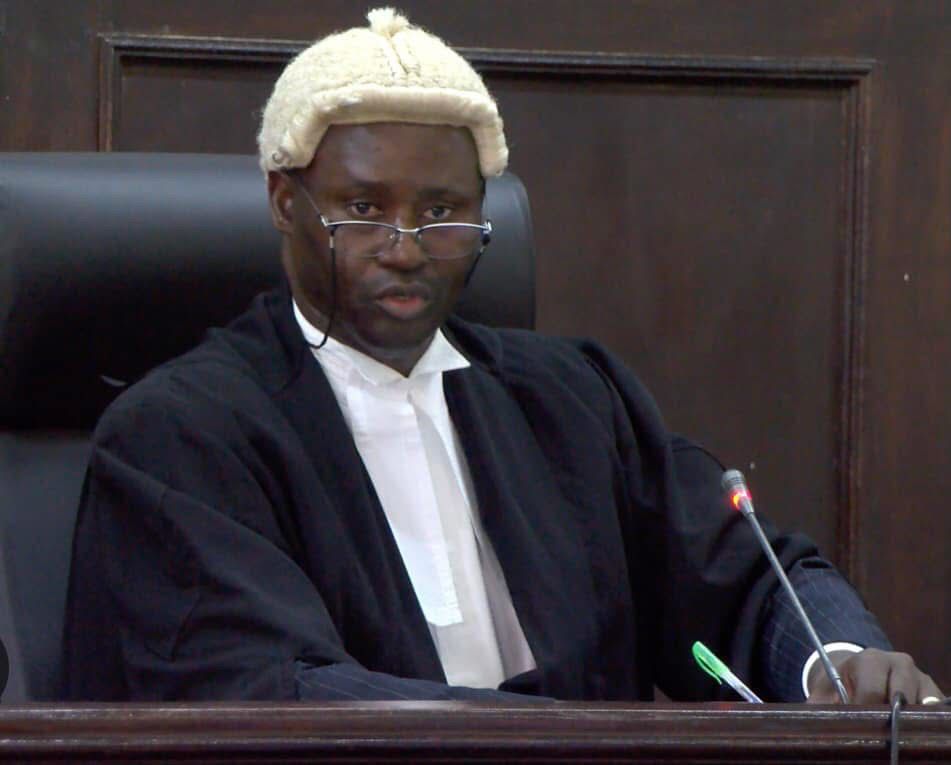
In a scathing ruling that highlights serious lapses in banking practices, Justice Ebrima Jaiteh of the High Court in Banjul has declared that First International Bank (Gambia) Limited unlawfully used the properties of two brothers as collateral for a multimillion-dollar loan based on forged documents.
The recent judgment dismissed the bank’s original claim and granted relief to the brothers, Sabilo Sumbundu and Janko Sumbundu, who successfully pursued their counterclaim. The court found the bank’s actions negligent and ordered the immediate release of the brothers’ title deeds, free from any encumbrance.
The dispute stemmed from a loan facility granted by the bank in late 2012. Borrowers Alieu Badara Ceesay and Sarja Camara sought an overdraft of D10.5 million to finance a housing project in Sukuta through their joint venture, JV–Kaninli Group Investment. The bank approved the facility in December 2012, later increasing it to D15 million and adding USD 140,000 for cashew trading operations.
According to the bank, the Sumbundu brothers served as guarantors, executing Powers of Attorney and Memoranda of Deposit that allowed their leasehold properties—Serial Registration No. 369/2007 in the name of Janko Sumbundu and Serial Registration No. 407/2007 in the name of Salibo Sumbundu, both registered in Volume 70 KD—to be pledged as security.
However, the brothers vehemently denied any involvement. Janko Sumbundu testified that he resided in the United States from 1986 until May 2015 and had no business dealings with the bank during that period. His brother, Salibo, lived in the U.S. from 1989 to 2006 and similarly had no contact with the institution. Both insisted they never signed any Power of Attorney or authorized the use of their properties.
The brothers only learned of the pledge when served with court documents initiated by the bank to recover the outstanding debt, which had ballooned to D21,730,783.60 due to defaults.
To substantiate their claims, the brothers presented expert testimony from retired Deputy Commissioner of Police Alhaji Lamin S. Ndong, a handwriting specialist. He examined the signatures on the disputed Powers of Attorney and compared them to genuine specimens provided by the brothers. Ndong concluded that the signatures were forged by simulation and did not belong to either man. His opinion withstood rigorous cross-examination.
The bank’s witness, Landing Joof, admitted under cross-examination several critical failures. He confirmed the bank never contacted the brothers to verify their consent, that the borrowers presented the documents, and that no efforts were made to witness the signings or authenticate the brothers’ identities and signatures. Joof also acknowledged that additional funds were disbursed even after the borrowers had defaulted on the initial facility.
In his judgment, Justice Jaiteh emphasized that the central question was whether the brothers had authorized the use of their title deeds. While the initial burden of proof lay with the brothers in their counterclaim, they proved their case on the balance of probabilities. The bank did not challenge the expert evidence of forgery.
The judge sharply criticized the bank for accepting valuable title deeds from non-customers without any direct communication or verification. “The Defendant accepted valuable title deeds belonging to non-customers without ever speaking to them,” Justice Jaiteh stated. He described this as falling “below the standard expected of a prudent banker,” underscoring the institution’s duty to conduct proper due diligence when relying on third-party collateral.
The court ruled that the brothers did not execute or authorize the disputed documents, rendering the Powers of Attorney forged and the pledge of their properties unlawful, null, and void. The use of the properties as collateral was declared invalid. The brothers were exonerated from any liability as guarantors for the debt.
Justice Jaiteh issued a perpetual injunction barring the bank from any further dealings with the properties and ordered the return of all original title deeds. The bank was also hit with D100,000 in costs.
The case, originally filed by the bank but struck out, was continued through the brothers’ counterclaim. Abdoulie Sisohor and Fatoumatta Jobe represented them, while H. S. Sabally defended the bank.