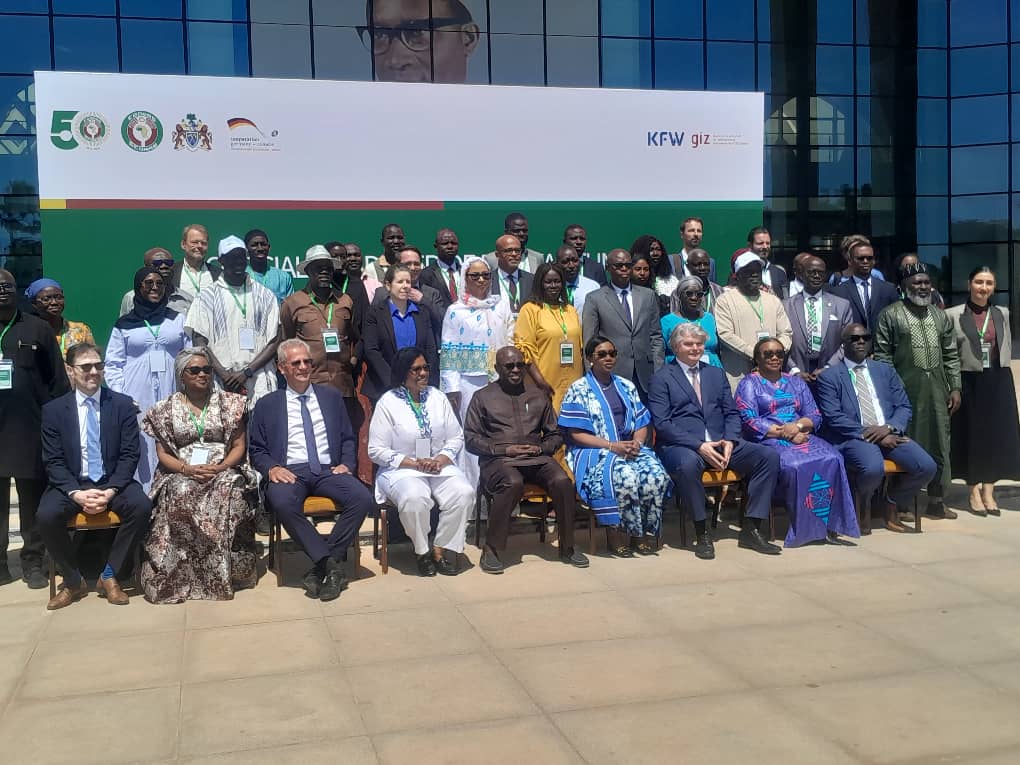
At a handing over ceremony signaling strengthened regional cooperation, the Economic Community of West African States (ECOWAS), in partnership with the German Agency for International Cooperation (GIZ) and the German Development Bank (KfW), on Tuesday handed over €21.5 million worth of infrastructural projects to beneficiary institutions and communities across The Gambia.
The event, held at the Sir Dawda Kairaba Jawara International Conference Center, marked the formal conclusion of the pilot phase of the ECOWAS Regional Stabilization and Development Fund (FRSD) in The Gambia. The initiative, implemented between 2019 and 2025, aims to foster economic resilience, create sustainable jobs, and curb irregular migration by empowering young people and women through targeted investments in key value chains.
Her Excellency Madam Damtien L. Tchintchibidja, Vice President of the ECOWAS Commission, led the high-level delegation and expressed profound gratitude to the Government of The Gambia, beneficiary communities, and institutions for their steadfast cooperation throughout the project’s lifecycle.
“This handing over ceremony symbolizes the deep-rooted partnership between ECOWAS and The Gambia,” Madam Tchintchibidja said. “It reflects our shared commitment to sustainable development and improving the living conditions of our people.”
She described the FRSD as a strategic tool designed to build economic and social resilience across ECOWAS member states, with particular emphasis on addressing challenges faced by youth and women, including limited economic prospects.
“Through this fund, ECOWAS and its partners promote concrete solutions that generate economic opportunities, build local capacity, and support income-generating activities,” she added. “The Gambia pilot perfectly illustrates our mission, funded through the ECOWAS Community Levy and complemented by the Government of The Gambia, alongside vital support from the German Federal Ministry for Economic Cooperation and Development (BMZ), KfW, and GIZ.”
The Vice President highlighted investments in technical education, fisheries, agriculture, horticulture, and poultry farming. These have led to the construction of production facilities, the installation of irrigation systems, and capacity-building for local stakeholders.
“The goal is to create sustainable employment and income opportunities for young people and women, strengthen entrepreneurship, and boost community economies,” she noted. “By investing in local value chains and empowering youth and women, this project tackles one of the region’s major challenges—providing viable alternatives to irregular migration.”
Madam Tchintchibidja praised GIZ and KfW for their decisive contributions and urged beneficiaries to take full ownership of the infrastructures for long-term success. She expressed confidence that the projects would become “hubs of economic activity” and serve as a model for future FRSD interventions in other ECOWAS countries.
“ECOWAS remains fully committed to building a more stable, resilient, and prosperous West Africa,” she concluded.
Permanent Secretary Mod Secka of the Ministry of Finance and Economic Affairs echoed these sentiments, describing the Gambia Pilot Program (GPP) as a concrete expression of the government’s vision for youth employment and economic transformation.
“Our government is committed to combating irregular migration by creating viable local opportunities and developing high-potential value chains in fisheries, agriculture, and poultry,” PS Secka stated. “The success of this pilot positions The Gambia as a shining example of what regional cooperation can achieve.”
He detailed significant achievements under the project’s three components.
Under Component 1 (infrastructure and equipment), the program established 19 community horticultural gardens, 22 poultry houses, and 2 fisheries projects. Through matching grants for private initiatives, it supported 27 additional horticultural gardens, 9 poultry houses, and 2 fisheries projects. Complementary investments included fish smoking facilities in Brufut, Jeswang, and Barra, enhancing value addition in coastal communities.
Component 2 focused on vocational training and skills development, resulting in the establishment of an agro-food processing center at the Gambia Tourism and Hospitality Institute (GTHI) in Kanifing, and workshops at the University of Applied Science, Engineering and Technology (USET) annexes in Mansa Konko and Julangel.
Component 3 emphasized local capacity building and governance through targeted training for beneficiaries and stakeholders across the value chains.
An independent end-line evaluation conducted in February 2026 confirmed transformative impacts: 18,552 new jobs created, including 6,042 permanent year-round positions. Notably, 35% of these permanent jobs are in value-addition stages, 80% are held by youth (exceeding the 70% target), and 100% of beneficiaries completed two full rounds of technical training.
“These figures represent real-life changes—empowered families, stronger communities, improved food security, and boosted local economies,” PS Secka observed. “We have moved from infrastructure to productivity, from productivity to income, and from income to lasting stability.”
Key infrastructures handed over include an 80-bed student dormitory at USET in Mansa Konko, a 40-bed dormitory at the Julangel campus, four fish smoking facilities at Brufut and Jeswang, a food processing center at GTHI in Kanifing, grants for young entrepreneurs, community-owned projects in horticulture, fisheries, and poultry, and revenue-generating initiatives for women.
Representatives from KfW, as well as beneficiaries from the Brufut Fish Landing Site and GTHI, spoke passionately about the project’s significance and pledged to sustain the gains through responsible management and productive use.
The FRSD pilot in The Gambia, part of a broader €25.2 million regional effort supported by Germany, has demonstrated how targeted investments in fragile contexts can deliver measurable results in employment, skills development, and social cohesion. As the handover opens a new chapter of local ownership, stakeholders expressed optimism that the model’s success will inspire similar initiatives across West Africa.
This milestone underscores ECOWAS’s ongoing dedication to regional integration and people-centered development, reinforcing the belief that economic opportunities at home are the strongest foundation for stability and prosperity in the sub-region.