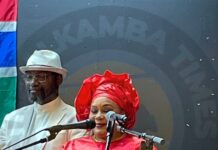
During Tuesday’s session, the Gambian National Assembly withdrew its earlier recommendations to pursue economic crime charges against former Attorney General and Minister of Justice Abubacarr “Ba” Tambadou over the controversial sale and disposal of assets linked to ex-President Yahya Jammeh. Instead, lawmakers voted to refer the matter to the executive branch for further investigation.
The debate centered on the report of the Special Select Committee established to inquire into the handling of assets identified by the Janneh Commission of Inquiry. The committee had previously flagged serious allegations against Tambadou, including violations of the Public Finance Act, abuse of office, and possible economic crimes related to the management and disposal of Jammeh’s forfeited properties, which range from real estate and vehicles to financial assets worth billions of dalasi.<
Hon. Jawara, National Assembly Member for Saloum, moved the motion to withdraw the direct criminal recommendations, stressing the need for fairness and equal treatment in handling both current and former Attorneys General. He argued that the Assembly must avoid premature conclusions on issues of misconduct or corruption.
The Majority Leader threw his full weight behind the motion, cautioning that it would be “premature” for the legislature to declare grand misconduct or corruption in the dealings of the former president’s assets without thorough verification. “We can just recommend through the executive for the matter to be further investigated,” he stated. “If anything we have found in it—be it misconduct or criminal—then we can be informed and action taken accordingly.”
Lawmakers expressed particular concern about the appointment of Alpha Capital to the asset disposal process and whether due diligence under public finance regulations was conducted. They also highlighted allegations that the Ministry of Finance and Economic Affairs was sidelined at key stages, resulting in the opening of multiple accounts that may have breached financial controls. Several members urged restraint in using the term “criminal,” with one declaring: “As a parliament, let’s stay away from the term criminal.”
The Speaker of the National Assembly reminded members that the committee’s findings and recommendations require preliminary approval by the House and are not final until adopted. The Assembly ultimately rescinded part of its earlier decision on the principal report and agreed to include Recommendation One on page 155, which now calls on the executive, through the police and under the supervision of the public prosecution office, to conduct a proper investigation into possible violations of the Public Finance Act and other issues involving the former Attorney General.
Not all members agreed. NAM for Foni Kansala argued strongly that the original committee recommendations should stand without dilution. Despite the division, the majority backed the motion for an executive-led probe rather than immediate Assembly-driven prosecution.
The development marks a cautious approach by the legislature in one of the most sensitive post-Jammeh accountability exercises. The Janneh Commission had uncovered vast assets accumulated during Jammeh’s 22-year rule, and questions of transparency, procedural compliance, and potential conflicts of interest have dogged the subsequent disposal process.
Critics inside and outside the chamber worry that softening the language could undermine public confidence in the fight against impunity.
Supporters of the new position insist that due process and fairness demand independent investigation before any conclusions are drawn, especially given the gravity of the allegations.
As the executive now takes the lead, attention turns to whether a full-scale probe will uncover systemic weaknesses in how the state has managed recovered assets—or whether the matter will fade into another chapter of unresolved governance questions in The Gambia’s young democracy.