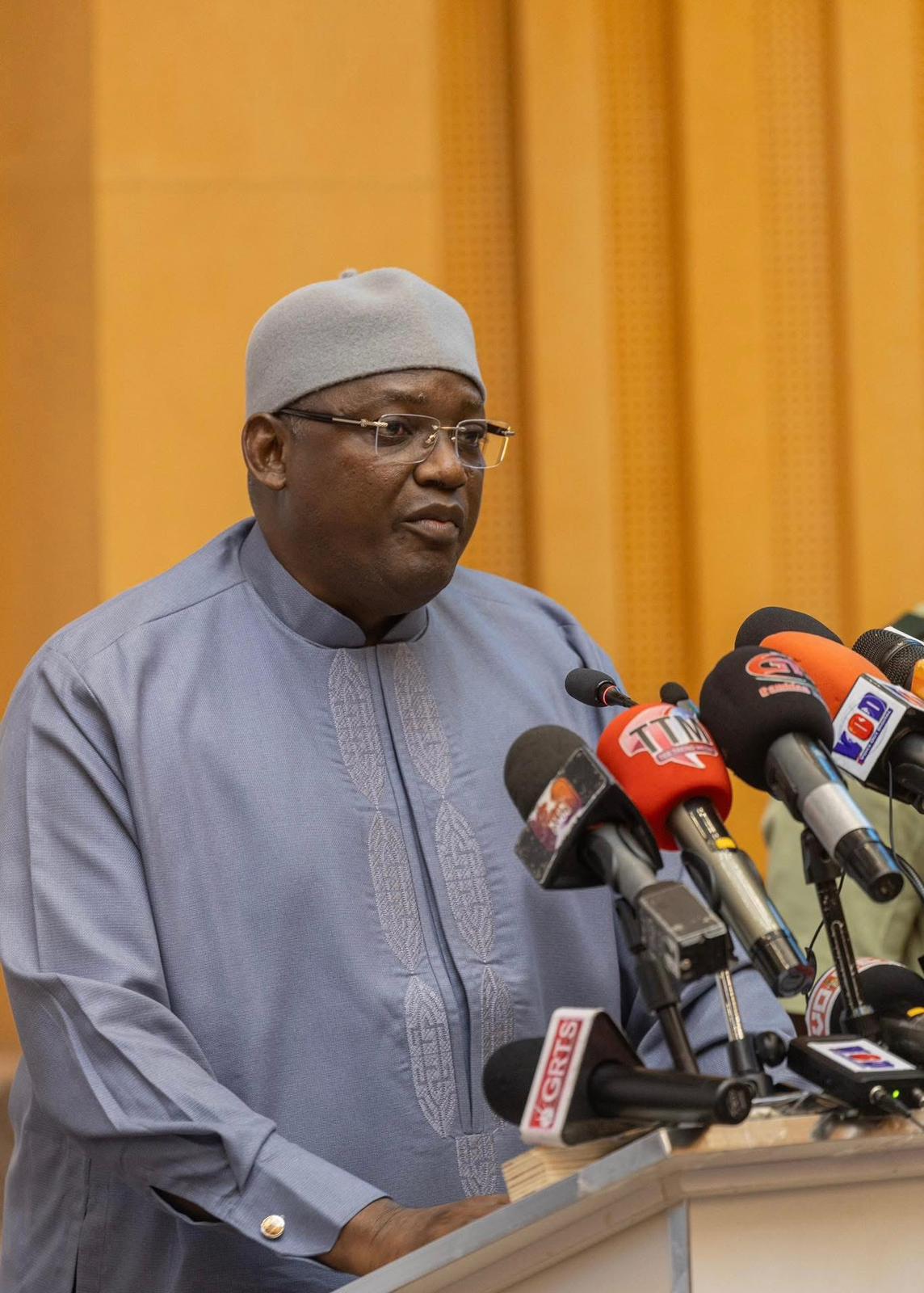
In a constitutionally mandated address to the National Assembly, President Adama Barrow on Thursday delivered what is expected to be his last State of the Nation Address (SONA) for his second term in office and the final one for the sixth legislature. Speaking in Banjul, the Gambian leader provided a comprehensive overview of the country’s progress, persistent challenges, and his administration’s roadmap for the future, as required under Section 77(1) of the 1997 Constitution and Order 24 of the National Assembly Standing Orders.
The address, broadcast live, focused on economic achievements, the human tragedy of irregular migration, food security concerns, and a strong appeal for peaceful political conduct as the country prepares for the December 5, 2026, presidential election.
President Barrow highlighted modest but steady economic growth, noting that The Gambia’s GDP expanded by an estimated 5.9% in 2025, up from 5.7% in 2024. This performance was driven primarily by key sectors including construction, agriculture, tourism, trade, telecommunications, and services. He framed the figures as evidence of resilience amid global uncertainties, crediting government policies and private sector contributions for sustaining momentum.
However, the president did not shy away from the country’s most pressing and emotive issue: irregular migration, often referred to locally as the “back way.” Thousands of young Gambians continue to risk their lives aboard overcrowded wooden boats in desperate attempts to reach Europe, with many perishing at sea or going missing. Barrow described the phenomenon as a national tragedy that is “robbing our nation of its youth.”
In response, he outlined urgent government interventions to tackle the root causes. “Irregular migration continues to rob our nation of its youth. We are treating this issue with utmost urgency by creating opportunities for decent jobs, skills development, and legal labour pathways,” the president stated. He pointed to strengthened Technical and Vocational Education and Training (TVET) systems and new bilateral labour agreements that are enabling Gambians to migrate safely and legally to Europe and the Middle East for work.
Barrow pledged continued collaboration with international partners and emphasized private-sector-led investments to generate employment and expand skills training, aiming to offer viable alternatives to dangerous irregular journeys.
Another major challenge addressed was the persistent cost-of-living crisis exacerbated by rising prices of basic commodities and the depreciation of the dalasi against major currencies. Many households continue to struggle with feeding their families amid these pressures.
The head of state committed his government to deeper investment in agriculture to enhance food self-sufficiency. “Mr. Speaker, my government recognises that, despite the progress made in 2025, challenges linger on. We are aware, for example, of the continuous cost-of-living pressures on many households, hence the heavy investment in agriculture to boost our food self-sufficiency drive through local production,” he said.
Barrow detailed ongoing support for smallholder farmers, including input subsidies designed to reduce their costs and increase earnings from produce. He acknowledged the largely subsistence nature of Gambian agriculture and vowed to provide further assistance to ease associated challenges.
As the country gears up for the 2026 presidential polls, the president used the platform to issue a unifying call to political actors. “Mr. Speaker, Honourable Members, Fellow Gambians, as we approach the 2026 Presidential Election, I call on all political parties, candidates, and supporters to conduct their campaigns in a spirit of peace, tolerance, and mutual respect. Elections are a cornerstone of our democracy, and they must strengthen rather than divide us,” he concluded.
Analysts view this SONA as a legacy-defining moment for Barrow’s second term, balancing celebration of incremental gains with candid acknowledgment of deep-seated socioeconomic issues. With the election less than nine months away, the address is likely to shape the national conversation on jobs, youth empowerment, food security, and democratic maturity.