By Sainabou Sambou
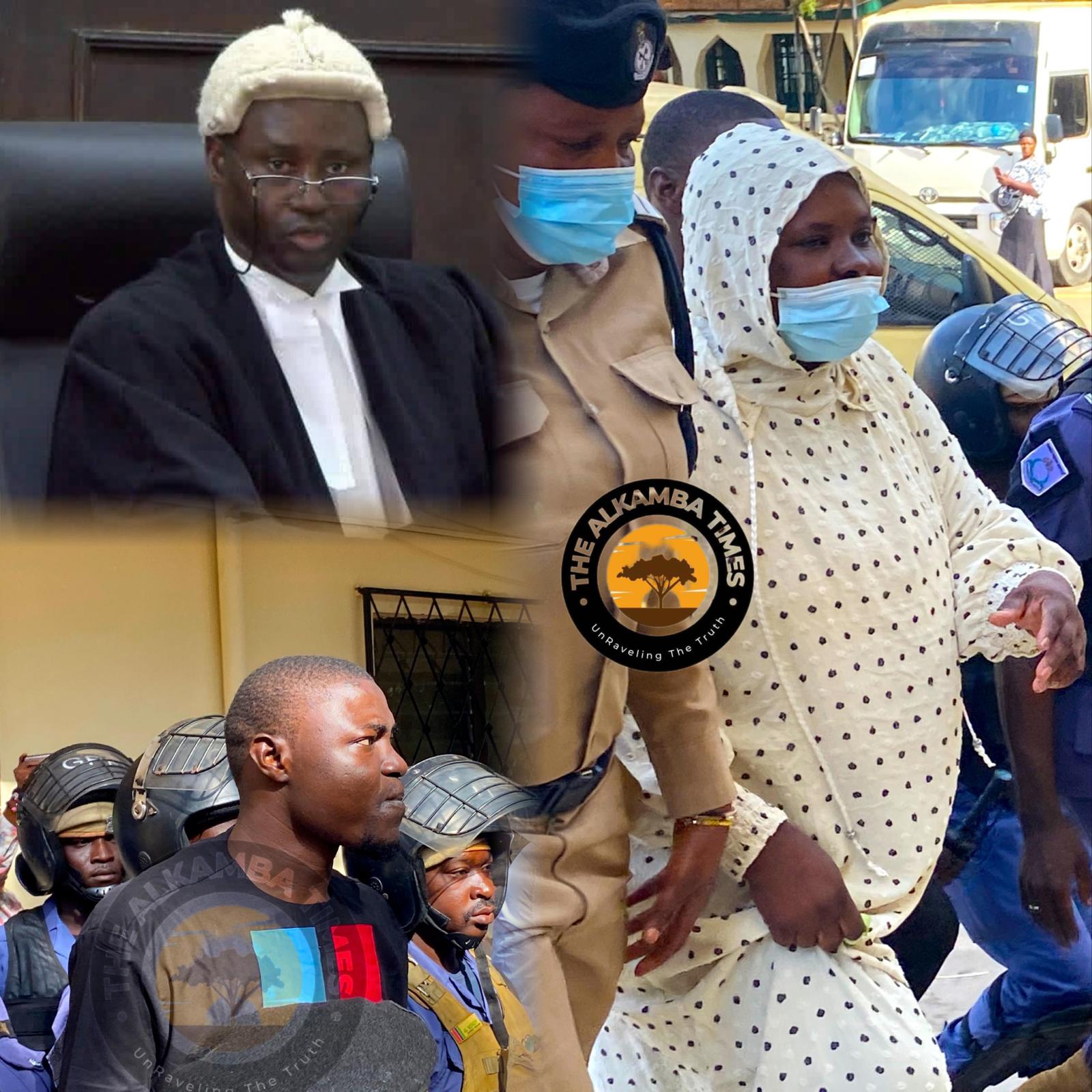
In a landmark judgment that has sent shockwaves through the nation, Justice Ebrima Jaiteh of the High Court in Banjul today acquitted and discharged Ousainou Bojang and his sister, Amie Bojang, of all charges connected to the September 2023 fatal shooting of two police officers at the Sukuta Jabang Traffic Lights.
The dramatic verdict, delivered on Monday, March 30, 2026, brings to a close a high-profile trial that gripped public attention for nearly three years. Ousainou Bojang had faced multiple serious counts, including the murder of Police Constables Sang J. Gomez and Pateh Jallow, attempted murder of Police Constable Ansey Jawo, and acts of terrorism. His sister, Amie Bojang, was charged as an accessory after the fact for allegedly assisting him in fleeing the scene.
Director of Public Prosecutions (DPP) AM Yusuf led the prosecution for the state, while a formidable defence team represented the accused. Counsel Lamin J. Darbo, assisted by J. Jeng, F. Bondi, and F. K. Darbo, appeared for Ousainou Bojang (1st Accused)—Counsel Lamin K. Mboge, with A. Sillah and K. Bojang defended Amie Bojang (2nd Accused).
In a meticulously reasoned judgment spanning several hours, Justice Jaiteh ruled that the prosecution had failed to prove its case beyond a reasonable doubt. The court found that the evidence presented was riddled with inconsistencies, lacked scientific corroboration, and fell far short of the high standard required in criminal proceedings where liberty and reputation are at stake.
The prosecution called 13 witnesses and tendered 33 exhibits in its attempt to link Ousainou Bojang to the crime. However, Justice Jaiteh highlighted critical weaknesses that undermined the case as a whole.
Central to the prosecution’s case was the identification of the shooter. Yet, two key military witnesses offered conflicting descriptions of the attacker’s attire. One described the assailant as wearing a yellowish shirt and three-quarter trousers, while the other insisted he was dressed in a flowing kaftan. Even more damaging, a surviving police officer who was present during the attack testified that she did not see the shooter’s face and could not identify him.
When Ousainou Bojang was paraded before several witnesses at Sukuta Police Station shortly after his arrest, none identified him as the perpetrator. Justice Jaiteh stressed that identification evidence, particularly in high-stress situations with limited visibility or poor lighting, must be approached with extreme caution. He criticised the investigators for failing to conduct a formal identification parade—a fundamental safeguard designed to prevent miscarriages of justice.
Physical evidence also crumbled under scrutiny. The prosecution produced a pair of boots allegedly belonging to the suspect and linked to the crime scene. To the court’s astonishment, the boots did not fit Ousainou Bojang. Instead, they fitted his brother, who openly claimed ownership. This mismatch further eroded confidence in the chain of evidence.
Justice Jaiteh repeatedly emphasised the absence of modern forensic and scientific evidence. In an era where DNA profiling, fingerprint analysis, ballistic reports, and gunshot residue testing routinely provide objective links between suspects and crimes, none of these were presented. “The lack of such evidence is glaring,” the judge noted, adding that serious crimes demand thorough, professional investigations grounded in objective proof rather than supposition.
Ousainou Bojang maintained from the outset that he was on duty as a security guard in Brufut on the night of the incident. He presented a robust alibi supported by multiple witnesses who testified consistently that he was at his workplace from approximately 7:00 p.m. until midnight. His employer provided WhatsApp messages showing continuous communication with him from around 8:18 p.m. into the early hours. The court found this alibi credible and unshaken. Justice Jaiteh pointed out that once an accused raises an alibi, the burden shifts to the prosecution to investigate and disprove it. The failure to do so proved fatal to the state’s case.
The court also discounted statements allegedly made by Bojang during police interrogation. Investigators had not complied with legal requirements under the Anti-Terrorism Act, including the mandatory video recording of such sessions. Without proper procedural safeguards or independent corroboration, these statements carried little to no evidential weight.
Turning to Amie Bojang, the judge ruled that her charge as an accessory after the fact could not stand independently. Accessory liability requires proof that the principal offence—here, the murders allegedly committed by her brother—was established. Since the prosecution failed to prove Ousainou Bojang’s involvement beyond a reasonable doubt, the case against Amie collapsed entirely.
Amie Bojang testified that she believed she was helping her brother with a private family or personal dispute, not aiding an escape from a criminal act. There was no evidence that she had knowledge of the killings at the time she provided assistance. Her subsequent cooperation with investigators further suggested no intent to conceal any crime. The court accepted her account as truthful.
In a broader critique of the investigation, Justice Jaiteh highlighted systemic shortcomings: the absence of a proper identification parade, the failure to secure forensic evidence, the inadequate probing of the alibi, and the underutilisation of electronic and digital records. He warned that focusing narrowly on a single suspect without building a solid evidentiary foundation risks injustice and undermines public confidence in the justice system.
Reaffirming fundamental principles of criminal law, the judge declared: “The burden of proof lies squarely on the prosecution and must be discharged beyond a reasonable doubt. Where the identity of the perpetrator is in issue, the evidence must be clear, credible, and reliable. In this case, it was not.”
Justice Jaiteh concluded that the prosecution had failed to prove any of the offences charged against Ousainou Bojang—including murder, attempted murder, grievous bodily harm, and terrorism-related counts. He was accordingly acquitted and discharged on all charges.
Amie Bojang was similarly acquitted and discharged on the accessory charge.
The verdict was met with emotional scenes inside and outside the courtroom. Supporters of the Bojang family erupted in celebrations as the siblings walked free, while others expressed concern over the unresolved killing of the two police officers. The tragic incident at Sukuta Jabang Traffic Lights in September 2023 had shocked the nation, leaving two families grieving and raising questions about security and policing in the Greater Banjul Area.
Legal observers hailed the judgment as a strong reaffirmation of the presumption of innocence and the high evidentiary threshold in criminal trials. “This case underscores that no matter how serious the allegations, convictions cannot rest on weak, inconsistent, or uncorroborated evidence,” one senior lawyer remarked outside court.
The acquittal does not close the chapter on the deaths of Constables Gomez and Jallow. Questions remain about the identity of the real perpetrator and whether a more robust investigation could have yielded different results. The state now faces the challenge of either appealing the decision or redirecting resources toward fresh lines of inquiry.
For Ousainou and Amie Bojang, today marks the end of a long ordeal that began with arrest, prolonged detention, and a trial marked by intense public scrutiny. Their legal teams expressed satisfaction that justice had prevailed through rigorous adherence to due process and evidentiary standards.
The High Court’s decision today not only frees two individuals but also reinforces the bedrock principles upon which The Gambia’s criminal justice system rests: that it is better that many guilty persons go free than that one innocent person suffer wrongful conviction.