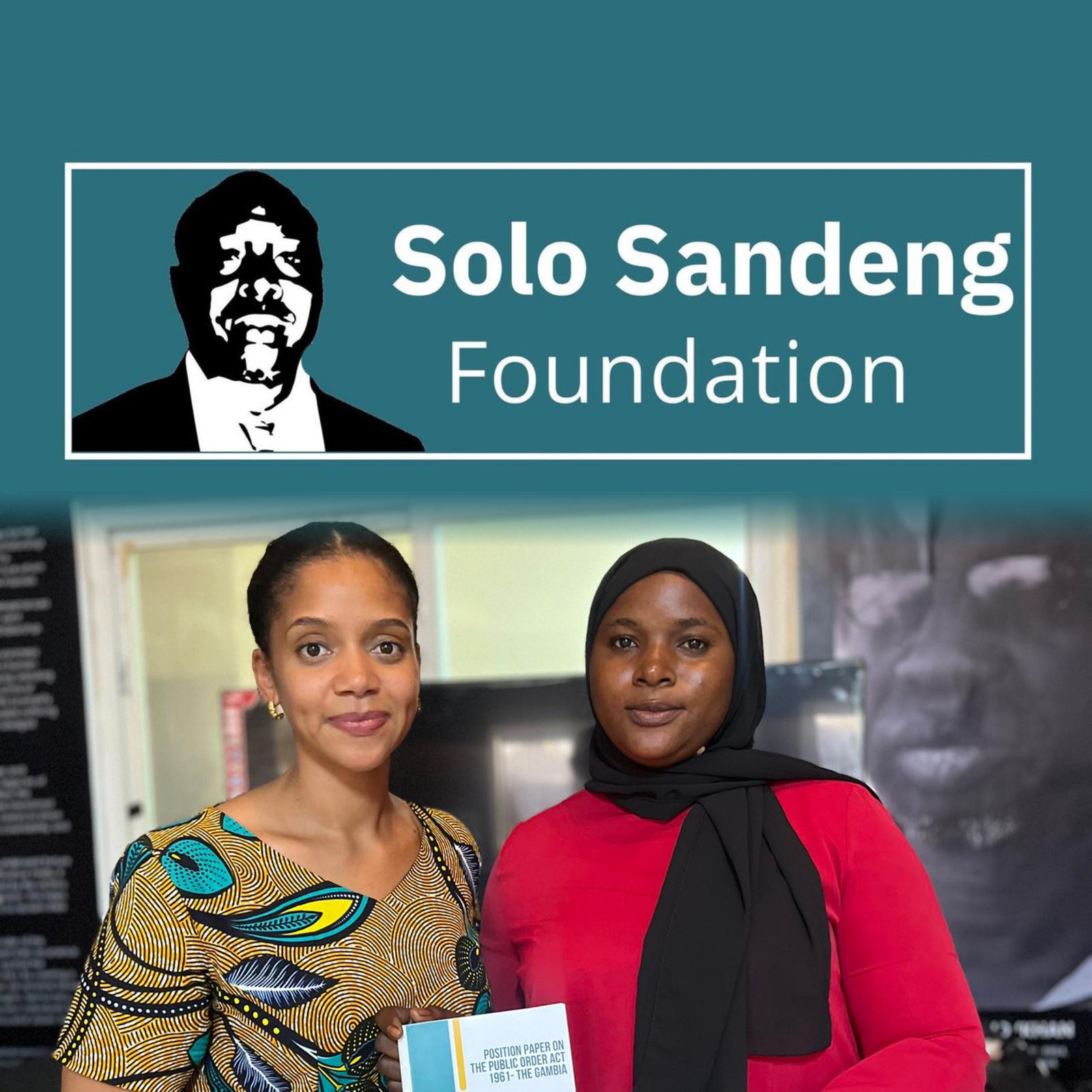
Exactly ten years after activist Ebrima Solo Sandeng was arrested, tortured, and killed in detention for demanding electoral reforms, the Solo Sandeng Foundation has released a hard-hitting position paper urging the government of President Adama Barrow to finally reform the repressive 1961 Public Order Act that contributed to his death and continues to silence peaceful dissent.
On April 14, 2016, Solo Sandeng and fellow activists took to the streets under the banner of the United Democratic Party (UDP) to protest for credible elections and legal reforms. Instead of being heard, they were arrested by security forces. Sandeng was taken to the then National Intelligence Agency (now State Intelligence Service), where he was brutally tortured and beaten to death. His body was secretly buried. Two days later, UDP leader Ousainou Darboe and senior party executives were arrested during a follow-up protest and charged under the Public Order Act for “unlawful assembly.”
A decade on, the Solo Sandeng Foundation says the same colonial-era law that enabled those events remains largely unchanged and is still being used by authorities under President Adama Barrow to restrict peaceful assembly.
Permit System Turns Rights into Privileges
The Public Order Act of 1961, enacted in the final years of British colonial rule, requires organizers of public processions or gatherings to obtain prior approval from the Inspector General of Police (IGP) or regional governors. Section 5 grants the IGP wide discretion to deny permits if he is not “satisfied” that the event will not cause a breach of the peace, with minimal safeguards or requirement to give reasons.
The Foundation argues that this prior authorization regime converts a fundamental constitutional right into a privilege dependent on one official’s mood. Section 25(d) of the 1997 Constitution guarantees freedom of peaceful assembly, allowing restrictions only when “reasonably justifiable in a democratic society.” The current system, the paper says, fails the four-part proportionality test used in human rights law: legitimate aim, rational connection, necessity, and proportionality.
It also conflicts with The Gambia’s obligations under the International Covenant on Civil and Political Rights (Article 21), the African Charter on Human and Peoples’ Rights (Article 11), and the African Commission’s guidelines, which recommend a simple notification system rather than burdensome permits.
A Pattern of Repression Across Regimes
The position paper chronicles how the Act has been weaponised from the Yahya Jammeh dictatorship through to the current administration among them the April 2000 student protests Triggered by alleged abuse and rape cases, the demonstrations ended in the deaths of at least 16 students amid a violent crackdown partly justified by lack of permits; Femi Peters’ arrests;The activist was imprisoned multiple times, including in 2016 after protesting Sandeng’s killing; Faraba Banta 2018; An environmental protest turned deadly when police fired live ammunition, killing three civilians; Serrekunda Market 2019; Protests over alleged police brutality led to dozens of arrests, including rapper Killa Ace; Three Years Jotna movement (2019–2021) which Demands for Barrow to step down after three years faced permit denials, violence and arrests; GALA protests (2025): Activists demanding transparency on Jammeh-era looted assets were arrested on May 8 after a permit denial; their persistence eventually forced some disclosure. PURA protest, August 23, 2025: 19 people were arrested for demonstrating against a new data price floor without a permit; the Brufut protests, April 1–2, 2026, where youths protested the state’s re-arrest of Ousainou and Amie Bojang shortly after their High Court acquittal. Police fired tear gas into homes and a clinic, injuring several. The siblings were later released, and the Justice Minister admitted the re-arrest was unconstitutional — yet no officers have been held accountable.
The Foundation notes that several protests in recent years — including those on FGM and religious issues in 2024 — proceeded peacefully without permits when police chose to facilitate rather than suppress. This, it argues, shows that permit denials themselves often provoke confrontation.
TRRC, NHRC, and Government White Paper Ignored?
Both the Truth, Reconciliation and Reparations Commission (TRRC) and the National Human Rights Commission (NHRC) have recommended reforming Section 5 by replacing the permit requirement with a notification requirement, reviewing the entire Act, and aligning it with international standards. The Government White Paper accepted the TRRC recommendation, yet legislative progress has stalled despite earlier attempts in the National Assembly.
Foundation’s Strong Position and Call to Action
The Solo Sandeng Foundation describes the Public Order Act as a colonial tool designed to suppress anti-colonial mobilization rather than promote democratic participation. It remains, the group says, “an unjust law” that stifles accountability and dissenting voices.
The Foundation calls on President Adama Barrow’s government to urgently honor its White Paper commitments and initiate reforms; on the National Assembly to table and pass amendments that replace permits with notification; and on the Ministry of Justice, civil society organizations, and victim-led groups to conduct broad consultations.
“Ten years after Solo Sandeng gave his life demanding reforms, the same law that contributed to his killing continues to haunt Gambian democracy,” the paper states. “Reforming the Public Order Act is not legal housekeeping — it is a litmus test for the country’s commitment to civic freedom, accountability, and human dignity.”
As The Gambia prepares for the December elections, the Foundation warns that failure to act risks further democratic backsliding and the repetition of past tragic cycles.
The release of the position paper on this solemn tenth anniversary has reignited public debate on whether the post-2016 democratic transition has truly broken from authoritarian habits.