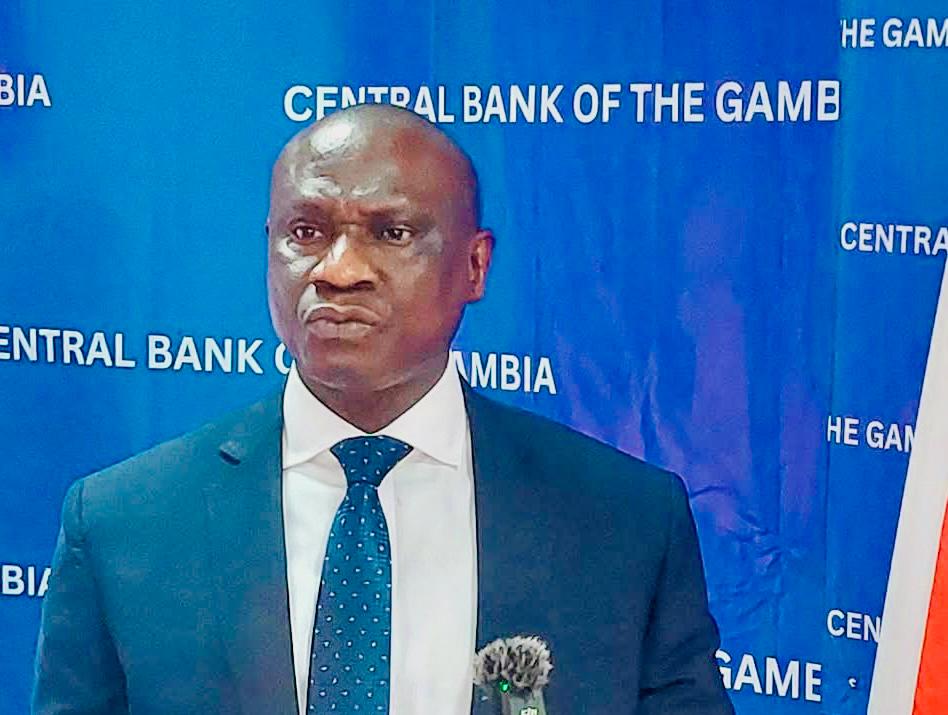
The Monetary Policy Committee (MPC) of the Central Bank of The Gambia (CBG) has decided to maintain the Monetary Policy Rate (MPR) at 14 percent following its two-day meeting on May 20 and 21. The decision comes as domestic inflation shows signs of accelerating, while the Gambian economy continues to display resilience amid heightened global uncertainties stemming from geopolitical tensions in the Middle East.
The Committee cited a careful assessment of both domestic and international economic conditions. Global growth is projected to moderate to 3.1 percent in 2026, according to the IMF’s April World Economic Outlook, a 0.2 percentage point downgrade from earlier forecasts. The slowdown reflects persistent geopolitical risks, elevated energy prices, and policy uncertainty affecting trade and investment worldwide.
Advanced economies are expected to grow by a modest 1.8 percent, while emerging and developing economies, including those in Sub-Saharan Africa, are forecast to expand by 3.9 percent and 4.3 percent, respectively. The Sub-Saharan projection marks a slight moderation from 4.5 percent in 2025, largely due to the ongoing Middle East conflict, tight fiscal conditions, and currency pressures in some countries.
Global inflation is expected to temporarily rise to 4.4 percent in 2026, up 0.6 percentage points from January estimates, before easing to 3.7 percent in 2027. The surge is primarily linked to higher energy and transport costs stemming from the Middle East war and disruptions to maritime routes. International commodity prices have jumped sharply, with the IMF All-Commodity Price Index rising 28.1 percent between January and April 2026. Oil prices climbed dramatically from US$60 per barrel to US$100 over the same period.
Domestically, The Gambia’s economy has shown strong resilience. Real GDP growth is projected at 5.7 percent for 2026, though this represents a 0.5 percentage point downward revision due to higher energy costs and global spillovers. The Central Bank Composite Index of Economic Activity averaged 3.5 percent growth in the first three months of the year, supported by robust performance in tourism, construction, trade, and financial services.
The Central Bank’s Business Sentiment Survey for Q1 2026 revealed continued optimism among firms, fueled by festive demand, peak tourism season, and strength in construction and digital finance. However, businesses remain concerned about inflation, exchange rate movements, geopolitical spillovers, and election-related uncertainty.
External balances weakened somewhat in the first quarter. The current account deficit widened to US$20.83 million (0.8 percent of GDP) from US$13.19 million (0.5 percent of GDP) in the same period of 2025. This deterioration was driven by rising imports of printing materials, mineral fuels, oil, cereals, and vehicles, despite gains in tourism receipts and remittances. The goods account deficit expanded to US$284.37 million (11.2 percent of GDP).
Nevertheless, the foreign exchange market remained stable with increased transaction volumes totaling US$644.19 million. Remittance inflows rose 17.2 percent to US$246.08 million in the January-March period. The Dalasi showed marginal appreciation against the US dollar (0.3 percent) and the British pound (0.5 percent), while depreciating modestly against the euro, the Swiss franc, and the CFA franc. Gross international reserves stood at a comfortable US$556.5 million by the end of April, covering 4.3 months of prospective imports.
On the fiscal front, government operations improved. The overall deficit, including grants, narrowed to D2.3 billion (1.2 percent of GDP) in Q1 2026 from D2.7 billion (1.4 percent) a year earlier. Domestic revenue mobilization strengthened thanks to better tax administration and fiscal consolidation. Domestic debt rose to D53.3 billion (24.0 percent of GDP), still concentrated in short-term instruments.
Money market rates stayed relatively stable but higher than the previous year amid tighter liquidity and government borrowing needs. Annual money supply growth accelerated sharply to 23.2 percent in March 2026, driven by credit expansion. Private sector credit grew by a robust 35.4 percent. The banking sector remains sound, with total assets reaching D129.9 billion (67.6 percent of GDP). Customer deposits increased 20 percent to D84.2 billion. The capital adequacy ratio stood at 24.3 percent, the liquidity ratio at a strong 78.3 percent, and non-performing loans improved to 7.7 percent.
Digital financial services continued their rapid expansion. Mobile money cash-in transactions rose 11.7 percent to D27.0 billion, cash-out grew 15.2 percent to D30.5 billion, and registered users reached 5.4 million.
The most pressing domestic concern highlighted by the MPC is the recent reversal in inflation trends. Headline inflation rose to 7.0 percent in April 2026 from 6.6 percent in December 2025 and 6.4 percent in January.
Food inflation increased to 6.7 percent, while non-food inflation accelerated to 7.2 percent, reflecting higher transport, housing, and utility costs. Core inflation measures also strengthened significantly, with Core 1 (excluding energy) reaching 6.6 percent and Core 2 (excluding food and energy) at 6.5 percent, indicating broader-based price pressures.
In its deliberations, the Committee noted the global economy’s underlying resilience but warned of downside risks from geopolitical tensions and energy market disruptions. These factors are expected to spill over into The Gambia through tourism, remittances, commodity prices, and trade. For a small, import-dependent economy like The Gambia, vulnerability to imported inflation via fuel, transport, and exchange rate channels remains a key risk, tilting the inflation outlook to the upside.
On the positive side, strong domestic fundamentals — including resilient growth, improved forex liquidity, adequate reserves, and a stable banking system — provide a solid buffer. The MPC nevertheless emphasized the need for prudent policy to address renewed price pressures.
Accordingly, the Committee resolved to maintain the Monetary Policy Rate at 14 percent; keep the Required Reserve ratio at 13 percent; hold the standing deposit facility rate at 5 percent; and retain the standing lending facility rate at 15 percent.
The CBG reaffirmed its commitment to returning inflation to target over the medium term and pledged to monitor developments closely, ready to act if necessary.
The next MPC meeting is scheduled for August 26-27, 2026.