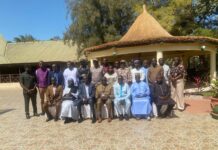
Human rights activist and spokesman for Gambians Against Looted Assets (GALA), Omar Saibo Camara, has raised fresh alarms over the escalating irregular migration crisis in Jinack Island, following a recent on-site visit that exposed deep-rooted facilitation networks and government inaction.
Camara, accompanied by Baboucarr Nyang, described Jinack – a coastal village in the North Bank Region – as a major transit point for sub-regional migrants, primarily from Guinea and Senegal, attempting perilous journeys across the Mediterranean to Europe. During his visit, he observed numerous foreign nationals, including young women, awaiting departure, who had resorted to bush camps due to exorbitant accommodation costs charged by local landlords.
“Some landlords are profiting immensely, charging thousands of dalasis for short stays,” Camara reported, noting that while not all villagers are involved, certain individuals – including sub-agents – assist in logistics such as securing fuel, food, and shelter. Main migration facilitators operate from outside The Gambia, but local complicity has turned the activity into a lucrative underground economy.
A striking revelation was the absence of law enforcement, attributed partly to a persistent myth that uniformed officers risk misfortune or job loss by entering the village – a belief that, though questioned by locals, underscores perceived governance gaps.
Camara’s findings come amid a series of tragedies linked to Jinack’s departures. In late 2025, boats carrying hundreds vanished or capsized, with one November voyage feared to have claimed nearly 200 lives. Just days ago, on New Year’s Eve, another overcrowded vessel with over 200 migrants capsized near the island, resulting in seven confirmed deaths, 102 rescues, and dozens still missing, according to President Adama Barrow.
The activist criticized the government’s negligence in allowing Jinack to become a smuggling hub, urging immediate collaboration with communities to address root causes such as economic desperation. Migrants, he said, are driven by hopes of supporting families, often undeterred by failures – as evidenced by intercepted Senegalese returnees who lost massive sums but vowed to try again.
Camara called for expediting a long-drafted Anti-Smuggling Act to provide legal tools against facilitators, alongside community-driven reporting systems. “Without political will, more lives will be lost,” he warned, emphasizing that blaming villagers alone ignores broader state responsibility.
As search operations continue for the latest capsized boat, Camara’s visit spotlights the urgent need for coordinated action to stem The Gambia’s role in one of West Africa’s deadliest migration routes.