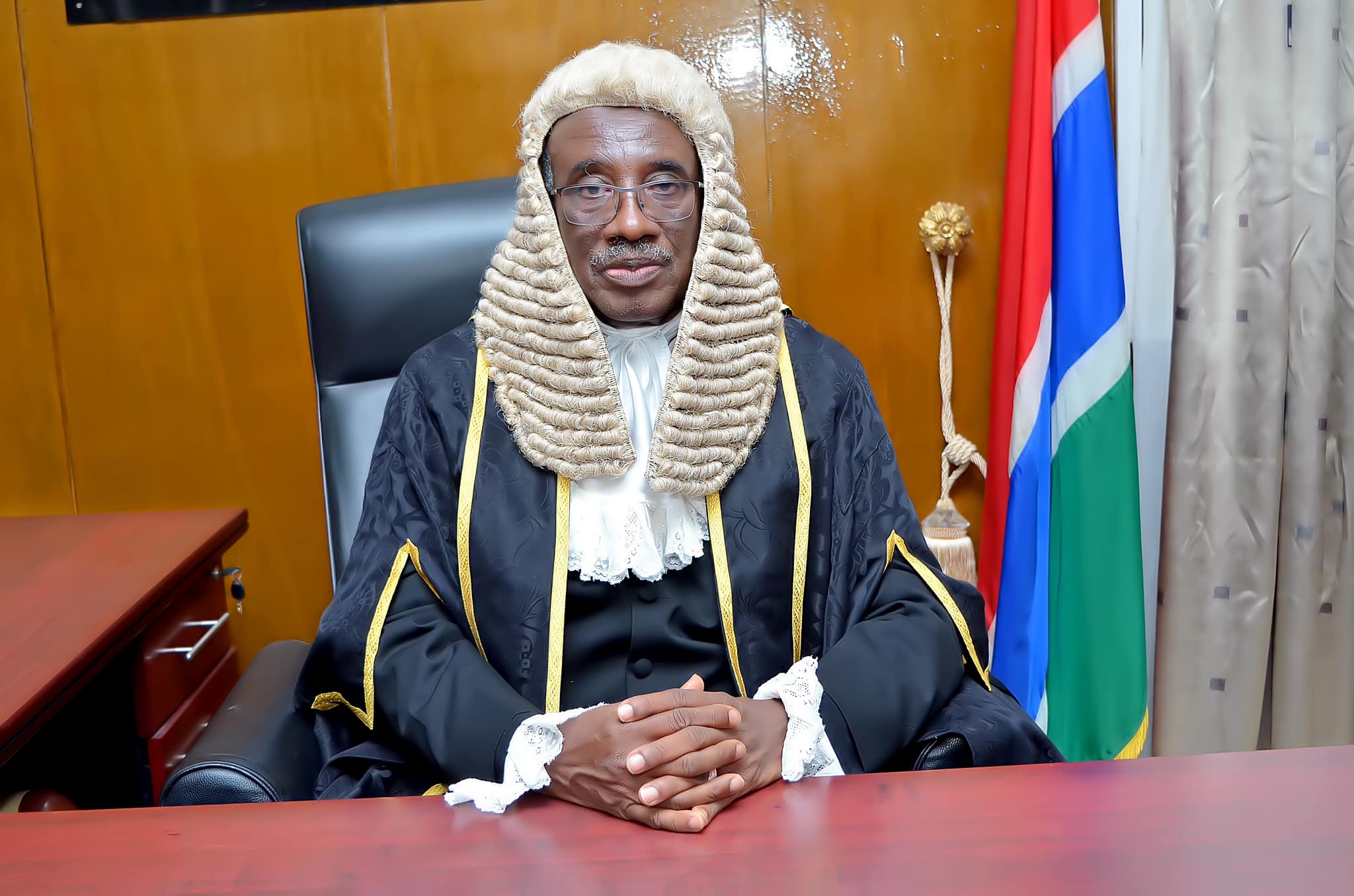
In a poignant and reflective address at the second Sir Dawda Kairaba Jawara Pan-African Lecture, organized by the Kairaba Conservation and Leadership Organisation (KAIRACLO), Chief Justice Hon. Justice Hassan B. Jallow paid an eloquent homage to The Gambia’s founding president, Alhaji Sir Dawda Kairaba Jawara.
Speaking at the Sir Dawda Kairaba Jawara International Conference Centre in Bijilo, the Chief Justice—drawing from his personal experience as Jawara’s Attorney General and Minister of Justice from 1984 to 1994—emphasized the timeless relevance of Sir Dawda’s commitment to democracy, the rule of law, human rights, and national unity.
The lecture, titled “Sir Dawda Kairaba Jawara and Governance: Legacy and Relevance for Our Times,” served as a powerful reminder of Jawara’s role in transforming The Gambia from a skeptical “improbable nation” at independence in 1965 into a respected beacon of stability and good governance in Africa.
Chief Justice Jallow began by expressing deep honor at the invitation from KAIRACLO’s Board of Trustees, praising the organization for establishing the lecture series as a lasting tribute to a leader dedicated to good governance, human rights, and democracy—not only in The Gambia but across Africa, the Commonwealth, and the world. He playfully noted the acronym KAIRACLO evoked “Kairasilo,” meaning “the Path to Peace and Wellbeing,” fitting for a man who embodied such principles.
Reflecting on Jawara’s foundational role, Jallow described him as the legitimate “Father of the Nation,” who led the struggle for independence alongside colleagues despite widespread doubts about The Gambia’s viability as a sovereign state. He vividly recounted witnessing the midnight ceremony on February 17, 1965, at McCarthy Square in Banjul: the lowering of the Union Jack, the raising of the Gambian flag in its red, white, blue, white, and green stripes, the first public playing of the national anthem, and the handover of independence instruments by the Duke of Kent on behalf of Queen Elizabeth II.
Jallow contrasted the hardships of the colonial and early post-independence era—lack of electricity, running water, telephones, proper roads, and educational facilities—with the progress achieved under Jawara’s leadership. Growing up in Bansang and studying in Banjul under candlelight or street lamps, he highlighted how Jawara instilled confidence and self-belief, proving skeptics wrong. “Sixty years later, today that supposedly ‘improbable’ state is a firmly established and respected member of the global community,” he said, crediting Jawara’s vision, integrity, modesty, and commitment.
The Chief Justice underscored that Jawara’s most incredible legacy lay not merely in material development but in governance. At a time when dictatorship, one-party rule, and human rights abuses dominated much of Africa, Jawara championed an alternative: respect for the rule of law, constitutionalism, judicial independence, political pluralism, free and fair elections, and human rights. Jallow, who worked closely with him, affirmed these were deep personal convictions, not political expediency.
Key milestones under Jawara included the 1982 direct presidential election by universal suffrage, the abolition of leg irons for prisoners, the 1992 abolition of the death penalty, and the establishment of the Ombudsman for administrative justice. Even after the 1981 coup attempt, which led to a state of emergency, Jawara’s response remained in line with international human rights standards, as confirmed by Amnesty International.
Jallow highlighted Jawara’s international contributions: condemning human rights violations globally, supporting the African Charter on Human and Peoples’ Rights (known as the Banjul Charter), hosting its Commission in The Gambia, and establishing the African Centre for Democracy and Human Rights Studies. These elevated The Gambia’s influence far beyond its size.
On national unity, Jallow praised Jawara for transcending tribal, religious, and sectional divides, transforming the People’s Progressive Party (PPP) into a national organization and forming diverse cabinets. He described Jawara as “tribeless,” earning trust across ethnic groups through courtesy, punctuality, intellect, compassion, and restraint.
Jallow recounted instances of Jawara’s steadfastness: resisting calls to unilaterally declare a republic after a failed referendum, instead resigning and calling elections (which he won overwhelmingly); rejecting one-party state pressures; and insisting on merit-based public service appointments. These choices were vindicated over time, with The Gambia becoming a republic in 1970 through a referendum and maintaining pluralism.
The Chief Justice noted Jawara’s 1991 announcement at the PPP congress in Mansakonko that he would not seek re-election in 1992, which was later withdrawn under pressure. At this rare moment, the party overrode his wishes. Surveys near the end of his tenure ranked The Gambia among Africa’s top economies and highest in good governance and human rights.
Jallow urged the nation to rededicate itself to Jawara’s values: sovereignty, rule of law, human rights, peace, unity, tolerance, self-reliance (“Tesito”), and progress. He cautioned against over-dependence, criticizing imports of second-hand goods as harmful to innovation and the environment.
Regarding contemporary challenges, he advocated strengthening oversight institutions, including the judiciary, the Ombudsman, the National Human Rights Commission, the Audit Office, and the National Assembly. He welcomed the new Anti-Corruption Commission and called for effective implementation to promote integrity.
In a notable intervention on constitutional reform—after two failed attempts since 2017—Jallow proposed a pragmatic shift: focus on consensus areas in recent drafts to amend the 1997 Constitution, deferring disagreements for a more conducive time, to advance good governance without impasse.
He concluded by calling for continued safeguarding of The Gambia’s independence project, launched on February 18, 1965, through individual and collective commitment to Jawara’s ideals of peace, progress, and prosperity.
The lecture, attended by dignitaries including former officials and academics, reinforced Jawara’s multifaceted legacy as a statesman, conservationist, and Pan-Africanist. It highlighted the need to preserve his vision amid ongoing national efforts to build on past achievements.