By Fatou Dahaba
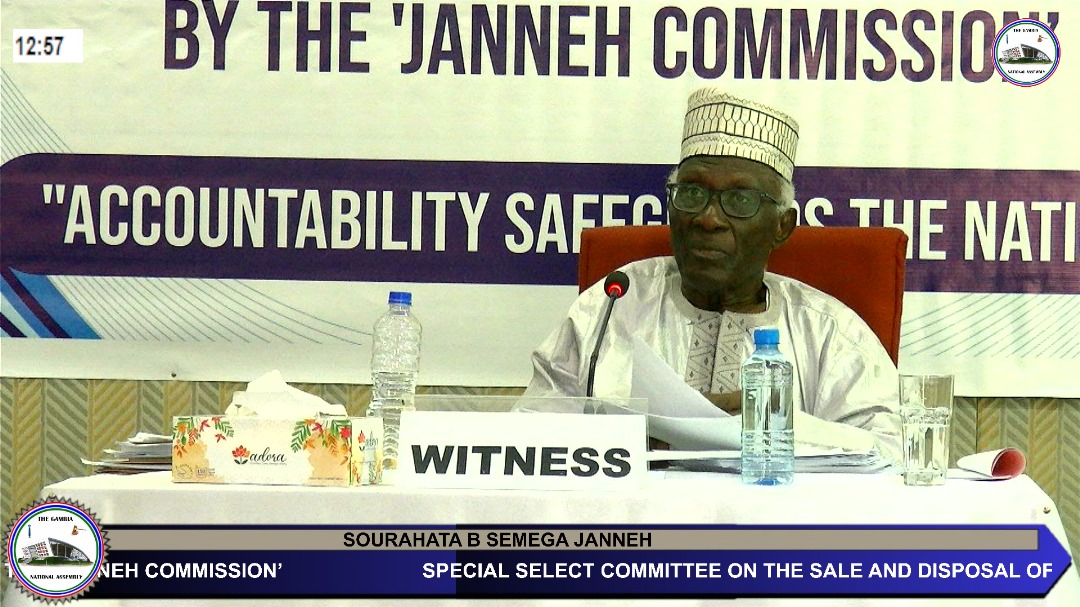
Mr. Sourahata B. Semega-Janneh, the former chairperson of the Janneh Commission, testified before the National Assembly’s Special Select Committee, which is tasked with investigating the sale and disposal of assets linked to former President Yahya Jammeh, as identified by the Janneh Commission. The hearing focused on the commission’s establishment, administrative structure, oversight mechanisms, and its operational and financial independence from the Ministry of Justice.
The Janneh Commission, established to investigate financial dealings and asset management under the former president’s regime, has been under scrutiny for its processes and decision-making. During the session, Mr. Semega-Janneh provided insight into the commission’s framework, emphasizing its reliance on government funding and the lack of a distinct role for the chairperson.
Mr. Semega-Janneh explained that three key instruments governed the commission’s operations, though he could not recall any additional discussions beyond these legal documents regarding the commission’s scope or functions. When pressed by Lead Counsel Dibba on whether further deliberations had occurred regarding the commission’s mandate or the roles of its commissioners, Mr. Semega-Janneh reiterated that no such discussions had taken place outside the legal notice.
On the relationship between the commission and the Ministry of Justice, the former chairperson stated there was no direct interaction or influence. He stressed that the commission relied entirely on the ministry for funding, with no independent expenditure. “We did not spend any money; we depended completely on the government through the Ministry of Justice,” he testified.
Counsel Dibba probed further into the chairperson’s role, questioning whether it was administrative, supervisory, judicial, or a combination of these. Mr. Semega-Janneh referred to the commission’s terms of reference, noting, “There is nothing in the constitution or the terms of reference that says the chairman has a special role, except that he chairs the commission.” He emphasized that his responsibilities were identical to those of other commissioners, with decisions made by consensus rather than voting. “The chairman had no special power; we were all equal,” he added.
When Counsel Dibba suggested that, in most organizations, a chairperson might have a casting vote in decision-making, Mr. Semega-Janneh maintained that no such provision exists in the commission’s operations, with no recorded disagreements among commissioners.
The hearing also touched on the role of the commission’s former secretary general, described as a professional accountant who provided expertise on financial matters. Mr. Semega-Janneh noted that while the secretary led discussions on accountancy issues, legal matters were guided by the commission’s lead counsel, Amie Bensuda, whose input was highly respected. The secretary’s role later evolved to include specific assigned duties, ensuring smooth administrative operations.
Questions were also raised about the commission’s financial and operational independence from the Ministry of Justice, as well as the impact of High Court orders and asset custody decisions on its work. Mr. Semega-Janneh maintained that the commission operated independently, with no undue influence from external bodies, though its financial dependence on the government was undeniable.
The testimony shed light on the inner workings of the Janneh Commission, highlighting its adherence to established protocols and its collaborative approach to decision-making. However, the lack of financial autonomy and the absence of a distinct chairperson role raised questions about the commission’s structure and efficiency, which the Special Select Committee continues to explore.
As the investigation into the disposal of assets linked to former President Jammeh progresses, Mr. Semega-Janneh’s testimony underscores the complexities of the commission’s operations and its critical role in addressing past financial misconduct. The committee’s findings are expected to provide further clarity on the handling of these assets and the effectiveness of the commission’s framework.