By Fatou Dahaba
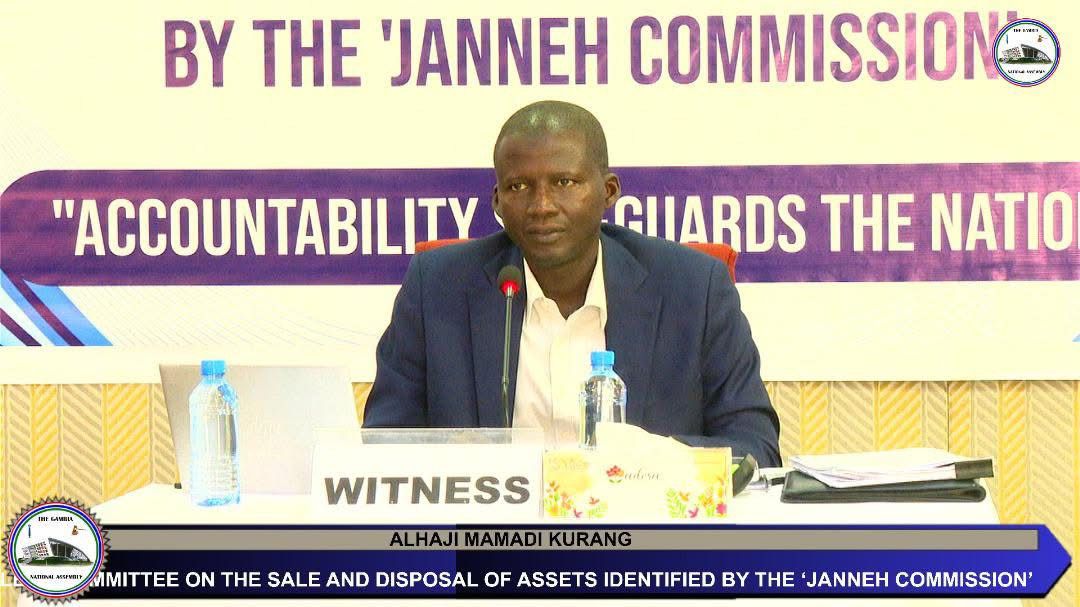
Alhagie Mamadi Kurang, former Secretary of the Janneh Commission of Inquiry, testified on Wednesday before the National Assembly’s Select Committee, shedding light on the valuation process of assets linked to former President Yahya Jammeh. Kurang, the third witness to appear before the committee probing the disposal of Jammeh’s assets, revealed that the valuation of properties, including cattle, vehicles, and land, was conducted by evaluators from the Department of Livestock and the Ministry of Lands and Surveys.
Kurang told the committee that the valuation of Jammeh’s cattle was carried out by experts from the Department of Livestock, who priced the animals based on their meat value per kilogram. He emphasized that these evaluators worked under the direction of the commission’s lead counsel, Amie Bensouda, and were not permanently based at the commission. “The lead counsel would be the best person to explain how the land property valuers came about,” Kurang stated, noting that the process was managed by external experts coordinated through the commission.
The Janneh Commission, established to investigate the financial dealings and asset acquisitions of former President Jammeh, identified several properties, including cattle farms, vehicles, and landed properties. Kurang explained that two institutions—the Sheriff Division of the High Court and the Gambia Livestock Marketing Agency (GILMA)—were tasked with assisting in the evaluation and disposal process. He recounted that an order from the High Court, issued by a judge named Kimbeteng, mandated the evaluation and tagging of assets for sale, with the proceeds to be transferred to the Sheriff.
Kurang detailed visits to three locations—Kanilai, Farato, and Banjulnding—where Jammeh’s livestock were held. He disclosed that approximately 700 cows were recorded at Jammeh’s farm in Kanilai. However, upon reaching Banjulnding, some cows were unaccounted for, with no trace of their whereabouts. “Some cows went missing without a trace,” Kurang testified, raising concerns about the oversight of the assets during the process.
Regarding the valuation of landed properties, Kurang noted that an expert from the Ministry of Lands and Surveys was responsible for determining their worth. He admitted to limited personal involvement in the land valuation process, as he left the commission after one year. “I didn’t see most of the valuation process because I left,” he told the committee, but he affirmed that the commission relied on professional evaluators for both cattle and vehicles.
When pressed by the committee’s lead counsel on who initiated the valuation process, Kurang clarified that the commission made the decision collectively, with the Department of Livestock specifically mentioned in the order. He added that the valuation of vehicles, including tractors, followed a similar process, though he was unaware of the specific individuals involved. “Eventually, an individual will be identified, but there was a valuation process of some sort,” he said.
Kurang’s testimony highlighted the structured yet complex nature of the asset valuation process under the Janneh Commission. He emphasized that evaluators, whom he referred to as “valuers or quantity surveyors,” operated under the guidance of the lead counsel and relevant government departments. “Their department is able to source expertise,” he said, expressing confidence in the professionalism of the process.
The National Assembly’s Select Committee continues its probe into the handling of Jammeh’s assets, with Kurang’s testimony raising questions about the transparency and accountability of the disposal process. The committee is expected to call additional witnesses, including the commission’s lead counsel, to provide further clarity on how valuations were conducted and why some assets, such as the missing cows, remain unaccounted for.
As the investigation unfolds, the public awaits answers on the management of the former president’s extensive holdings, which have been a subject of national interest since Jammeh’s departure in 2017.