By Fatou Dahaba
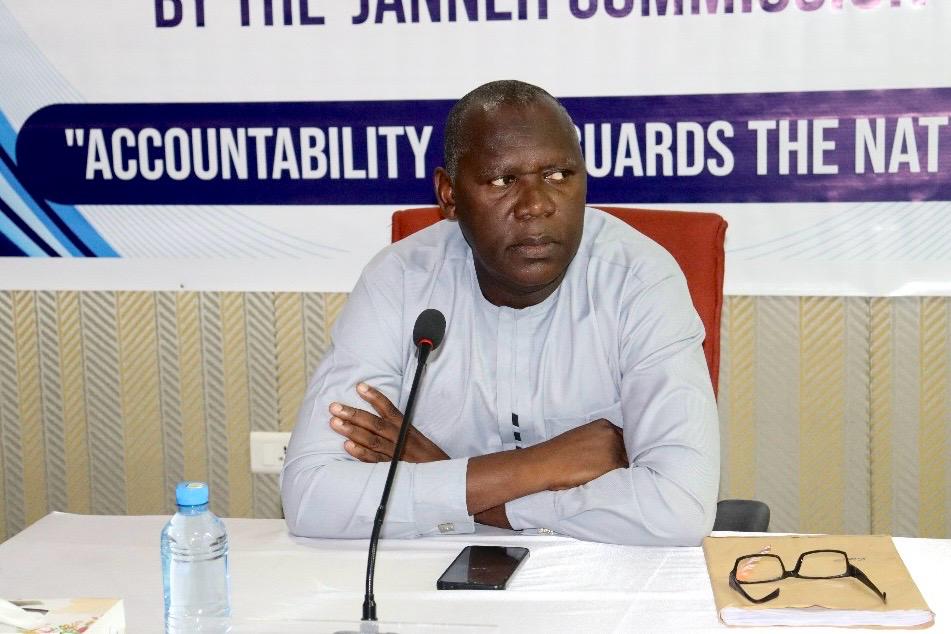
Alieu Jallow, the former Registrar General, reappeared before the Special Select Committee on Tuesday, August 5, 2025, to address discrepancies in his initial testimony regarding the sale and disposal of assets linked to former President Yahya Jammeh, as identified by the Janneh Commission. The hearing, marked by sharp exchanges, saw Jallow confronted with documents that contradicted his earlier claims, raising questions about his role in handling Jammeh’s assets during his tenure.
In his first appearance before the committee, Jallow was directed to produce any relevant documents in his possession, including memos, correspondence, and reports related to the assets. The committee requested copies of a sheriff’s report summarizing the livestock scale, a land statement, and a list of files with corresponding remarks. Jallow had claimed a lack of recollection about key details, prompting the committee to demand further evidence.
Since his initial testimony, several witnesses have appeared before the committee, offering accounts that directly challenge Jallow’s statements. These testimonies cast doubt on his role in the sale of Jammeh’s assets and his communications with the Janneh Commission and the Chief of Defence Staff (CDS). Jallow, however, maintained that he had no direct correspondence with either the commission or the CDS, insisting that all his communications were channeled through the Solicitor General at the Ministry of Justice.
The hearing took a dramatic turn when Counsel Aji Sainey Kah presented Jallow with a document bearing his signature, addressed to both the CDS and the Attorney General. Kah accused Jallow of deliberately concealing information, stating, “You are intentionally concealing information from the committee. You were given every opportunity to tell the truth, but you vehemently denied or claimed not to remember these crucial documents. You’re not taking this committee seriously.”
Kah further pressed Jallow, noting that the committee had possessed these documents since his first appearance but had given him the benefit of the doubt to see if he would acknowledge authoring them. “I asked you specifically, have you ever written to the Chief of Defence Staff. You said no. And now you are holding letters you wrote to the Commission of Inquiry and the CDS. The committee can now say that you intentionally concealed information,” Kah charged.
Jallow denied the accusations, emphasizing that he was not hiding anything. “Counsel, I am a human being. There is nothing to conceal in this. There is nothing so special in this as to conceal,” he said. He attributed his lapses in memory to the eight years that had passed since the events in question, adding that the testimonies of other witnesses had helped jog his memory. Upon reviewing the documents, Jallow confirmed that he was their author, as evidenced by his signature.
When questioned about inventories he sent to the Janneh Commission, Jallow admitted to submitting them but claimed he was unaware of subsequent court orders related to the assets. The committee highlighted a high court order that placed additional properties, including 17 companies and frozen bank accounts, under the control of Augustus Prom, in addition to 14 companies previously assigned. Jallow insisted he had never seen this order and was not informed by the Justice Minister.
Further scrutiny arose over an application by the Attorney General to the High Court regarding additional assets for a trust fund to be allocated to companies. Jallow told the committee that the Attorney General neither consulted him before making the application nor informed him after obtaining the court order.
The hearing underscored lingering questions about transparency and accountability in handling Jammeh’s assets, with Jallow’s testimony raising concerns about the accuracy of his recollections and the extent of his involvement.
As the Special Select Committee continues its probe, the public awaits further clarity on managing these assets, which remain a contentious issue tied to Gambia’s efforts to address the legacy of Jammeh’s regime.