By: Sainabou Sambou
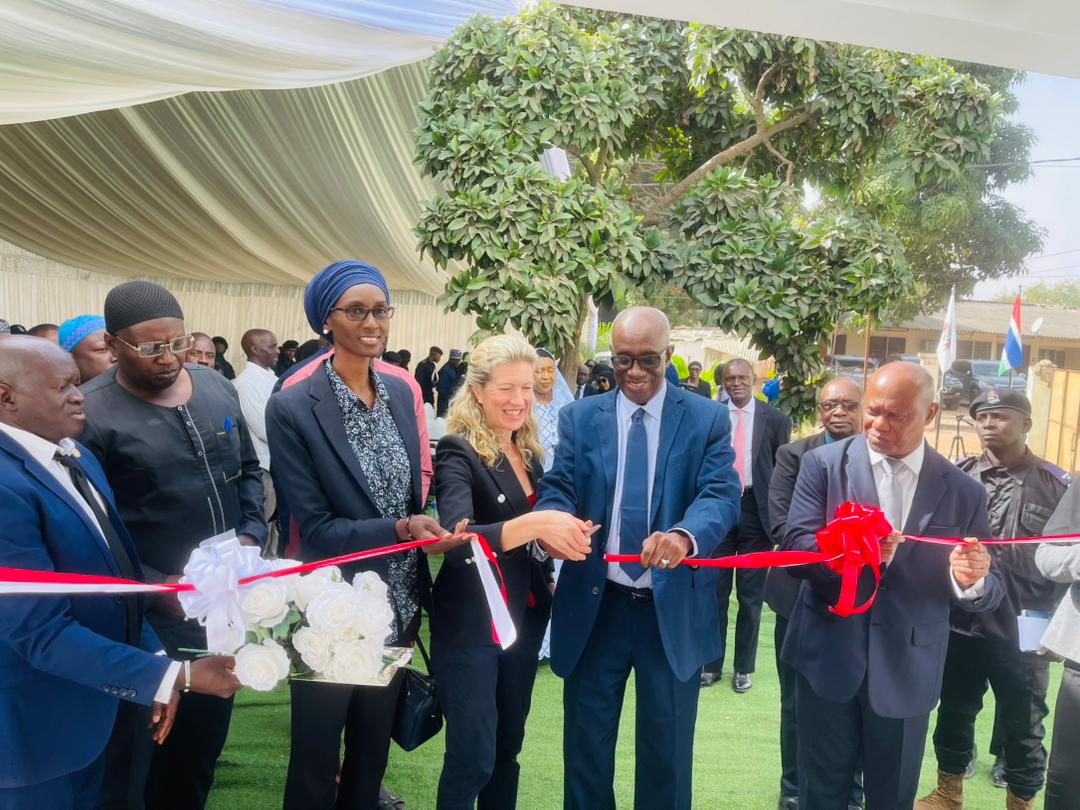
In a significant step toward strengthening the rule of law and delivering justice for victims of historical human rights violations, the Government of The Gambia, in partnership with the Judiciary, the Gambia Bar Association (GBA), and international supporters, has officially inaugurated the newly constructed premises of the Special Criminal Division of the High Court in Bakau.
The ceremony marked the opening of a modern judicial facility designed to handle serious and complex criminal cases, including those stemming from the recommendations of the Truth, Reconciliation and Reparations Commission (TRRC). The TRRC, established in 2017, investigated widespread abuses—including murder, enforced disappearances, torture, inhumane treatment, rape, sexual offenses, and property violations—committed by state agents during the 22-year regime of former President Yahya Jammeh from July 1994 to January 2017.
Honourable Chief Justice Hassan B. Jallow, in his inaugural address, described the new court complex as a powerful symbol of renewed commitment to the justice sector. The building replaces a dilapidated structure and represents the first phase of the Special Criminal Division. A judge has already been assigned, with plans to expand capacity further.
The Chief Justice emphasized that crime violates fundamental human rights and erodes community trust when left unaddressed. “Effective accountability mechanisms are essential to prevent crime, deliver justice to victims, and restore public confidence,” he said. He urged all stakeholders—judges, court staff, lawyers, and partners—to maintain the highest standards of professionalism and integrity.
Chief Justice Jallow highlighted the collaborative effort behind the project, thanking the Government of The Gambia, the United Kingdom, the Gambia Bar Association, and the contractors. He positioned the Special Criminal Division as a key advancement in upholding the rule of law, ensuring fair and efficient justice, and bolstering public confidence in the judicial system.
Ms. Neneh M.C. Cham, President of the Gambia Bar Association, linked the Division directly to The Gambia’s transitional justice journey. She recalled the TRRC’s findings of systematic state-sponsored abuses and the Government’s acceptance of its recommendations via a White Paper, committing to prosecute those most responsible. While two criminal cases have already been successfully prosecuted, these occurred under challenging conditions, underscoring the need for specialized infrastructure.
The Division, established by the Chief Justice, aims to handle serious criminal matters more expeditiously. With financial and technical backing from the British High Commission, the Judiciary, and GBA, the company rebuilt the Bakau facility. Ms. Cham noted that the court will complement any future internationalized mechanisms for crimes beyond domestic jurisdiction, such as torture and enforced disappearances.
The new complex features modern courtrooms, judges’ chambers, lawyers’ robing rooms, secure holding cells, and victim- and witness-protection facilities. Special attention has been given to creating safe, dignified spaces for survivors of sexual and gender-based violence, embodying a victim-centered approach.
The Government contributed over $10 million to support the Division, covering salaries for judges, registrars, clerks, interpreters, secretaries, and other staff.
Harriet King, British High Commissioner to The Gambia, called the inauguration a milestone in justice, accountability, and democratic institution-building. She praised the TRRC for mapping a path to accountability and stressed that credible, independent institutions are vital. The Division, she said, will reduce case backlogs, enhance efficiency, improve public trust, and provide better conditions for victims—particularly survivors of gender-based violence. She commended the GBA’s role in upholding judicial independence.
Representing the Attorney General and Minister of Justice, Solicitor General Hussein Thomasi described the Division as a transition from truth-telling to concrete action. Drawing from international best practices, it shows domestic courts can meet global standards when properly resourced. He acknowledged ongoing challenges, including limited funding and competing priorities, calling for sustained support and shared responsibility.
Alkalo of Bakau, Dodou Bojang, welcomed the facility as a symbol of justice and fairness, expressing gratitude to all contributors and hope that it would serve with integrity.
Contractor Solo Darboe Company Limited, represented by Fanta Darboe, explained that initial renovation plans were abandoned after assessments revealed structural weaknesses. The old building was demolished, and a new, purpose-built complex was erected to ensure safety and effective justice delivery.
The inauguration aligns with broader judicial reforms, including the 2026 Legal Year activities, and reflects The Gambia’s ongoing efforts to address its past while building resilient institutions for the future. As the nation confronts historical injustices, this specialized court stands as a beacon of hope for victims seeking redress and a stricter rule of law.