By: Alieu Ceesay
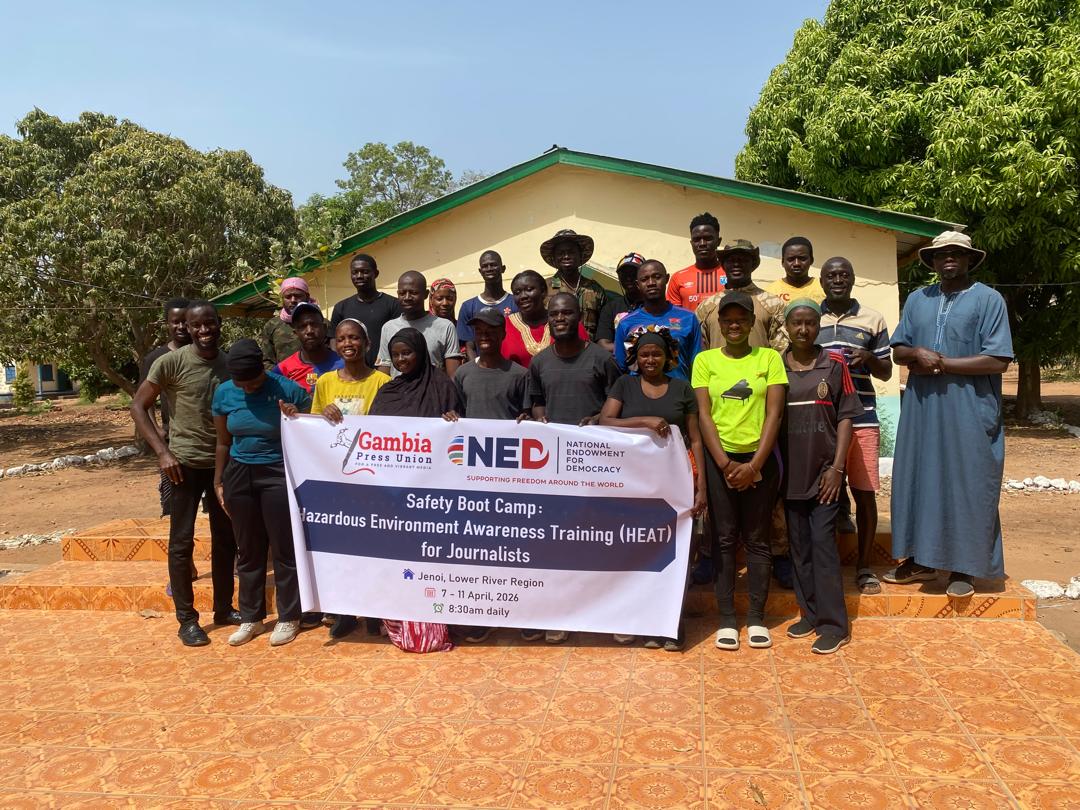
The Gambia Press Union (GPU) has successfully wrapped up a five-day intensive Hazardous Environment Awareness Training (HEAT) boot camp, aimed at equipping journalists with critical safety skills as the country prepares for the 2026 presidential elections.
The residential training, held at the Rural Farmers’ Agricultural Training Center in Jenoi, Jarra West, Lower River Region, concluded on Saturday. It brought together 20 journalists drawn from newspapers, online platforms, radio, and television stations across the country.
Supported by the National Endowment for Democracy (NED), the programme combined theoretical lessons, practical simulations, and debriefing exercises. Participants were trained on essential survival techniques, risk assessment, and best practices for operating in hazardous and hostile environments, including crowd control during protests and high-tension situations.
GPU Secretary General Modou Joof emphasized the union’s long-standing commitment to journalist safety.
“Over the years, the GPU has trained journalists on safety. This particular training is all about ensuring the safety of journalists ahead of the 2026 elections and 2027 as well,” Joof said.
He urged participants to put the lessons into practice, stressing that knowledge alone is not enough without application, especially during moments of tension.
“It’s not always easy. I have several points to remember. There are skills that we gained here… that you must never forget. Never forget your training,” he added.
Joof also called on the journalists to maintain emotional control when covering volatile situations.
One of the lead trainers, Sang Mendy, highlighted the program’s importance in building both competence and the right mindset.
“This training is very important. Those journalists who attended were equipped with the requisite skills, knowledge, understanding, and even the right attitude to cover a protest, a violent press conference, to assess the situation, analyze it, and come up with a mitigation plan,” Mendy said.
The course also included modules on emergency medical response, enabling participants to provide basic first aid in crises.
Participant Arret Jatta of The Standard newspaper described the training as both unique and highly practical.
“This is something new, and it’s something very essential because these are things we face sometimes in our work environments, like protests and press conferences,” she said.
“I’m sure most of us have learned so much, and even if we are reporting on these issues now, we are going to do better. We are going to assess, we are going to do everything that we have been taught here.”
As The Gambia moves closer to the December 2026 elections, media practitioners and press freedom advocates believe such capacity-building initiatives will play a vital role in ensuring responsible and safe coverage of potential flashpoints, including protests and politically charged events.
The GPU says it remains committed to continuous professional development and safety training for Gambian journalists in an increasingly complex media landscape.