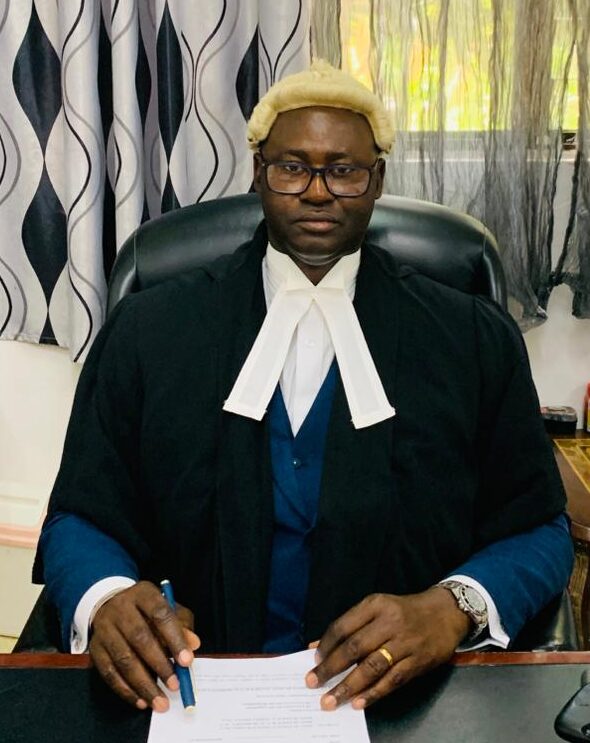
High Court Judge Hon. Justice Ebrima Jaiteh granted the prosecution’s application to compel the Edward Francis Small Teaching Hospital (EFSTH) to produce the post-mortem report on the late Cherno Touray, central to the ongoing murder trial of accused Mariama Jallow.
The case, The State v Mariama Jallow, involves allegations that Jallow fatally stabbed 16-year-old Cherno Touray during an incident in Brufut on November 29, 2023. Jallow, a resident of Brufut, has pleaded not guilty to the murder charge and remains on trial before Justice Jaiteh at the High Court in Banjul.
During proceedings on February 23, State Counsel M. Sarr informed the court that despite a police request for a post-mortem examination ordered by the Banjul Magistrates’ Court on December 1, 2023, the State Law Office had been unable to obtain the report from EFSTH. Invoking Section 221 of the Evidence Act, 1994, the prosecution applied for a court summons directing the hospital’s management to appear and produce the document.
Section 221 allows the court to summon any person, party, or non-party to produce a relevant document without requiring their personal attendance to testify, provided the document is submitted.
Defence Counsel F. C. Anyanwu strongly opposed the application. He argued that the defence had never been served with any formal request for a post-mortem and expressed doubt that such an examination had ever taken place. Counsel contended that if the report existed, the prosecution would have presented it earlier in the trial, suggesting its absence might indicate it was never prepared.
Justice Jaiteh, in a detailed ruling, overruled the defence objection. He emphasized that in a murder prosecution, establishing the cause of death beyond a reasonable doubt is a core element of the state’s case. A post-mortem report, when available, serves as critical scientific and medical evidence regarding the cause, nature, and circumstances of death.
The judge took judicial notice of the police request for the examination, made pursuant to the magistrates’ court order. He held that the prosecution’s difficulty in obtaining the report did not negate its potential existence or relevance. Section 221, he explained, exists precisely to empower courts to compel third parties—including public institutions like EFSTH—to produce documents in their custody or control that are material to justice.
Addressing defence concerns, Justice Jaiteh described them as speculative and insufficient to override the court’s statutory authority. He stressed that producing the report would not prejudice the accused; rather, it would enhance transparency and fairness. The defence, he noted, would retain full opportunity to scrutinize and challenge the document’s contents through cross-examination or other legal avenues.
In his order, Justice Jaiteh directed the Chief Medical Director of EFSTH—or any authorized officer holding the records—to produce the post-mortem report on Cherno Touray forthwith. A copy of the original police request was attached to the order for reference. The court registrar was tasked with ensuring service and compliance.
The case was adjourned to March 16, 2026, at 10:30 a.m. for further proceedings.
The judge’s ruling underscores the judiciary’s commitment to securing all relevant evidence in serious criminal matters, particularly where medical documentation is essential to proving or disproving key facts. The trial has already featured eyewitness testimonies describing the alleged stabbing, as well as police evidence on the recovery of a knife.
Legal Observers note that the post-mortem report’s eventual production could prove pivotal in clarifying the medical cause of death and influencing assessments of intent or circumstances surrounding the incident.