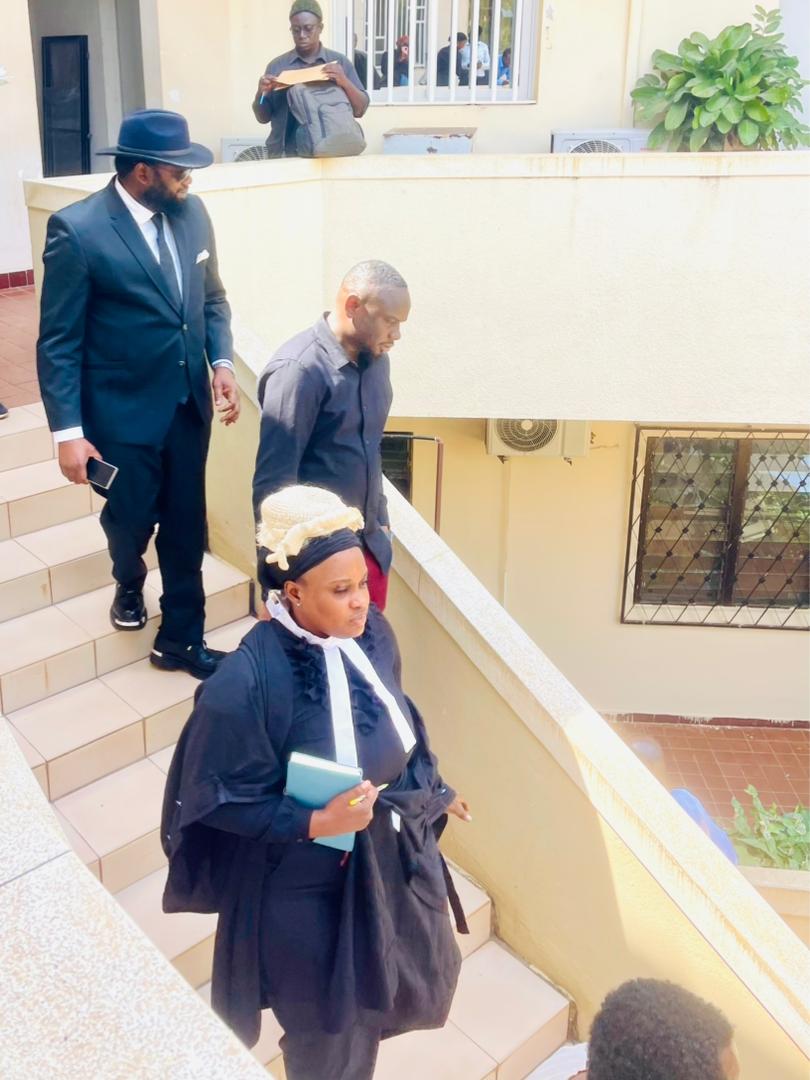
By Sainabou Sambou
In a ruling on January 14, 2026, Justice Ebrima Jaiteh of the High Court in Banjul granted the first defendant leave to call an additional witness in the high-profile civil fraud and misappropriation case involving GACH Global Trading Company Limited.
The plaintiff, GACH Global Trading Company—owned by businessman Abubakary Jawara—is seeking to recover more than D58 million from former employee Khadijatou Kebbeh and Saihou Drammeh, erstwhile Managing Director of Gam Petroleum. The claim centers on alleged fraud and theft tied to petroleum transactions, including D221,000 in U.S. dollars for petroleum products, $1,600 in commission, D1 million in legal fees, plus accrued interest.
Counsel I. D. Drammeh, representing GACH, informed the court that the plaintiff did not oppose the application by the first defendant to introduce an additional witness, stressing that all relevant and admissible evidence should be admitted to serve the ends of justice.
Khadijatou Kebbeh, the first defendant, appeared in court represented by Counsels L. S. Camara and K. Jallow. The second defendant, Saihou Drammeh, was absent but represented by Counsels B. S. Conteh and S. Akimbo.
The application, filed by the first defendant on December 29, 2025, sought permission to file an additional affidavit of witness statement from Harouna Kebbeh—Khadijatou Kebbeh’s younger brother—and to deem the affidavit filed adequately on that date. It was supported by a 15-paragraph affidavit sworn by Cathrine Fatty.
The second defendant opposed the move via a 17-paragraph affidavit sworn by Ndogal Sowe on January 13, 2026.
Counsel K. Jallow for the first defendant argued that the opposing affidavit contravened Sections 19 and 21 of the Evidence Act, as it included legal conclusions, bare denials, and arguments rather than facts within the deponent’s personal knowledge. She emphasized that Harouna Kebbeh was not a new or surprise witness—his name had featured repeatedly in pleadings and prior testimony—and that he was pivotal to the core factual dispute: whether funds paid by GACH for petroleum products were delivered to Saihou Drammeh via Harouna Kebbeh.
Counsel B. S. Conteh for the second defendant resisted, contending that the pleadings had closed and the trial had begun, rendering new evidence impermissible. He characterized the request as a disguised attempt to amend pleadings, which the rules do not allow at this stage.
Counsel I. D. Drammeh supported the application, urging the court to prioritize justice by admitting all pertinent evidence and criticizing the opposing affidavit for improperly attempting to evaluate evidence—a role reserved for the court.
In his detailed ruling, Justice Jaiteh invoked Order 23 Rule 14(7) of the High Court (Amendment) Rules 2013, which grants the court discretionary power to summon witnesses when justice requires it, without rigid restrictions tied to the procedural stage, as long as the request is made in good faith and the evidence is relevant.
The judge highlighted that a key issue in the case was whether the alleged payments reached Saihou Drammeh through Harouna Kebbeh. He noted that the second defendant’s own witness, Abdoulie Saine, had testified under cross-examination that he witnessed Harouna Kebbeh delivering the funds to Drammeh’s residence—confirming Harouna Kebbeh was already known to the proceedings.
Justice Jaiteh dismissed the claim that the application constituted an impermissible amendment: “Amendments alter pleadings, whereas calling a witness merely seeks to prove existing pleadings,” he said. He ruled that the request fully complied with the law and should not be rejected on technical grounds.
The judge also scrutinized the opposing affidavit, finding it laden with speculative assertions, bare denials, and improper legal conclusions—including labeling a witness as “tainted.” Such assessments, he said, belong exclusively to the court and render the affidavit of little evidential value. He further held that it breached Sections 90 and 91 of the Evidence Act.
Citing Lord Denning and other authorities, Justice Jaiteh underscored that procedural rules serve justice, not obstruct it. Courts must decide cases on their true merits, admitting relevant evidence absent irreparable prejudice to any party.
He concluded that allowing the additional witness would cause no prejudice, whereas refusing it would risk depriving the court of crucial testimony.
The court therefore granted leave for the first defendant to file Harouna Kebbeh’s additional affidavit of witness statement and deemed the December 29, 2025, filing properly made and served.
The matter was adjourned to February 4, 2026, for continuation.