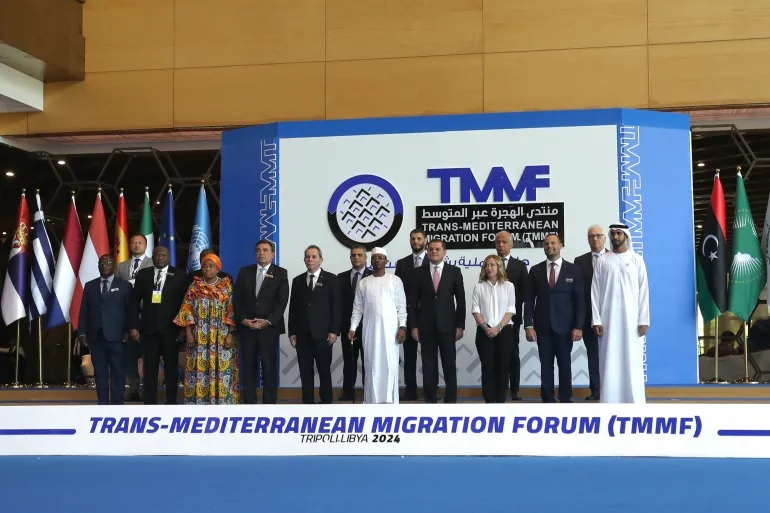
North African countries seek assistance at Tripoli conference to help stem flow of refugees and migrants.
Representatives from 28 African and European countries have met in Libya’s capital, Tripoli, to discuss ways to address irregular migration.
In his opening remarks at the beginning of the Trans-Mediterranean Migration Forum on Wednesday, Libyan Prime Minister Abdul Hamid Dbeibah said countries “have a moral responsibility” towards the people “who cross the desert and the sea” hoping to reach Europe.
KEEP READING
list of 4 items
Trump’s hardline immigration policies in spotlight on day two of RNC
Finland passes law to block asylum seekers crossing from Russia
Four people die in attempt to cross English Channel from France
Sudanese refugees hiding in Ethiopian forest to escape bandits and militias
end of list
The North African country is a main departure point for refugees and migrants, mostly from sub-Saharan African countries, risking dangerous sea journeys to seek better lives. The United Nations has registered more than 20,000 deaths and disappearances in the central Mediterranean since 2014, making it one of the most perilous migrant crossings in the world.
In recent years, the European Union has increased efforts to reduce migration, including by providing equipment and financial support to the Libyan Coast Guard, a quasi-military organisation linked to militias accused of abuses and other crimes.
As a result, many have found themselves stranded in Libya, often held in detention in conditions that rights groups describe as inhumane.
The International Organization for Migration said in May that there were more than 706,000 migrants in Libya at the start of the year, but Libyan officials say the actual number exceeds two million.
“Libya found itself caught in pressure between [Europe’s] turning back of migrants and [their] desire to migrate,” Dbeibah said, calling for development projects in departure countries.
“We can only resolve the migration crisis at the root, in the countries of departure,” he said.
Last week, authorities in Libya said that up to 80 percent of foreigners in the country are undocumented, and hosting people hoping to reach Europe has become “unacceptable”.
“It’s time to resolve this problem,” Interior Minister Imad Trabelsi had said, because “Libya cannot continue to pay its price”.
Libya, which is still struggling to recover from years of war and chaos after the 2011 NATO-backed overthrow of longtime ruler Muammar Gaddafi, has been criticised over the treatment of migrants and refugees. Accusations from rights groups range from extortion to slavery, while smugglers and human traffickers have also taken advantage of the climate of instability in the country.
“I’m looking around Libya here right now – it’s very, very dangerous,” Waly, a young Nigerian in Tripoli, told Al Jazeera.
“Our people go to sea [and] want to cross the sea, so they want to stop us,” he said. “I’m thinking to move forward or to go back.”
Reporting from the forum, Al Jazeera’s Malik Traina said “there’s a sense of fear” among migrants in Libya currently. Officials in the country, however, “want to bolster the relationship between Africa and the EU to mitigate the migration problem”, he added.
Speaking to reporters, Dbeibah said Libya lacked the resources to address the issue and called on wealthier countries to “provide the funds” in order to stop the influx of migrants.
Tunisian Prime Minister Ahmed Hachani also called on European countries at the Tripoli conference to increase financial aid to his country and others to help tackle the flow of migrants from sub-Saharan Africa.
“More assistance must be provided to countries such as Tunisia. The aid provided is insufficient to address the problem,” he said. “There are towns that have absorbed migrants beyond their ability.”
Italy’s far-right Prime Minister Giorgia Meloni told the conference that the situation could not be resolved without tackling the problem in the countries of origin.
She also denounced “criminal organisations” who “decide who has the right or not to live in our countries”, adding that “illegal migration is the enemy of legal migration”.