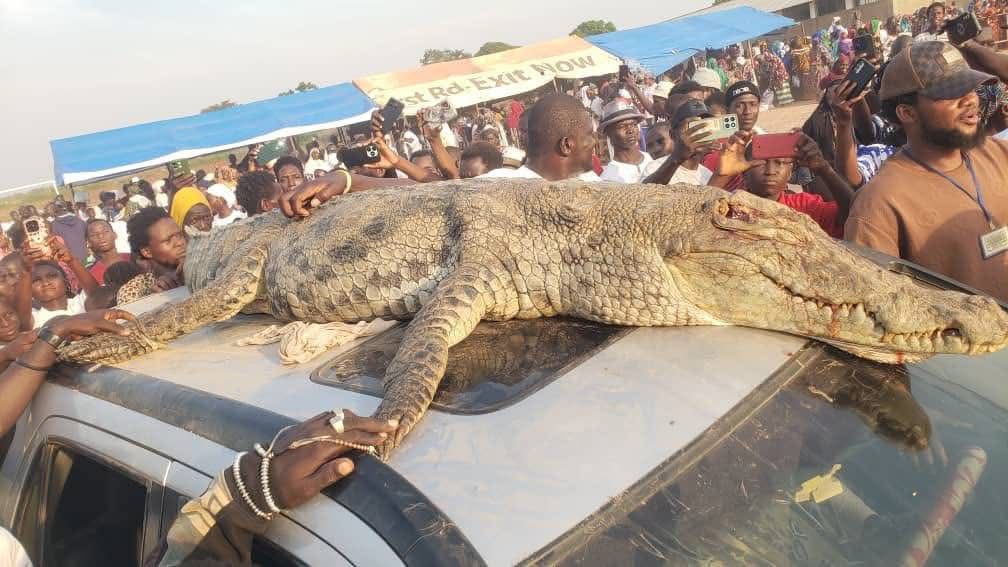
President Adama Barrow’s ongoing “Meet the People Tour” has ignited fresh controversy after he accepted a dead crocodile as a gift from the Gambia Hunters Association in Sandu Kirau Arrafang, prompting sharp condemnation from the Edward Francis Small Centre for Rights and Justice (EFSCRJ) for violating wildlife laws.
On Day 7 of the tour, hunters presented the slain reptile to Barrow as a token of loyalty and cultural tradition, eliciting cheers from local supporters. However, EFSCRJ swiftly denounced the act as the second illegal wildlife killing tied to the president in recent years. “We express deep concern and grief over this willful destruction,” the group stated in a press release, labeling it a “flagrant violation” of the Wildlife Conservation Act 1977, which bans the killing, possession, and trafficking of protected species.
The incident mirrors an October 2023 episode when the Department of Parks and Wildlife Management ordered the killing of a hippopotamus, which was later delivered to Barrow’s private residence in Mankamang Kunda. EFSCRJ holds Barrow “personally responsible,” accusing him of normalizing poaching by accepting such trophies without accountability. “By willingly receiving these prohibited gifts, the President encourages the destruction of our natural heritage and undermines the rule of law,” the statement read.
EFSCRJ highlighted The Gambia’s obligations under international treaties, including the Convention on Biological Diversity (CBD) and the Convention on International Trade in Endangered Species (CITES), arguing that these acts erode environmental governance. Crocodiles and hippos are among the protected species critical to the country’s biodiversity, with populations already threatened by habitat loss and human-wildlife conflict.
In response, EFSCRJ demanded that Barrow immediately reject and return the crocodile’s remains, urging him to uphold his oath by enforcing conservation laws. The group also called on the Department of Parks and Wildlife Management and the Inspector General of Police to launch independent probes into both killings and prosecute all involved.
Animal rights advocates echoed the outcry, warning that such gestures endanger fragile ecosystems and set a dangerous precedent. “This is not tradition; it’s exploitation,” said one wildlife expert unaffiliated with EFSCRJ. Supporters of Barrow defended the gift as a longstanding rural custom symbolizing respect, but critics countered that it abuses power and disregards legal protections.
EFSCRJ reaffirmed its commitment to environmental justice, rallying citizens, civil society, and authorities to prevent future violations. As Barrow continues his tour, the episode underscores growing tensions between cultural practices and modern conservation imperatives in The Gambia.