By: Fatou Dahaba
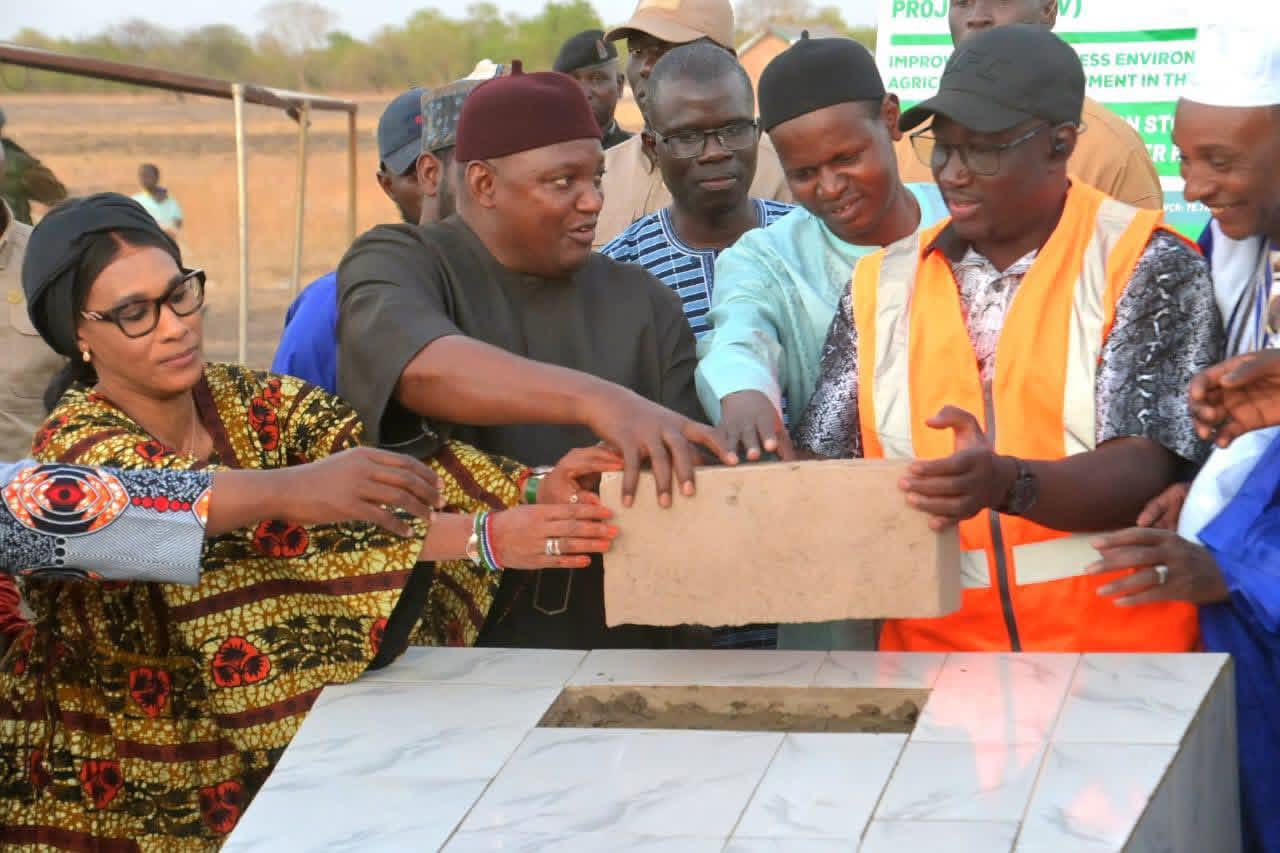
President Adama Barrow has officially laid the foundation stone for a 13.6-kilometre feeder roads project in The Gambia’s Upper River Region (URR), as part of the nationwide Gambia Inclusive and Resilient Agricultural Value Chain Development (GIRAV) Project funded by the World Bank.
The initiative, which forms part of a larger effort to construct 204.7 kilometres of feeder roads across the country, aims to improve rural connectivity, enable farmers to reach their fields more easily, and facilitate the transport of produce to markets. The URR component under Lot 1 includes two sections: an 8.2km road from Sare Fodike to Sare Jammu Mballow in Sandu, and a 5.4km stretch from Chamoi Bunda to Limbambulu in Wuli West. These roads will be supervised by the Pace and Ceeteq Joint Venture.
Speaking after the ceremony in Chamoi village on Sunday, President Barrow reaffirmed his administration’s commitment to infrastructure development and agricultural transformation. “I want farmers to have access to their farms, and from there to the markets through good roads,” he said. He emphasised that high yields require not only better access but also modern farm implements, and promised government support to ease labour constraints and boost productivity.
Barrow acknowledged ongoing nationwide works but stated he remains unsatisfied, pledging more development starting from 2027. He urged citizens to obtain national documents to participate in elections and expressed satisfaction at the spread of rural electrification, which he said has already lowered living costs. The President pledged continued delivery of electricity, roads, clean drinking water, and farm tools, while reminding Gambians of their responsibility to engage in agriculture for national food self-sufficiency.
Local leaders and residents enthusiastically welcomed the project. Kebba Sillah highlighted the importance of the new roads in linking Limbambulu Yamadou to surrounding communities and praised support for farmers, including land clearing and rice cultivation under projects like NEMA, which has developed five hectares in the area. He called for more feeder roads, upgrades to the Chamoi health centre, and the establishment of skills centres in schools to empower youth.
Alhagie Bubou Drammeh commended the rapid pace of infrastructure under Barrow’s leadership and encouraged residents to utilise free seeds and fertilisers provided by the government. Youth representative Ousman J. Bah noted that the GIRAV project is implementing 40 initiatives nationwide, with eight in URR, demonstrating the region’s prioritisation. He pointed to the dramatic drop in the cost of ice blocks—from 100 to 15 dalasis—thanks to rural electrification and assured the President of strong regional support.
Women’s representative Aja Fatou Saho spotlighted the positive impact of tractors supplied through agricultural projects, which have increased yields. She urged communities to return to farming, noting that the government is fulfilling its role by providing implements and inputs.
National Assembly Member for Wulli West, Nfamara Sabally, contrasted the current progress with decades of neglect since the First Republic, describing the foundation-laying as a long-overdue intervention. He appealed to citizens to back the Barrow administration.
Regional Governor Samba Bah reported ongoing expansion of rural electrification in both URR North and South. He stressed that feeder roads are essential for accessing farms, markets, and services, dismissing critics who downplay their importance. “Without good roads, farmers cannot access farms, markets, or essential services,” he said, while calling for peace and stability to sustain development.
Sulyaman Sumareh Janneh, Managing Director of the National Roads Authority (NRA), assured stakeholders that the feeder roads would be built to international quality standards.
As part of his provincial tour, President Barrow also conducted side visits to other feeder road sites in the North Bank Region (NBR) and Central River Region North, including the Banni–Salikeni–Njaba Kunda Road, Nyanija–Nyanga Bantang Road, and Karantaba–Dem Faye–Fitu Fulla Road.
The GIRAV project, fully financed by the World Bank with a US$25 million investment for the feeder roads component, seeks to strengthen agricultural value chains and enhance resilience in rural Gambia. Officials expect the new roads to significantly reduce transportation challenges for farmers and stimulate economic activity in remote communities.