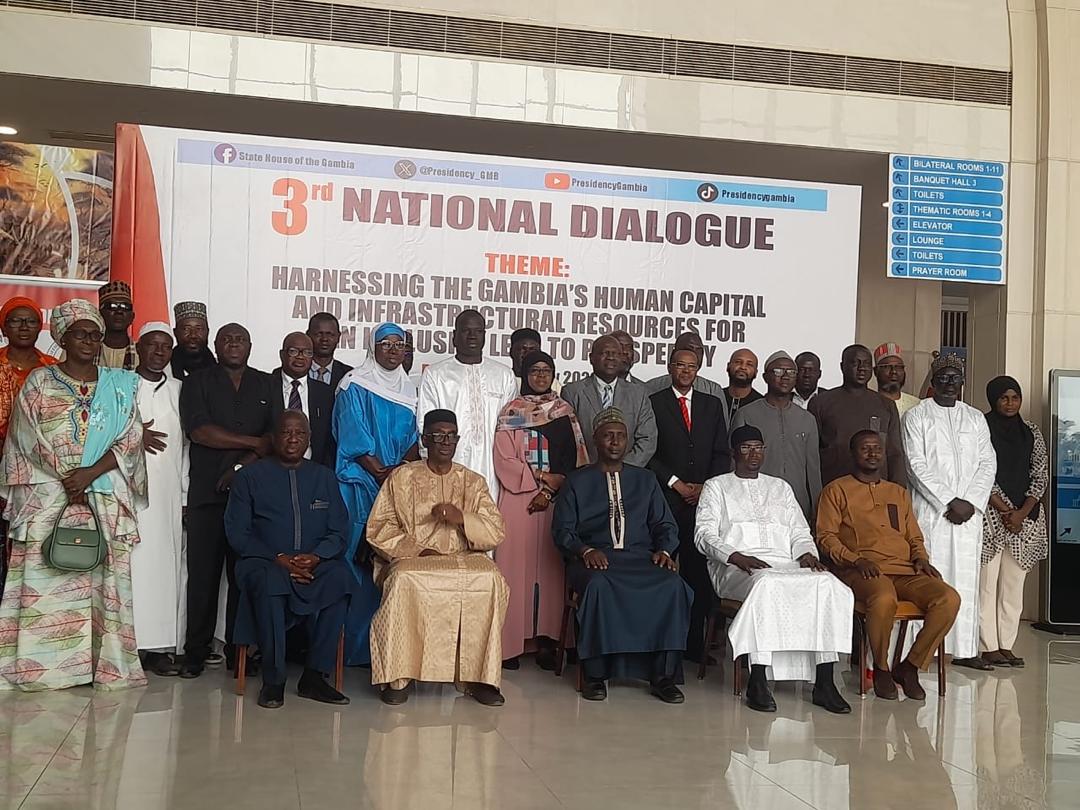
At the Sir Dawda Kairaba Jawara International Conference Centre, leaders, civil society representatives, citizens, and stakeholders from across the country gathered on Monday for the 3rd National Dialogue. The event focused on strategies to harness the nation’s human capital and infrastructure investments to drive inclusive economic prosperity.
Held under the theme “Marching in Solidarity for Self-Reliance and National Development,” the 2026 dialogue built directly on insights gathered from extensive regional consultations. These inclusive engagements involved central and local authorities, political parties, civil society organizations, youth groups, women’s associations, religious and cultural leaders, the private sector, and persons with disabilities in all administrative regions.
Key challenges surfaced during the consultations painted a clear picture of the nation’s priorities. In the Central River Region, participants highlighted youth unemployment, skills mismatches in the labor market, saltwater intrusion affecting agriculture, and the need for improved irrigation and storage facilities. The West Coast Region emphasized stronger women’s representation in decision-making and youth empowerment initiatives. The North Bank Region raised concerns over irrigation deficits, post-harvest losses, and inadequate storage. The Upper River Region identified gaps in agricultural storage and processing infrastructure. In urban areas, Banjul City Council delegates decried persistent youth unemployment, soaring housing costs, and environmental degradation, while Kanifing Municipality focused on youth joblessness, irregular migration, drug abuse, and skills gaps.
These regional inputs provided a robust evidence base for national-level discussions, informing both the current dialogue and future development frameworks. Officials reiterated a collective commitment to inclusive prosperity, identifying agriculture and youth empowerment as national imperatives. They stressed the need for integrated investments in human capital—through education, skills training, and health—and physical infrastructure to unlock sustainable growth.
Representing President Adama Barrow, Hon. Bubacarr Boye, Minister of Public Service, Administration Reforms, Policy Coordination, and Delivery, addressed the assembly. He described the dialogue as a reflection of the abundant opportunities in The Gambia and a reminder of stakeholders’ shared responsibility to safeguard institutions, promote accountability, and maintain peace and stability. Boye emphasized that the theme reaffirms the dignity inherent in pursuing self-reliance and national advancement.
“The National Dialogue is not a ceremonial occasion but a vital platform for meaningful exchange, networking, and collective problem-solving,” Boye said. He highlighted government progress in implementing recommendations from prior dialogues through stable governance and institutional mechanisms. Underscoring youth as the backbone of the country’s human capital, he noted the deliberate inclusion of government officials and technical experts to ensure policies remain responsive and timely.
Chief Justice Hassan B. Jallow reflected on the dialogues as reaffirmations of The Gambia’s core values—democracy, rule of law, and human rights. He argued that no nation achieves sustained progress without effectively harnessing its human capital, calling for substantial investments in education and capacity building, especially for young people. Jallow framed development as both a human rights imperative and essential for national advancement. He pointed to ongoing judicial reforms aimed at boosting efficiency and expressed optimism about the country’s democratic trajectory toward lasting peace and prosperity.
Momodou K. Dibba, Deputy Chief of Staff at the Office of the President, reinforced the need to pair human capital investments with infrastructure development to spur economic transformation. He outlined government efforts to strengthen health services, skills development, productivity, and resilience—foundations for converting fiscal infrastructure into tangible opportunities.
Dibba called for stronger partnerships among policymakers, the private sector, and civil society to ensure these investments yield inclusive growth. “The overarching question remains: How can these investments effectively contribute to the country’s prosperity?” he posed, urging collaborative action to translate commitments into results.