By: Jali Kebba
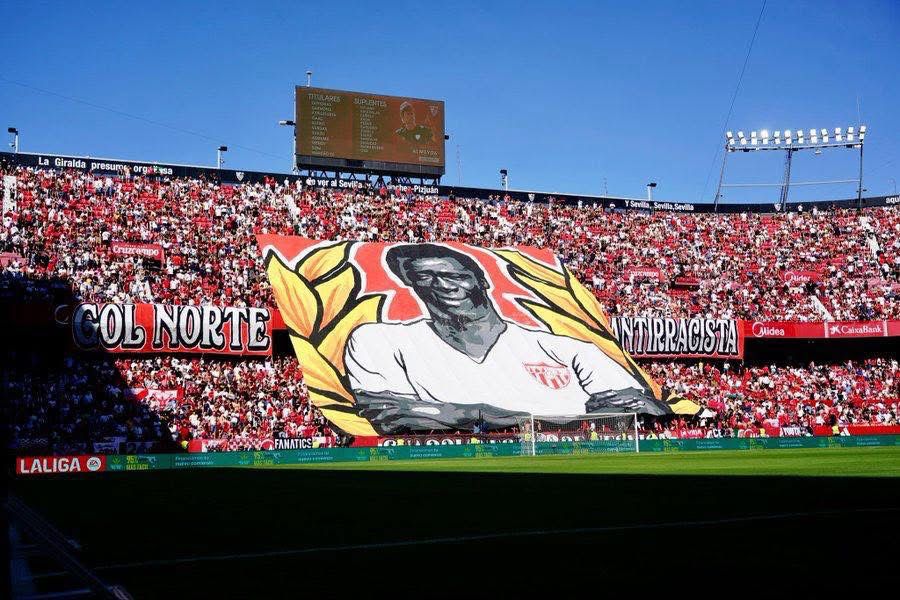
Last weekend, Sevilla FC defeated Barcelona — a huge win by any standard. But amid the jubilation, one sight stood out: a massive flag of a Gambian legend sweeping through the stadium. His name? Biri Biri.
In that moment, thousands in Spain remembered what millions in The Gambia have seemingly forgotten. And that should trouble us.
More Than a Footballer — A Pioneer, A Patriot
Born Alhaji Momodou Njie in 1948 on Perseverance Street in Banjul, Biri Biri’s name became synonymous with Gambian football greatness. Long before footballers like Yankuba Minteh were making headlines in the Premier League, Biri Biri was blazing a trail in Europe — not as a guest, but as a king.
He played for local clubs like Black Star, Arrance, Augustinians, and Wallidan before leaving for trials abroad. In 1970, he was invited to Derby County in England, under famed manager Brian Clough. The deal never materialized — some say it was due to disagreements over a signing fee; others cite institutional racism. But fate had other plans.
He went on to Denmark, then joined Sevilla FC in 1973, becoming one of the first black players in the club’s history. He didn’t just play; he conquered. Over five seasons, he scored 34 goals in over 100 appearances, led Sevilla to promotion into La Liga, and earned the undying love of fans.
The Biris Norte — Sevilla’s most loyal fan section — was named in his honor. Their most famous song carries his name. In 2017, the club awarded him their Gold Badge of Honor.
Yet here at home? Few murals. Fewer tributes. And almost no national honors beyond lip service.
A Selfless Gambian Patriot
Biri Biri wore the Gambian jersey for over two decades — and in more than one position. Defender, midfielder, striker — even goalkeeper. Whatever the nation needed, he became. He is said to be the only player in Gambian history to have played in every position for the national team.
When the government couldn’t afford tickets, jerseys, or boots, he paid out of pocket. When club commitments conflicted with national games, he took red cards intentionally — just to be available for The Gambia.
Who does that?
We love to say “patriotism is dying.” But Biri lived it — and we barely said thank you.
Why Is He Not Celebrated Here?
How can a player honored in Spain with banners, chants, and medals, be buried with whispers back home?
Is it because he didn’t pander to political elites? Is it because his glory came abroad and not within? Or is it something darker — jealousy, envy, the pettiness that plagues small societies when one of their own becomes larger than life?
The same question echoed last week as we reflected on Gambian soldiers abandoned after serving in Liberia. Forgotten heroes. Unmarked graves. No pensions. No parades.
Biri Biri is no different. He died in 2020 in Dakar. Sevilla mourned. The Gambia… blinked.
It’s Not Too Late
We owe Biri Biri more than empty praise. We owe him:
• A statue in Banjul or at Independence Stadium.
• His name on a stadium stand or football complex.
• A national sports day in his honor.
• Inclusion in school curricula as a symbol of excellence, sacrifice, and African pride.
• Oral history projects to preserve the stories of his peers before they vanish.
And perhaps most importantly: we owe him a conversation. About why we let our heroes die uncelebrated. About why we export greatness but import mediocrity.
From Biri to Minteh
Today, Yankuba Minteh dazzles in the English Premier League. But there would be no Minteh without Biri. He broke the mold. He proved that a Gambian could walk onto European soil and make it his own.
Our children should know that. Our schools should teach that. Our country should honor that.
Conclusion: Let the Dialogue Begin
Let this be more than an article. Let it be a mirror. For every ministry of youth and sports, for every school, for every football fan, for every Gambian who chants foreign names louder than they speak their own.
If Sevilla can raise a banner, surely Banjul can raise a voice.
Biri Biri sang with his feet. Now we must sing his name.