
In a significant contribution to global public health education and practice, Dr. Amadou Barrow, a Gambian-born epidemiologist based in the United States, has developed and released FlexEpiCalc Pro. This comprehensive, free, web-based epidemiological calculator makes essential data analysis accessible to professionals and students everywhere.
Dr. Barrow, a PhD candidate in the Department of Epidemiology at the University of Florida College of Public Health and Health Professions, announced the launch of FlexEpiCalc Pro via social media. The tool, hosted at https://flexepicalc.netlify.app/, serves as an all-in-one toolkit for epidemiological computations, eliminating the need for expensive software or complex coding.
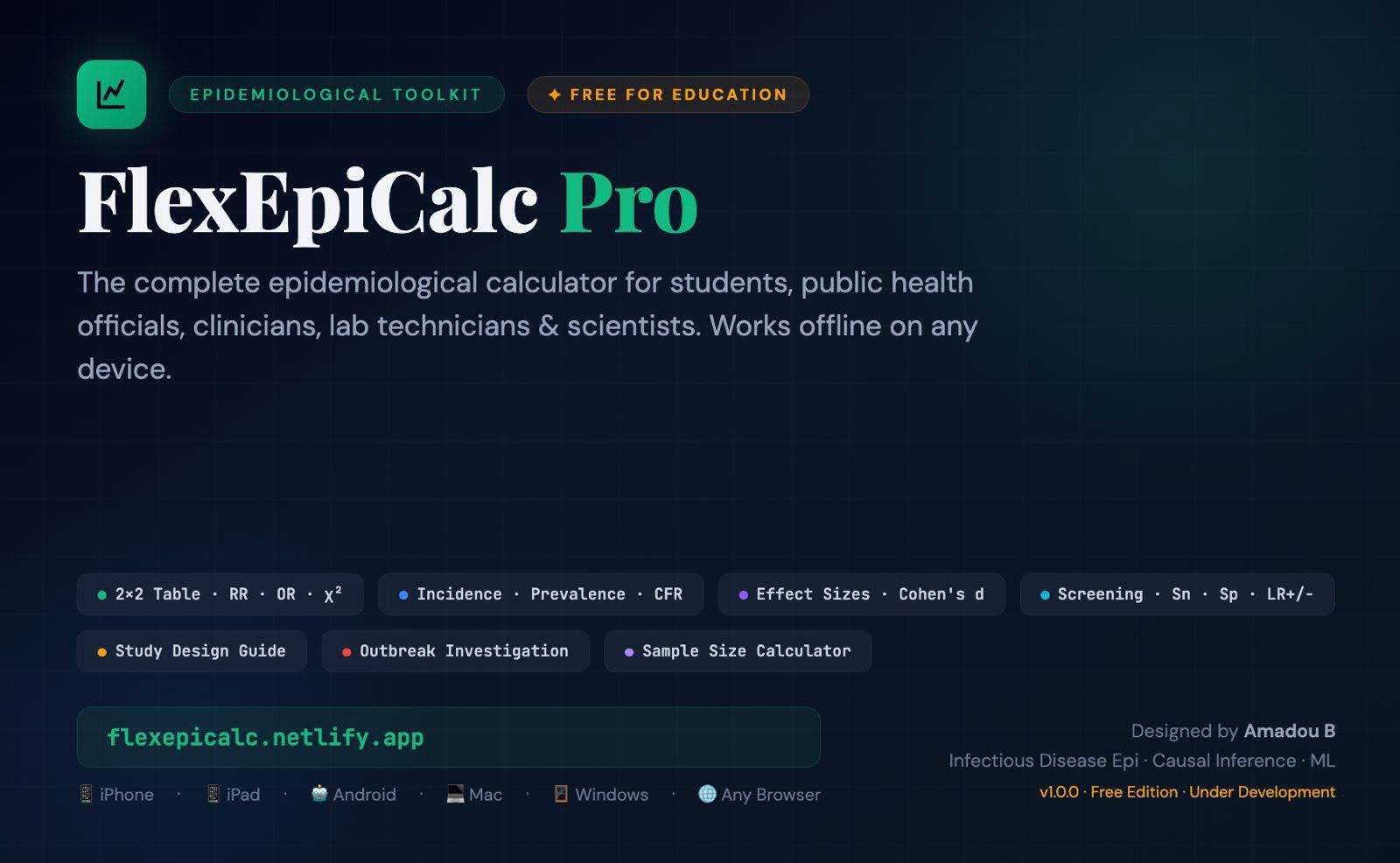
FlexEpiCalc Pro includes a wide array of features tailored to real-world public health needs. Users can instantly generate results from 2×2 contingency tables, calculating risk ratios (RR), odds ratios (OR), risk differences, number needed to treat/harm (NNT/NNH), attributable risks, chi-square tests, p-values, and 95% confidence intervals—complete with plain-language interpretations. Additional modules cover disease frequency measures, including incidence rates, prevalence, attack rates, case fatality rates (CFR), and maternal mortality ratios (MMR).
The platform also supports effect size calculations for cohort and case-control studies, as well as diagnostic test evaluations, including sensitivity, specificity, positive/negative predictive values (PPV/NPV), likelihood ratios, Youden’s Index, and accuracy metrics. An interactive reference guide explains major study designs—Cohort, Case-Control, Cross-Sectional, Ecological, Randomized Controlled Trials (RCTs), and surveillance—with their strengths, limitations, biases, and evidence levels.
The outbreak investigation tools feature food-specific attack rate tables that flag potential sources, and an epidemic curve builder to distinguish point-source from propagated outbreaks. A sample size calculator helps plan studies for proportions or two-group comparisons, accounting for confidence levels and power.
What sets FlexEpiCalc Pro apart is its user-friendly design and offline capability. The progressive web app works on any device—smartphones, tablets, or computers—and can be installed for offline use, ideal for fieldwork in remote areas or low-connectivity settings like clinics and classrooms.
Dr. Barrow, who specializes in infectious disease epidemiology, causal inference, and machine learning, created the tool for educational purposes to support learning and practical application. As an early-career researcher with roots in The Gambia and advanced training in the US—including multiple master’s degrees (MPH, MSc, MSPH)—he draws from his experiences in global health, maternal and child health, and HIV research in resource-limited settings.
Version 1.0.0 is now live, with ongoing development planned based on user feedback. Dr. Barrow encourages epidemiologists, public health officers, clinicians, students, lab scientists, and surveillance workers to try the tool and share it widely.
“This free resource puts powerful epidemiological methods in everyone’s pocket,” Barrow said in his announcement, emphasizing open science and equitable access to tools that advance public health worldwide.