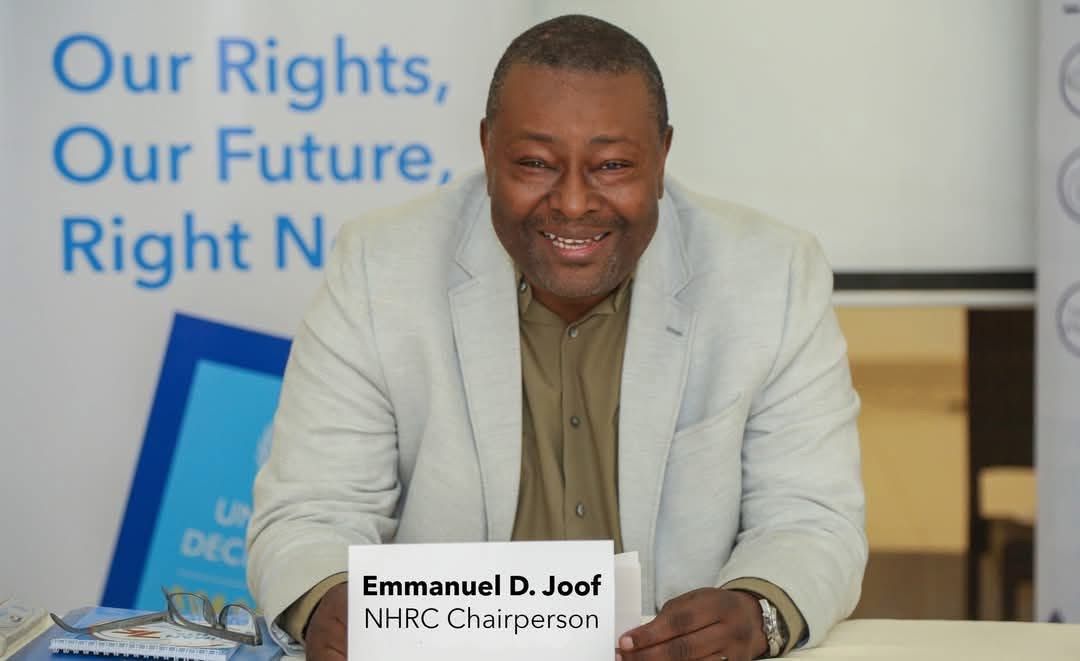
The Chairperson of the National Human Rights Commission (NHRC), Emmanuel Daniel Joof, has issued a robust response to allegations made by the Gambia Press Union (GPU) in a public statement on May 8, 2025. The GPU claimed that Joof, alongside Bai Emile Touray, Executive Secretary of the Media Council of The Gambia, and Babucarr Cham, Chairperson of the Media Council’s Governing Council, attempted to pressure journalist Mustapha K. Darboe to exonerate former Minister of Justice Abubacarr Tambadou.
The allegations stem from a story published by The Republican on April 30, 2025, and a subsequent meeting held at the NHRC premises on May 6.
Joof, in a detailed statement, described the GPU’s claims as “unfounded, misleading, and malicious,” asserting that they misrepresent the purpose and proceedings of the meeting. He emphasized that his response was necessary to set the record straight, despite his usual practice of maintaining confidentiality in mediation efforts, a cornerstone of the NHRC’s dispute resolution mandate.
The controversy began when Tambadou contacted Joof on May 5, expressing dissatisfaction with The Republic’s article, which he felt did not fairly reflect his responses to Darboe’s questions. Tambadou noted that he had provided comprehensive answers within five days, only for the article to be published the same day, suggesting his input was disregarded. While some advised legal action, Tambadou preferred an amicable resolution and requested a meeting involving Darboe, the Media Council, and the NHRC.
Joof agreed to attend the meeting as the NHRC’s representative, given the unavailability of Commissioners Drammeh and Imam Baba Leigh, who typically oversee mediation. He underscored the NHRC’s established role in alternative dispute resolution, citing past examples such as facilitating dialogue during the 2020 “Three Years Jotna” protests, which led to the reopening of two FM stations, and mediating between *The Voice Newspaper* and the Office of the President in 2024.
Darboe voluntarily attended the May 6 meeting, convened by Touray at the NHRC. Joof categorically denied GPU allegations that Darboe was intimidated or pressured to retract his article or co-sign a statement clearing Tambadou. Instead, Tambadou, through Touray, expressed concern that the article created a misperception of corruption, a view Darboe countered by noting he had published Tambadou’s rejoinder and bore no malice. Darboe stated he would consult his editorial team before responding formally.
Joof refuted specific GPU claims, including allegations that the NHRC endorsed rumors of Darboe being paid or suggested the article’s timing was problematic due to Tambadou’s International Court of Justice nomination. He clarified that these were Tambadou’s personal concerns, not NHRC positions, and no proposal for a joint statement was made.
The NHRC Chairperson criticized the GPU for failing to verify the allegations with him, Touray, or Cham before publishing, calling the approach “unprofessional and defamatory.” He argued that the GPU’s statement violated the journalistic standards it claims to uphold, contributing to confusion rather than fostering dialogue.
Joof reaffirmed the NHRC’s commitment to justice, fairness, and freedom of expression, emphasizing its impartial role in mediating disputes. He described the GPU’s portrayal of the NHRC’s actions as “incorrect, unjustified, and damaging” to the Commission’s reputation and the individuals involved.