By Fatou Dahaba
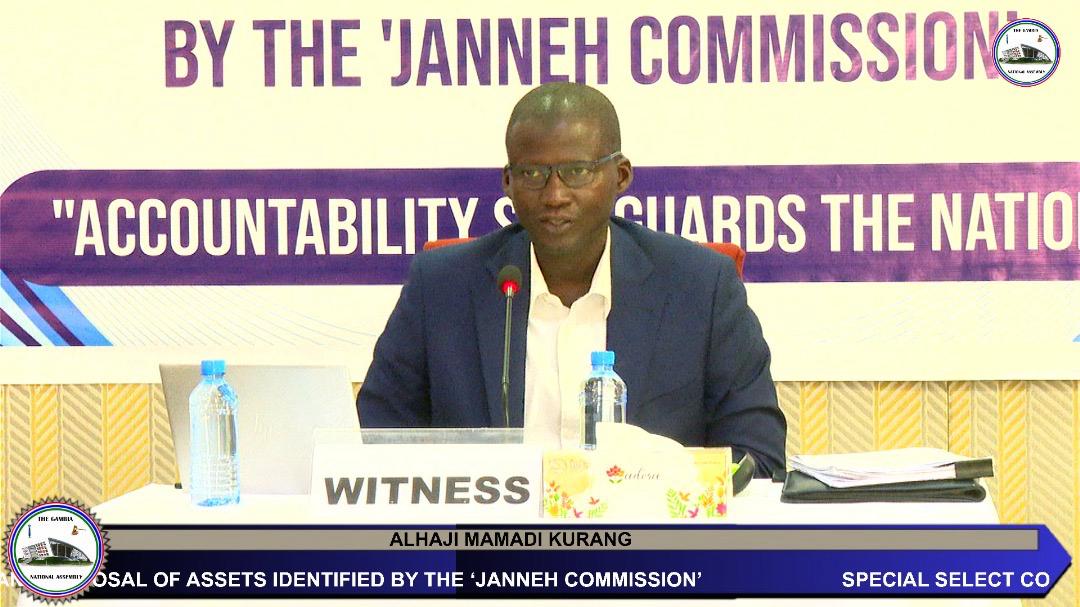
In a revealing testimony before the National Assembly on Thursday, Alagie Mamadi Kurang, the former Secretary of the Janneh Commission, confirmed his involvement in the sale of 43 tractors, shedding light on a controversial chapter of asset recovery linked to the former regime. Kurang’s testimony provided a detailed account of how the tractors originally impounded by the commission were distributed, with some allocated to communities and others sold to individuals.
The Janneh Commission, established to investigate financial dealings and asset mismanagement under the previous regime, had seized numerous assets, including a fleet of tractors. According to Kurang, approximately 90% of these tractors had already been distributed to individuals or communities by the former regime before the commission’s intervention. Some recipients provided receipts proving they had legally purchased the tractors from KGI, a company affiliated with former President Yahya Jammeh.
“When the tractors were brought to the secretariat, I would make notes and forward them to the counsel to advise the commission on whether there was sufficient evidence to release the tractor back to the rightful owner,” Kurang explained. He emphasized that the commission’s role was to verify ownership claims and decide whether to return the tractors or retain them for further action.
Kurang revealed that not all tractors were sold. Some commissioners recommended distributing certain tractors to communities to serve public interests, while others were sold, including transactions facilitated by KGI before the commission’s establishment. The tractors were initially impounded and stored at various police stations across the country, with the Vehicle Control Department maintaining records of the seizures. These records were later supplied to the commission through the lead counsel, who coordinated directly with the Vehicle Control Department.
“I remember seeing records of tractors at the commission, but I cannot recall the exact number,” Kurang stated. He noted that the commission conducted site visits to verify the locations of the impounded tractors. “The commission went on several site visits, and most of the places where the tractors were parked were seen by the commission,” he added.
Among the locations visited were the Kanifing Municipal Council and the West Coast Region, where tractors were found. The Vehicles Control Unit at the State House was tasked with identifying, locating, and seizing the tractors before parking them at designated sites.
Addressing the valuation process, Kurang disclosed that a Mr. Njie, a former Managing Director of the Maintenance Service Department at the Kotu Workshop, was responsible for valuing the tractors. Njie had been involved in the arrival and assembly of the tractors, making him a key witness in the commission’s proceedings. However, questions arose about whether a proper procurement process was followed to appoint Njie as the valuer or if other individuals were considered for the role. Kurang clarified that at the time of the valuation, Njie was no longer the head of the maintenance service and had been recommended to the commission through the office of the lead counsel.
The testimony raised concerns about the transparency and rigor of the valuation process, with Kurang admitting that no formal procurement process was undertaken to select the valuer. “The recommendation came through the lead counsel’s office,” he reiterated, leaving some assembly members questioning whether alternative candidates were evaluated for their competence in valuing the tractors.
The sale and distribution of the 43 tractors have been a point of contention, as they represent a fraction of the assets the Janneh Commission was tasked with recovering. Kurang’s testimony underscored the complexities of handling assets that had been partially distributed before the commission’s work began. The involvement of KGI, a company tied to the former regime, further complicated the process, as some tractors were sold to individuals who could prove legitimate ownership.
As the National Assembly continues to probe the findings and operations of the Janneh Commission, Kurang’s testimony highlights the challenges of asset recovery in a post-regime transition. The commission’s efforts to balance restitution to rightful owners with equitable distribution to communities reflect the broader difficulties of addressing financial mismanagement while ensuring fairness.
The hearing concluded with assembly members pressing for further details on the valuation process and the ultimate beneficiaries of the tractor sales. Kurang’s testimony, while clarifying some aspects of the commission’s work, leaves open questions about the mechanisms used to ensure accountability. As the inquiry progresses, the public awaits further revelations about how assets tied to the former regime were managed and whether justice was served in their recovery and redistribution.