
By Ebrima Mbaye and Alieu Ceesay
Nineteen protesters were arrested on Friday outside the headquarters of the Public Utilities Regulatory Authority (PURA) in Banjul, following a peaceful demonstration against the regulator’s controversial decision to enforce a minimum data tariff of D50 per 1GB. The arrests, made on charges of unlawful assembly, have sparked outrage among civil society groups, who accuse PURA of prioritizing corporate interests over the needs of ordinary Gambians.
The protest was spearheaded by a coalition of civil society organizations, including the Edward Francis Small Centre for Rights and Justice (EFSCRJ), Gambians Against Looted Assets (GALA), and Team Gom Sa Bopa. The coalition condemned PURA’s new policy as “anti-competitive” and a direct assault on affordable internet access, a critical lifeline for education, employment, and civic engagement in Gambia. The D50 per GB minimum tariff marks a staggering 243% increase from promotional data bundles previously offered by GSM operators at rates as low as D13.33 per GB.

“PURA’s decision is a betrayal of the Gambian people,” said Yusef Taylor, spokesperson for Team Gom Sa Bopa, moments before his arrest. “This price floor protects telecom profits while pricing out low-income citizens, stifling digital innovation, and restricting access to education and jobs.”
The coalition had planned to deliver a petition to PURA’s headquarters, outlining their demands for the immediate suspension of the price floor, full transparency on the cost model and benchmarks used to justify the policy, and the implementation of a price ceiling to protect consumers.
They also called for tangible improvements in internet service quality to accompany any pricing adjustments. However, riot police intervened before the petition could be formally submitted, dispersing the crowd and detaining protesters.
Among those arrested were prominent activists, including Taylor, Ali “Killa Ace” Cham, Abdoulie T. Bah, and Fallou Gallas Ceesay of GALA. The 19 detainees were initially taken to Kairaba Police Station but later distributed across four stations—Kairaba, Kanifing, Kotu, and Bakoteh—complicating observers’ efforts to confirm the complete list of arrestees. Witnesses described the arrests as chaotic, with police detaining individuals seemingly at random.
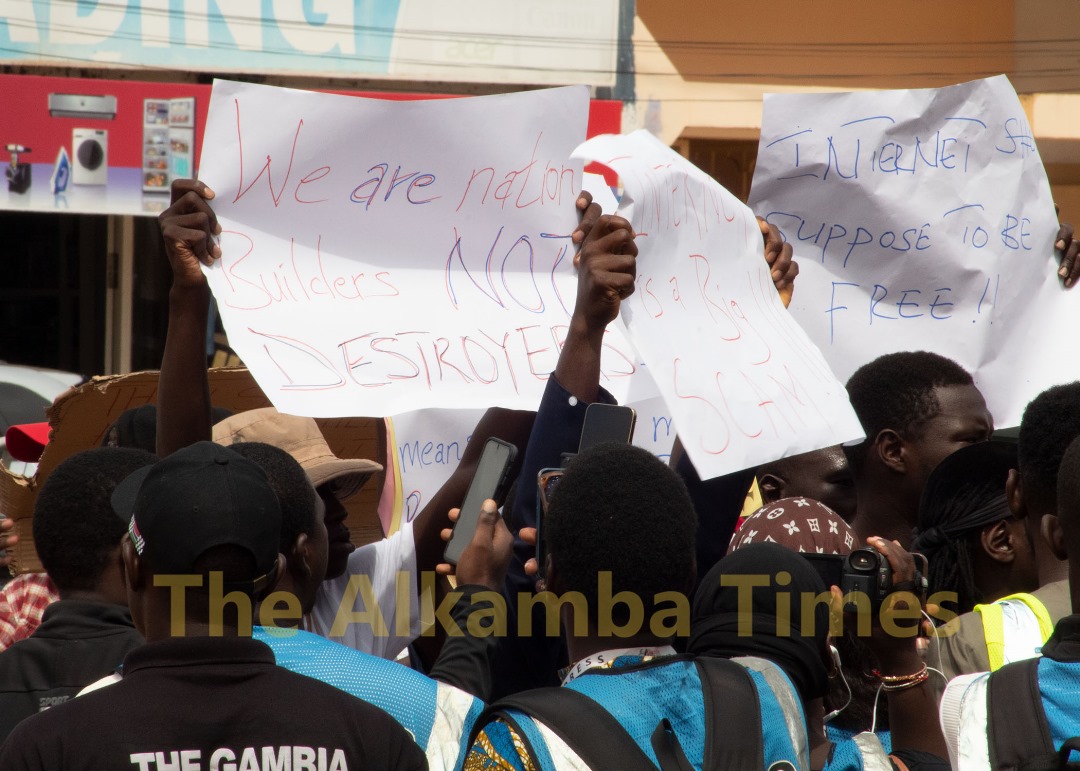
“This was a peaceful protest, and the heavy-handed response from the police is unacceptable,” said Madi Madi Jobarteh, Executive Director EFSCRJ and a prominent human rights activist. “The right to protest is enshrined in our constitution, and PURA must answer for this policy that punishes the most vulnerable.”
The coalition’s petition emphasized that PURA’s mandate, under Section 13 of the PURA Act, is to protect consumers and enforce service standards, not to shield telecom companies from competition. They pointed to the Gambia Competition and Consumer Protection Commission (GCCPC), which has publicly opposed the price floor, arguing that recent tariff competition had benefited small businesses and low-income households. The GCCPC’s stance has bolstered the coalition’s case, with many protesters echoing the commission’s call for policies that prioritize affordability and accessibility.
“The price floor is a regressive step that burdens ordinary Gambians,” the coalition said in a joint statement. “If PURA were truly committed to the public interest, it would impose a price ceiling and demand better service quality, not raise costs to protect GSM operators.”
The sharp increase in data prices has struck a nerve in Gambia, where internet access is a vital tool for education, entrepreneurship, and civic participation, particularly among youth. Many rely on affordable data for online learning, remote work, and staying informed in a rapidly digitizing world. Critics argue that the price hike risks exacerbating inequality, particularly for low-income households already struggling with economic pressures.
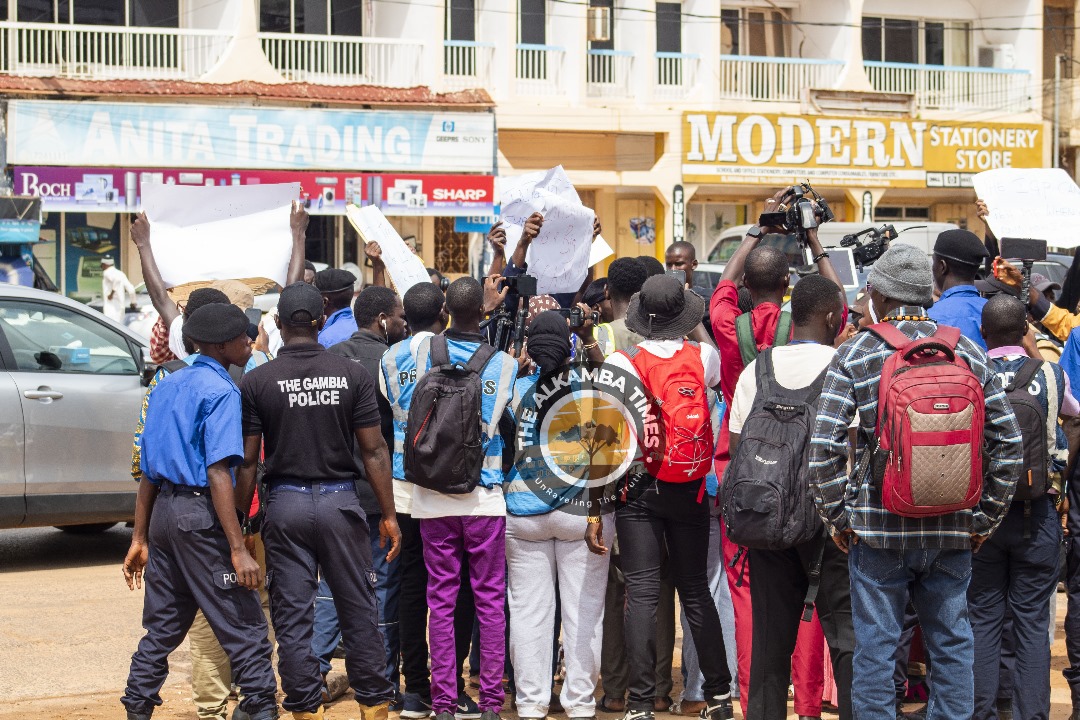
“This isn’t just about data; it’s about access to opportunity,” said Fatou Jagne, a university student who attended the protest. “How can we compete in a global economy when the cost of being online is out of reach for so many?”
The coalition has issued an ultimatum to PURA, demanding the suspension of the price floor by the close of business on Wednesday, August 27, 2025. They have vowed to escalate their campaign if their demands are not met, hinting at further protests and potential legal action.
As news of the arrests spread, civil society groups and concerned citizens took to social media to demand the immediate release of the detainees. Hashtags like #DataForAll and #FreeThe19 trended online, with many condemning PURA’s policy and the police’s response. “This is a fight for our future,” one user posted. “We won’t be silenced.”
The situation remains tense as authorities have yet to comment on the arrests or the status of the detainees. TAT Correspondents covering the protest are monitoring developments at the four police stations, and civil society groups have pledged to provide legal support to those detained. The coalition has also called for solidarity from the public, urging Gambians to join their campaign for affordable internet access.

As the deadline approaches, all eyes are on PURA to see whether it will heed the coalition’s demands or double down on its controversial policy. For now, the arrests have only galvanized the movement, with activists vowing to continue their fight for digital equity in Gambia.