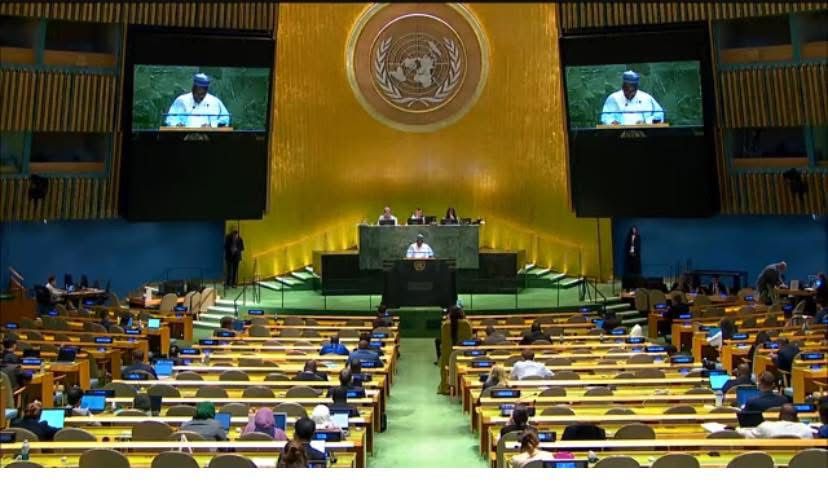
In an address to the 80th Session of the United Nations General Assembly currently underway in New York, United States, His Excellency Mr. Mohammed B. S. Jallow, Vice President of The Gambia, delivered a statement on behalf of President Adama Barrow, urging world leaders to recommit to the principles of the UN Charter and address pressing global challenges through multilateral cooperation.
Speaking at a pivotal moment for international peace and security, Jallow emphasized The Gambia’s dedication to democracy, human rights, and sustainable development while calling for urgent reforms to the UN system and greater support for conflict prevention, climate action, and global equity.
Jallow began by congratulating Her Excellency Annalena Baerbock, President of the 80th Session, on her election, pledging The Gambia’s full support. He also thanked Philemon Yang, President of the 79th Session, for his leadership. Highlighting the Session’s theme, “Better Together: 80 years and more for peace, development and human rights,” Jallow underscored the UN’s role as the cornerstone of multilateralism and its responsibility to uphold human rights, peace, and security worldwide.
The Vice President noted the historic significance of The Gambia’s election as Chair of the UN’s 2nd Committee, a milestone reflecting the nation’s commitment to shaping a stable and prosperous global order. “This session holds profound symbolism of progress for The Gambia,” Jallow said, emphasizing the country’s resolve to collaborate with Member States to tackle global challenges.
Jallow painted a sobering picture of the current global landscape, citing ongoing wars, geopolitical fragmentation, and a weakening rules-based international order. He called for renewed solidarity to address these crises, warning that the international community is “desperately in search of answers” to multiple predicaments. He highlighted the UN’s past successes, particularly in supporting The Gambia’s democratic transition in 2017 through the Peacebuilding Commission, which helped uphold the will of the Gambian people and initiate a transitional justice system.
Domestically, Jallow outlined The Gambia’s progress under President Barrow’s leadership since 2017, including credible elections, legislative reforms, and the establishment of the Special Prosecutor’s Office Act 2024, aimed at addressing international crimes. The recently enacted Anti-Corruption Act and the operationalization of a national budgeting mechanism under the National Development Plan (YIRIWA) 2023-2027 demonstrate The Gambia’s commitment to inclusive governance and sustainable development. “Our goal is to rise above socio-economic challenges through inclusive engagement in democratic governance,” Jallow said, emphasizing the role of women and youth in nation-building.
On the regional stage, he noted that The Gambia has taken a proactive role in promoting peace and governance. Jallow highlighted the country’s recent hosting of the Sahel Governance Forum, which aims to address governance challenges in the Sahel region. As a member of the African Union Peace and Security Council and the UN Human Rights Council, The Gambia continues to advocate for conflict prevention and peacekeeping, urging the UN Security Council to take decisive action to resolve unrest in Africa and beyond.
Jallow addressed several pressing global issues, including the Israeli-Palestinian conflict, where he reiterated The Gambia’s support for a two-state solution and Palestine’s UN membership. “The plight of the Palestinians remains unresolved, with innocent civilians facing shocking difficulties,” he said, calling for an inclusive peace process based on justice and international humanitarian law. He also expressed support for the Moroccan Autonomy Initiative for the Sahara region, commending Morocco’s commitment to a ceasefire and the Morocco-Nigeria Gas Pipeline as a driver of regional stability and development.
The Vice President voiced solidarity with China’s One China Policy and called for the lifting of the economic embargo on Cuba, which he described as causing “undue hardship and economic devastation.” He also emphasized the need for greater inclusion of women in peace and security processes, marking the 25th anniversary of Security Council Resolution 1325. “Women must always participate in discussions on conflict and peace,” Jallow asserted, urging swift action to address barriers to women’s empowerment ahead of the fourth World Conference on Women.
Economic inequality and the global financial architecture were central themes in Jallow’s address. He noted that the current system, particularly debt restructuring mechanisms, hinders developing countries’ ability to invest in social sectors and achieve the Sustainable Development Goals (SDGs). With only 17% of SDG targets on track as the 2030 deadline approaches, Jallow called for enhanced international financial cooperation and a review of the global financial system to support targeted investments and industrialization.
Climate change was another critical focus, with Jallow acknowledging progress at COP29 but stressing the inadequacy of current climate financing. He urged all states to submit ambitious Nationally Determined Contributions (NDCs) ahead of COP30 in Belem, Brazil, to achieve net-zero emissions by 2050. “The threat of climate change continues to aggravate security challenges, especially in the Sahel,” he said, calling for resilience measures to address climate-related risks.
Jallow also advocated for UN Security Council reform, supporting the Common African Position outlined in the Sirte Declaration and Ezulwini Consensus. He described Africa’s under-representation in the Council as a “historical injustice” that undermines its legitimacy. “The time has come for the international community to support Africa’s call for meaningful representation,” he said, commending the AU Committee of Ten Heads of State for leading this effort.
The Vice President concluded by urging Member States to forge a new consensus to strengthen the UN as a “potent instrument” for global aspirations. “This is our only planet. Let us preserve it for posterity,” he said, reaffirming The Gambia’s commitment to making the world a better place for all.