By: Kebba Ansu Manneh
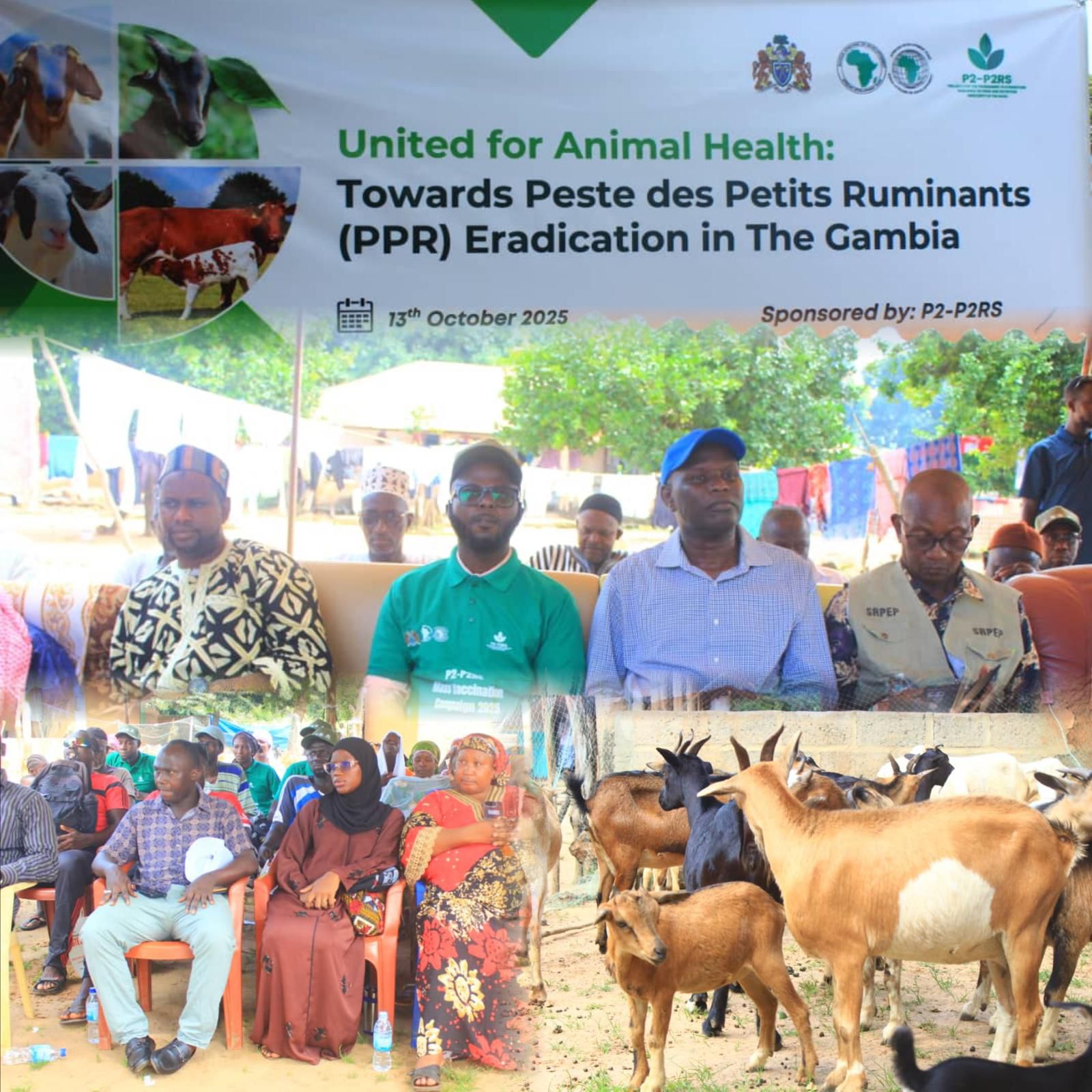
The Ministry of Agriculture, Livestock, and Food Security launched a nationwide small ruminant vaccination campaign in Tumani Tenda village, Kombo East District, West Coast Region. The initiative aims to control and eradicate Peste des Petits Ruminants (PPR) and other livestock diseases that threaten Gambia’s sheep and goat populations and impact household incomes, food security, and economic resilience.
The event, attended by local authorities, the National Livestock Owners Association (NaLOA), Gambia Livestock Marketing Agency (GLMA), West Africa Livestock Innovation Center (WALIC), and the Department of Livestock Services, was funded by Project 2 of the Programme to Strengthen Resilience to Food and Nutrition Insecurity in the Sahel (P2-P2RS) and the Small Ruminant Production Enhancement Project. These partners provided critical resources to support the campaign’s rollout.
Project 2 of the Programme to Strengthen Resilience to Food and Nutrition Insecurity in the Sahel (P2-P2RS)
In a statement delivered by Dr. Abdou Ceesay, Director of Livestock Services, on behalf of Agriculture Minister Dr. Demba Sabally, the campaign was described as a “decisive battle” against PPR, a disease dubbed the “silent thief of livelihoods.” Sabally emphasized that PPR has caused devastating mortality in small ruminants, eroding farmers’ incomes and undermining national food security. “This campaign is not an isolated event but a key step in our National Strategy for the Control and Eradication of PPR by 2030,” he said, highlighting Gambia’s alignment with the African Union’s PPR Elimination Strategy and the Global PPR Eradication Programme led by the FAO and World Organisation for Animal Health (WOAH).
Sabally underscored the collective effort required, praising the financial and logistical support from P2-P2RS and the Small Ruminant Production Enhancement Project. “By protecting our herds, we safeguard Gambian livelihoods and fulfill our role in preventing the cross-border spread of PPR,” he said. He also lauded veterinary officers, livestock health workers, and community animal health workers as the “frontline soldiers” who will vaccinate animals across the country’s challenging terrains.
Addressing farmers directly, Sabally urged them to participate actively, noting that the vaccination is free and vital for protecting their investments. “We know the pain of losing an animal to PPR represents lost school fees, medical bills, or a plate of food. This campaign is for you,” he said.
Dr. Abdou Ceesay, Director General of the Department of Livestock Services, elaborated that the campaign will target all unvaccinated sheep and goats over two months. “Our regional teams are ready to reach every corner of the country,” he said, adding that public sensitization efforts via radio and television have prepared communities for the initiative. Ceesay stressed that PPR, a viral disease with no medicinal cure, can only be prevented through vaccination.
Ansumana Njie, Project Director of P2-P2RS, highlighted the collaboration with the Small Ruminant Production Enhancement Project, which procured the vaccines for this year’s campaign. He noted that P2-P2RS aims to boost livestock production and productivity, supporting extension workers with mobility and logistics. The project has also focused on capacity-building for livestock owners, particularly women and youth, and distributed nearly 100 small ruminants in the Lower River Region, with plans to provide hundreds more across other regions.
Other speakers, including Mamud Njie, Project Coordinator of the Small Ruminant Production Enhancement Project, and Ebrima Jallow, President of NaLOA, expressed optimism about the campaign’s potential to transform the livestock sector. They emphasized the importance of collective action in achieving the ambitious goal of PPR eradication.
As the campaign rolls out, farmers and herders are encouraged to bring their animals for vaccination, a critical step toward securing Gambia’s agricultural future and ensuring economic stability for rural households.