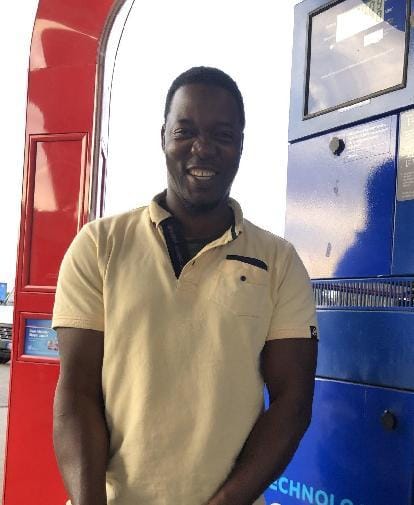
In a heart-wrenching climax to a desperate legal battle, Gambian migrant and refugee advocate Yerro Gaye was forcibly deported to Banjul on Wednesday night, ripped from the arms of his German fiancée aboard a heavily guarded charter flight. The 33-year-old teacher, who had woven a promising life in Germany since fleeing hardship in 2019, landed in his homeland early Thursday, his dreams of marriage and family shattered by what critics decry as cold bureaucratic cruelty and systemic bias.
The saga unfolded with brutal efficiency. Gaye, arrested during a routine immigration check in Haldensleben on September 30, was jailed in Dresden despite invoking EU family reunification laws (§5 with §3a of the FreizügG/EU). He met his fiancée in 2023, and the couple was on the cusp of marriage when authorities denied registry permissions. A torrent of evidence—photos, IDs, love letters—proved their deep bond, bolstered by a petition amassing over 3,500 signatures. High-profile support poured in from Green Party MPs Kassem Taher Saleh and Steffi Lemke, as well as Left Party lawmakers and refugee councils. Yet, on October 13, the Magdeburg Administrative Court rejected his urgent appeal just minutes after a solidarity rally, dismissing his achievements in integration as a teacher and activist.
“Efficiency trumped humanity,” fumed Gaye’s lawyer, Christine Lüth, in a blistering statement. Police yanked him from Dresden at 11 a.m. on October 15. A last-ditch voluntary return bid failed Tuesday; Wednesday’s appeal to Saxony-Anhalt’s Hardship Commission went unanswered—a silent rejection. By 8:30 p.m., Freebird Airlines’ charter flight lifted off from Frankfurt Airport’s Terminal 2, carrying Gaye and just six other deportees under the watch of 30 armed officers.
Outside the terminal, hundreds rallied under “Stop Deportation FFM” and Solidarity Movement (Solimo) banners, chanting “No to family separation!” Security forces swiftly dispersed the crowd. From Banjul, Gaye messaged supporters with defiant resolve: “I left my heart in Germany, but your voices carried me through. This fight for love and justice isn’t over.” In a viral video, his sobbing fiancée vowed, “We’ll battle from afar. Yerro is my future—he will return.”
Outrage erupted nationwide and beyond. Lüth lambasted the “deportation at any cost,” highlighting Gaye’s ironclad EU law protections, elite legal team, political endorsements, and proven integration. “Four rallies, seven press articles, 3,500 signatures—not enough,” she said. She slammed Haldensleben’s “doggedness,” Magdeburg’s “professional mistake”—hinting at ideological bias—and Saxony-Anhalt’s passive Interior Ministry: “Frightening efficiency. Catastrophic for lives behind files.”
The deportation struck just a day after Chancellor Friedrich Merz pledged “repatriations on a very large scale” to cleanse Germany’s “cityscape” of migrants. PRO ASYL, the refugee rights group, is funding a Federal Constitutional Court challenge, demanding Gaye’s immediate return: “He belongs with his fiancée and friends—in the cityscape, where he built his life.”
Gambian voices amplified the fury. Yahya Sonko, founder of the Gambia Refugee Association, called it a “barbaric dignity violation,” accusing Germany of “weaponizing bureaucracy” through EU-Gambia pacts. “No criminal—he’s a teacher, partner, activist fleeing hardship. Back to 40% youth unemployment and returnee trauma? Exile!” Sonko cited UN reports on migrant suicides, urging Gambia to reject such flights and fund aid instead of enabling “complicity.”
Germany-based Gambian human rights activist Kebba Kebbeh echoed the condemnation in an exclusive to The Alkamba Times: “I am outraged and heartbroken by the deportation of my friend Yerro Gaye. This is not just an administrative act—it is a profound injustice, illegal and inhumane. It represents a system that punishes the vulnerable instead of protecting us, valuing rigid policy over basic human decency.”
Kebbeh, who knew Gaye as “a friend, neighbor, comrade,” decried the cruelty: “He built a life here, found belonging, and gave back in countless ways. To tear him away destroys lives, breaks families, silences voices.” He called for reflection on true justice: “We must stand against cruel treatment of migrants and refugees, demanding policies grounded in dignity, fairness, and respect. No one is illegal—every person deserves safety and dignity.”
“I condemn this in the strongest terms,” Kebbeh continued. “We cannot stand by while governments use deportation as a tool of exclusion and fear. Demand an immigration system rooted in empathy, justice, and humanity. I stand in full solidarity with Yerro and all facing deportation. Their lives matter. Their stories matter. Our collective silence must end. ‘No one can silence us.”