By: Alieu Ceesay
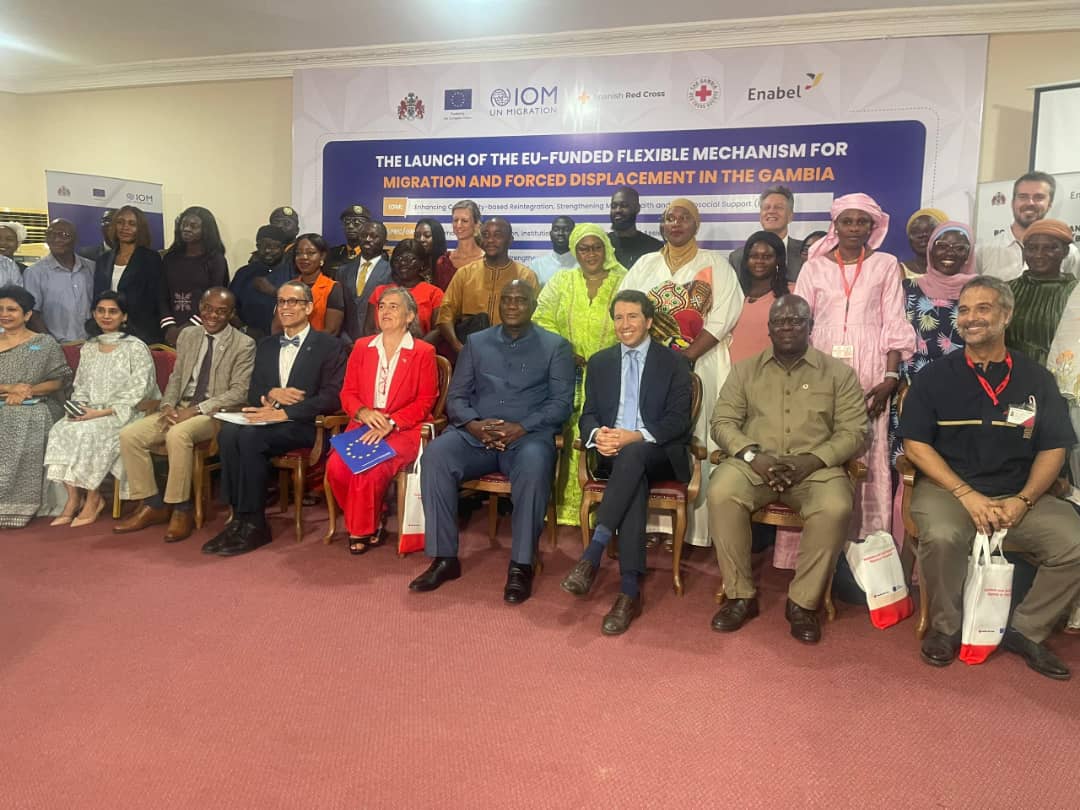
The European Union (EU), United Nations (UN), and key partners officially launched a €3.8 million initiative on Saturday aimed at unlocking job opportunities, strengthening migrant reintegration, and providing essential social support in The Gambia. The program, funded by the EU’s Flexible Mechanism for Migration and Forced Displacement, will be implemented by the International Organisation for Migration (IOM), Enabel, and the Gambia Red Cross Society (GRCS).
This landmark effort comprises three interconnected projects: enhancing the reintegration of returnees, boosting Gambian talents through skills development and entrepreneurship, and delivering assistance and social support to migrants in vulnerable situations. The initiative targets long-term challenges in socio-economic integration, focusing on five priority sectors: entrepreneurship, agribusiness, the green economy, construction, the creative industry, and ICT.
“Unemployment is high, and many jobs remain in the informal sector. Too often, young people may take some more dangerous routes abroad in search of opportunity. Together we can help change that story,” said Mr. Abou EL Mahassine Fassi-Fihri, highlighting the program’s goal to curb irregular migration by creating viable local alternatives.
Over 30,000 migrants are expected to gain access to integrated services, including information and counseling, emergency aid, health and nutrition support, and mental health and psychosocial services. Approximately 340 individuals will benefit directly through skill enhancement, sustainable livelihood building, and community contributions. The Spanish Red Cross will provide technical expertise for the GRCS-led component.
GRCS Secretary General Mr. Ebu Faye Njie emphasized the project’s inclusive approach. “The establishment and reinforcement of safe shelters, referral systems, and coaching mechanisms will ensure that no one is left behind, especially children and those at greatest risk,” he stated. Through dialogue, cultural exchange, and community engagement—through activities such as sports and the arts—the initiative aims to foster unity, understanding, and peaceful coexistence in at least seven communities nationwide. “This holistic approach truly embodies Gambia Red Cross and Red Crescent Movement humanitarian principles of humanity, impartiality, and voluntary service,” Njie added.
The Gambia grapples with complex migration dynamics influencing its political, economic, and social landscape. The government has enacted policy frameworks to improve migration governance across short-, medium-, and long-term goals.
UN Resident Coordinator Carl Frederick Paul praised these efforts. “The United Nations is aware that strengthening the integration of returnees in the Gambia project, to be implemented by IOM, will empower returnees and their communities through community-based reintegration and mental health support, while strengthening institutional capacities for sustainable reintegration,” he said.
The program addresses multifaceted challenges in migration, reintegration, youth employment, and social cohesion, aligning with the UN Sustainable Development Cooperation Framework. “I can assure you that IOM and also the UN’s full commitment to timely, efficient, and effective delivery of results while ensuring that our support reaches the most vulnerable,” Paul affirmed.
EU Ambassador Mrs. Imma Roca I Cortes underscored the shared commitment. “The launching shows the European Union and the Gambia government’s shared commitment to addressing migration in all its dimensions. It has to be done in a way that protects human dignity and creates hope for the future,” she said. “Our collective response must be comprehensive. We have to prevent trafficking and smuggling, prevent irregular migration, manage borders, protect those on the move, promote safe and legal pathways, but also implement international conventions that guarantee a safe return home for those who voluntarily choose to do so or that they have to do so because they are in an irregular situation.”
Gambia’s Foreign Affairs Minister, Serign Modou Njie, reaffirmed the national resolve. “We remain determined to strengthen our governance structures, enhance better systems in place to ensure that migration contributes to national development as well as national cohesion and well-being for every Gambian,” he stated during the opening session.
This collaborative initiative signals a proactive step toward transforming migration challenges into opportunities for growth and inclusion in The Gambia.