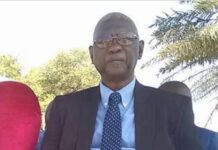
Tribute by: Ba Tambadou, Former Attorney General and Minister of Justice
Yesterday morning, on 23 December 2025, I woke up to the sad news that lawyer Alhaji Ousman Sillah was no more. Just over a year ago in August 2024, I wrote a tribute to Lady Justice Mam Yassin Sey, a legal warrior of immense courage and integrity. I recounted my personal interactions with her and the lessons learned from those experiences. I told about the April 2000 students case at the high court and how she fearlessly upheld the law and the rights of the students. The story that I told about Lady Justice Mam Yassin Sey was only a part of the story about the April 2000 students case. Another part of that story was about Lawyer Ousman Sillah, another fearless man of the law whose contributions to the development of the legal profession in the country cannot be overstated. It was Mr Ousman Sillah who led the Coalition of Lawyers for Defence of Human Rights to file a lawsuit in the high court against the State in the case of the April 2000 students. However, Mr Ousman Sillah’s story of courage and fearlessness cannot be told or understood without the broader context of events at the time.
The decade between 1990 and the year 2000 saw a seismic shift in the generation of lawyers in the country. The old order was beginning to give way to a new era of lawyers. In the early 1990s, a few years before the July 1994 military takeover by Yaya Jammeh and the AFPRC, the Gambian Bar Association had begun to undergo a generational transformation with an increasing number of young lawyers appearing in the ranks. Young lawyers like my brother Sheriff M. Tambadou, Mary Samba, Justice Omar Njie, Modou Sosseh and a few others were among those called to the Gambian Bar at the time. They had joined a profession that was one of the oldest in the world and which was based on the shared values of pride, respect and hierarchy. By the late 1990s and early 2000s, an even larger group of younger lawyers had become part of the Association. This included young lawyers like Alhaji Marong, Howson Janneh, Essa Faal, Edrissa Sisohor, Sheikh Tijan Hydara, Bory Touray, Almamy Taal, Lamin Jabbi, Justice Naceesay Sallah and myself. We were all young, excited and energetic but had joined a profession that was extremely conservative and dominated by an older group of lawyers who were more interested in maintaining the status quo. As young lawyers, we were brimming with fresh ideas and were eager to make an impact. We wanted our young voices to be heard in shaping the future direction of the Bar and the legal profession in the country in general but felt increasingly frustrated by the old guard who resisted any radical change to the profession. They probably saw the younger generation of lawyers not as threats to their careers but rather as revolutionaries in a conservative profession that had no room for revolutionary ideas; whereas the younger lawyers, coming fresh out of more modern law schools around the world, were more eager for reform and wanted to see new methods and practices introduced into the profession at a faster pace.
This simmering intellectual tension between the older generation of lawyers and the younger ones came to a head around 1999/2000 with the elections for a new executive of the Gambia Bar Association. The older generation of lawyers presented Mr Ousman Sillah as their candidate for president of the Bar with support from others like Mr Ousainou Darboe, the late Pap Cheyassin Secka, Mr Antouman Gaye. The younger generation presented Mr Joseph Joof as their candidate with support from others like the late Bola Carrol, Omar Njie, and myself. It was a bitterly contested election campaign with both sides sensing it as an opportunity to shape the future direction of the Association and the profession. With an increased membership of younger lawyers, Mr Joseph Joof was duly elected President and Bola Carrol as his vice president. I was elected as Social Secretary in Mr Joof’s new executive. It was an extraordinary moment for the Gambia Bar Association and we could sense that this was the beginning of a new era for the legal profession in the country.
However, soon after the election dust settled, a national tragic event was to occur which immediately altered the newly formed alliances and created new divisions. The 10 and 11 April 2000 students demonstration was going to provide the first test for the newly elected leaders of the Bar Association. In the immediate aftermath of the April 2000 student killings, some of us in the newly elected executive of the Bar Association felt obliged to act in some form. We felt strongly about the killing of unarmed student protesters and wanted to raise our voices in condemnation of this dastardly act by a callous government. Some of our colleagues in the newly elected executive preferred to stay silent in the face of such unprovoked, despicable acts of violence against innocent school children. Despite my personal relentless efforts to mobilise support for a public statement of condemnation of the killings as a start, the Bar Association remained silent.
On the other hand, and by sheer twist of fate, my chance encounter with late journalist Pa Nderry M’bai (Freedom newspaper) was to lead to a sequence of events that would ultimately change the course of events in the Bar. On the day after the April 2000 killing of the student protesters, and on my way back to my office from the high court, I gave Pa nderry mbai, who at the time was the court reporter for the Daily Observer newspaper, a ride in my car into Banjul. In our little casual chit chat about the events of the previous day and the general security situation in the country, I told him that something had to be done about it and that I was contemplating challenging in court the unlawful detention of the hundreds of students across the country. That casual conversation with Pa Nderry M’bai in my car on that day taught me one important lesson in my professional life, ie, never trust a journalist with any information. The next day’s Daily Observer back page carried a headline in bold stating that I was going to challenge the detention of the students. I was shocked when the publication was brought to my attention that morning because it wasn’t meant to be reported to the public and I wasn’t even sure at that time when I would do so. I thought that Pa Nderry M’bai had betrayed my confidence and put me in unnecessary danger. This was a very tense situation around the country at the time. The country was in shock over the killing of unarmed school children in broad daylight and the detention of many more. The government had reacted in such a callous manner because it believed that it was under threat and was therefore determined to crush the threat by any means. The events were unprecedented in The Gambia’s recent history. No one knew what was going to happen next and Pa nderry mbai had now plunged me in the center of this tense situation through his publication of my intentions.
However, this unexpected newspaper publication was to give rise to one of the most defining moments of civil society activism in the country at the time. When I went to the high court on the day of the newspaper publication, I ran into lawyer Mariam Denton (who became Speaker of the National Assembly following the change in 2016) in the premises of the high court complex in Banjul. She told me that she had seen the Daily Observer publication about my plans for the detained students and that she and Mr Ousman Sillah had also discussed similar ideas. She then suggested that perhaps we should come together to coordinate our efforts and that she would further discuss with Mr Ousman Sillah. I agreed. My discussions with lawyer Mariam Denton was to give birth to the creation of the Coalition of Lawyers for Defence of Human Rights under the leadership of lawyer Ousman Sillah. With the official Bar Association reluctant to publicly condemn the broad daylight killing of the unarmed students, I resigned from my position as Social Secretary of the Gambia Bar Association and became the de facto Coordinator of the newly formed Coalition of Lawyers for Defence of Human Rights. In fact, I was the one who created this name for this group of like-minded lawyers. This incident taught me another valuable lesson in my professional career. I learned that commitment to justice and the rule of law was not a matter of generational “ownership” but of personal conviction. I realised at that point that when it mattered most to the people of this country, that when the voice of the people needed to be heard, that when the people looked to our profession for leadership and hope in matters of justice, it was not the younger generation of lawyers now leading the Bar Association who rose to the challenge. It was the older generation who stood up and led from the front. I knew then that I had more in common with the older generation of lawyers than the group of younger lawyers now leading the Bar Association. From that moment on, Mr Sillah while not the elected President of the Gambia Bar Association, had taken over the moral leadership of the Bar. To me, he deserved and had earned my personal respect and commanded greater authority and legitimacy than any other elected leader of the Bar at the time. At a time when many simply looked the other way, Mr Sillah was not afraid or intimidated. He knew that there was something more important than fear, and it was to save our country from tyranny and the state of lawlessness that was being unleashed on the people by their government.
With other lawyers like Ms Amie Bensouda (former Lead Counsel to the Janneh Commission), Ms Awa Sisay Sabally (former Vice Chair of the Constitutional Review Commission), and Mr Emmanuel D. Joof (current Chairman of the National Human Rights Commission), we decided to challenge the illegal detention of hundreds of students across the country. We had no instructions from the students or their families. We were acting pro bono based on our collective conscience and sentiments about the tragic events in the country at the time. With Mr Ousman Sillah in the lead, we were fearless. He was a lawyer of formidable intellect and had great persuasive ability. His eloquence and understanding of the law was as impressive as his command of the English language. But above all, he was a brave and courageous lawyer and leader who was willing to put his life at risk for the public good at a moment of great danger in the country. Under his leadership, we filed the case at the high court seeking declarations about the illegal detention of the students and requested for their immediate release. The stakes couldn’t have been higher. The case was set for hearing and all the lawyers of the Coalition were present in court on that day. There were about ten of us. The courtroom was packed full with families of the students and the press. As a young lawyer at the time, I couldn’t have been prouder of my association with such a distinguished team of altruistic lawyers so committed to justice and the rule of law under Mr Sillah’s leadership. He made his submissions before the late Justice Mam Yassin Sey with all the persuasive skills that any lawyer in his position would have needed. It was not a surprise that the judge agreed with him and granted all the reliefs we sought. The court declared that the detention of the students violated their constitutional rights and ordered for their immediate release from custody. However, the court’s decision was not the end for us. For Mr Sillah and the rest of us in this group of lawyers, we were not only concerned about the legality of the government’s actions against the students. We were also concerned about the general welfare of the students. Soon after the court hearing, we organised a visit to the then RVH hospital to check on the students who were admitted and receiving treatment for their gunshot wounds. We had managed to put some money together to buy them essential items.
It was a simple humanitarian gesture with no press coverage or publicity surrounding the visit. Again, Mr Ousman Sillah led the way. He was simply exceptional. His passing therefore marks the closure of yet another important chapter in the history of the legal profession in the country. As part of the old order who carried themselves and their noble profession with respect, pride, dignity, integrity and honour, I was lucky to have had the opportunity to watch and learn from distinguished senior lawyers like him at the time. It was simply a joy to watch him and his generation in court in those days.
Mr Sillah’s courage and bravery would ultimately make him a target of an assassination attempt by the government of Yaya Jammeh. He was lucky to survive the gunshots to his head which left him partially disabled and effectively put an end to an illustrious legal career. His only crime was his strong conviction and belief in the rule of law and justice. He led by example and was a true ambassador of the law. He was greatly missed in the courts and perhaps one of the greatest injustices for the younger members of the Bar was that they were unjustifiably denied the opportunity to watch and learn from a distinguished senior lawyer like him.
May Allah grant him Al Jannah!