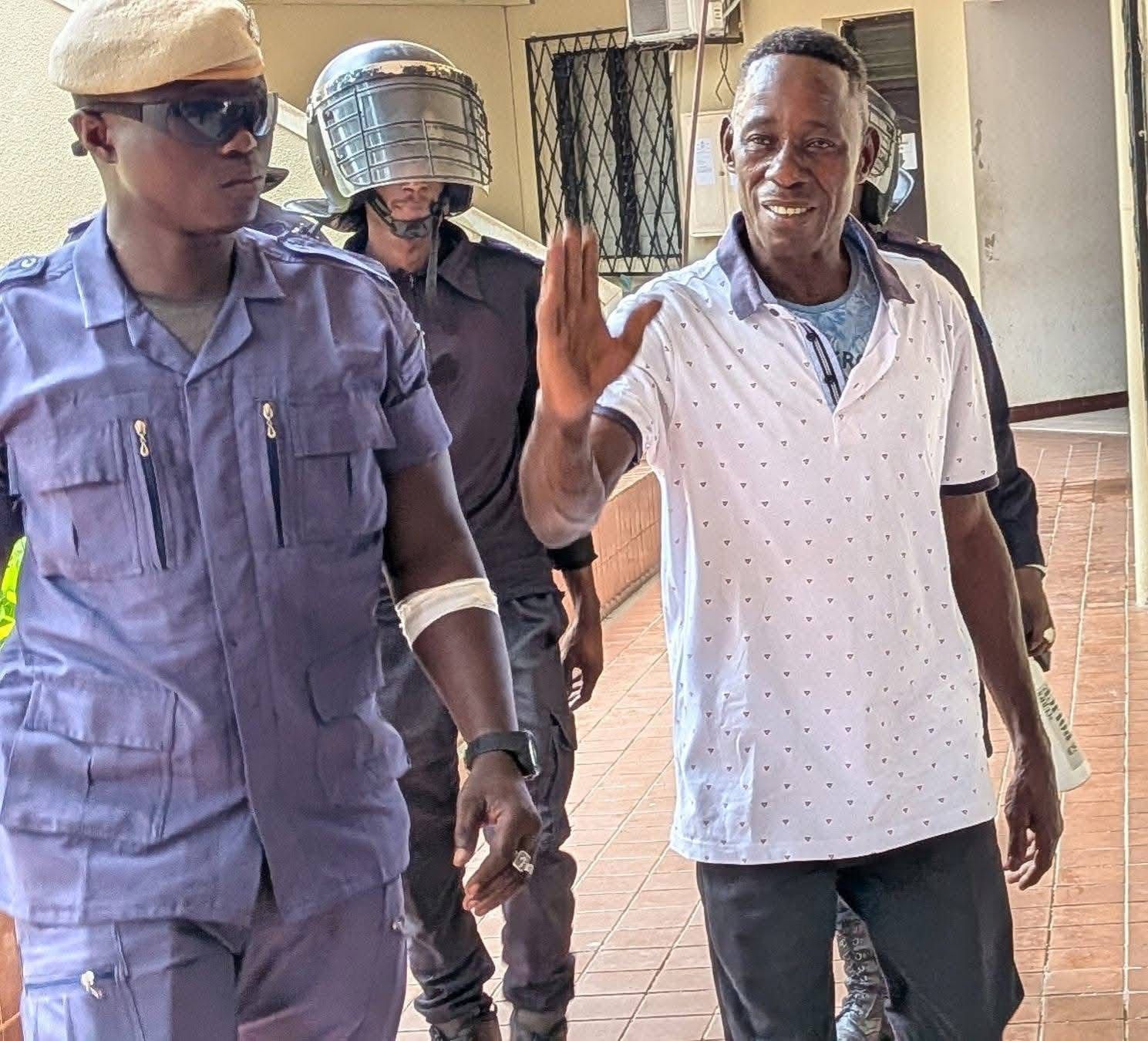
The State has lodged an appeal with the Gambia Court of Appeal challenging the recent acquittal of former soldier Abdoulie Sanyang, who was cleared by the High Court of charges related to a 2016 arson attack and interference with judicial proceedings.
On February 10, 2026, Hon. Justice Ebrima Jaiteh of the Banjul High Court acquitted and discharged Sanyang on both counts, ruling that the prosecution failed to prove its case beyond a reasonable doubt. The judgment followed a full trial involving seven prosecution witnesses and multiple exhibits, including Sanyang’s cautionary statement (Exhibit P3) and a video recording of his August 2025 interview on West Coast Radio’s “Coffee Time with Peter Gomez” (Exhibit P7).
The charges stemmed from the deliberate burning of the APRC Bureau in Kanifing in August 2016, with the prosecution alleging Sanyang financed or facilitated the arson, partly based on interpretations of statements he made during the radio appearance. A second count accused him of interfering with judicial proceedings through remarks criticizing ongoing court matters as “clandestine” and controlled.
Justice Jaiteh held that while the building was indeed torched by masked assailants, no sufficient independent evidence linked Sanyang to the crime. He emphasized that admissions in the exhibits did not relieve the prosecution of its burden, and suspicion alone could not substitute for proof.
In a petition of appeal filed as Crim. Appeal No: CACA/CR/086 2026, the State, as appellant, contests the entire judgment. The primary grounds argue that Justice Jaiteh erred in law by requiring the prosecution to prove facts already admitted by Sanyang in Exhibits P3 and P7.
The State claims the judge failed to appreciate the evidential value of these exhibits, which it says are consistent with the prosecution witnesses’ testimonies and establish the elements of the offences. It accuses the trial judge of misapplying Section 75 of the Evidence Act by imposing an unnecessary additional burden to prove admitted facts, misconstruing the provision, and disregarding precedent from the Court of Appeal in First International Bank v. Gambia Shipping Agency [2002-2008] 2 GLR 270, which states that admitted facts need no further proof.
A second ground criticizes the judge’s finding that the prosecution bore a “heightened legal obligation” to provide independent evidence connecting Sanyang to the arson, despite his alleged unequivocal admissions in the cautionary statement and radio interview video.
The appeal seeks to overturn the acquittal, though specific reliefs include setting aside the judgment and potentially ordering a retrial or conviction. Immediately after the High Court ruling, state counsel indicated an intent to appeal under the Criminal Procedure Act, and the court granted Sanyang bail pending the outcome, rejecting detention requests on residency grounds.
The case has drawn attention for its implications on freedom of expression, evidence standards in criminal trials, and the handling of historical political violence cases in post-Jammeh Gambia. Legal observers note the appeal underscores tensions between prosecutorial burdens and reliance on accused persons’ statements. The Court of Appeal will now determine whether the High Court’s interpretation of admissions and proof requirements warrants reversal.