By Foday Manneh
It has now been one week since the Gambia Football Federation (GFF) officially inaugurated the GFF–Nyakoi Mini Stadium in the Upper River Region — a project meant to symbolize long-awaited sporting progress that has instead ignited one of the most intense public scrutinies in recent regional football history.
From Nyakoi to Basse and beyond, the question dominating conversations is simple: Was D14.6 million truly spent on this facility?
A Promise of Transformation
The project was initially presented as a breakthrough for a region that has struggled for decades without a single standard sports facility since independence. According to the initial announcement from the GFF, the funding package included D12 million secured from the Saudi Arabian Football Federation and an additional D2.6 million counterpart contribution from the GFF.
With an initial completion timeline of four months following the laying of the foundation stone in July 2023, expectations were high. However, the project would eventually stretch close to three years before its inauguration in February 2026.
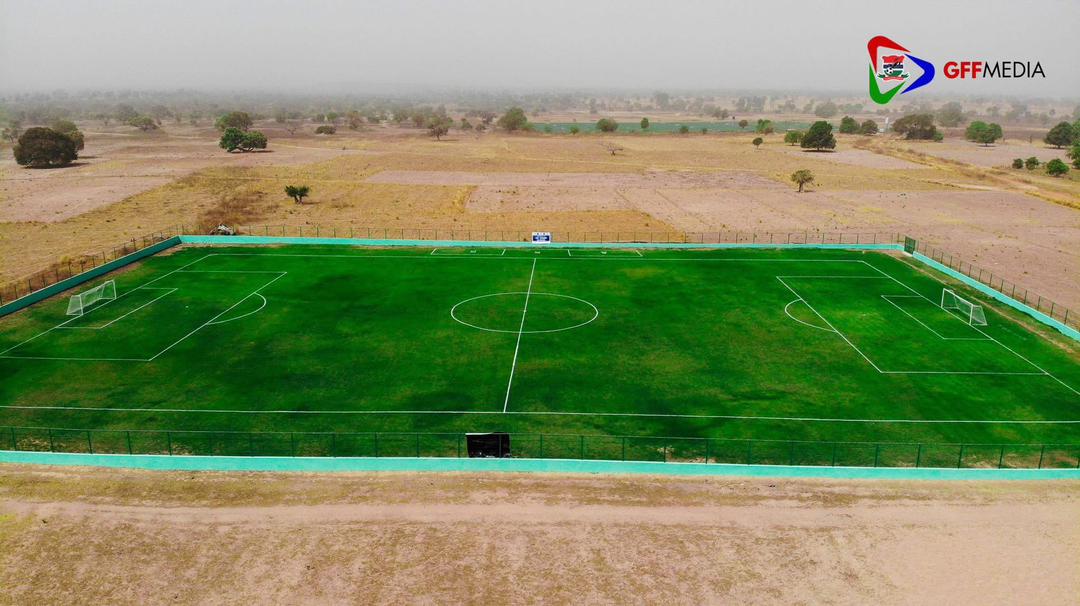
On paper, the works appeared substantial. According to the GFF’s official description, the project included: A new three-meter perimeter fence combining block-work and steel mesh, full pitch leveling with laterite soil and black sand supply, grass planting, installation of a sprinkler system, and construction of an 8-inch borehole system
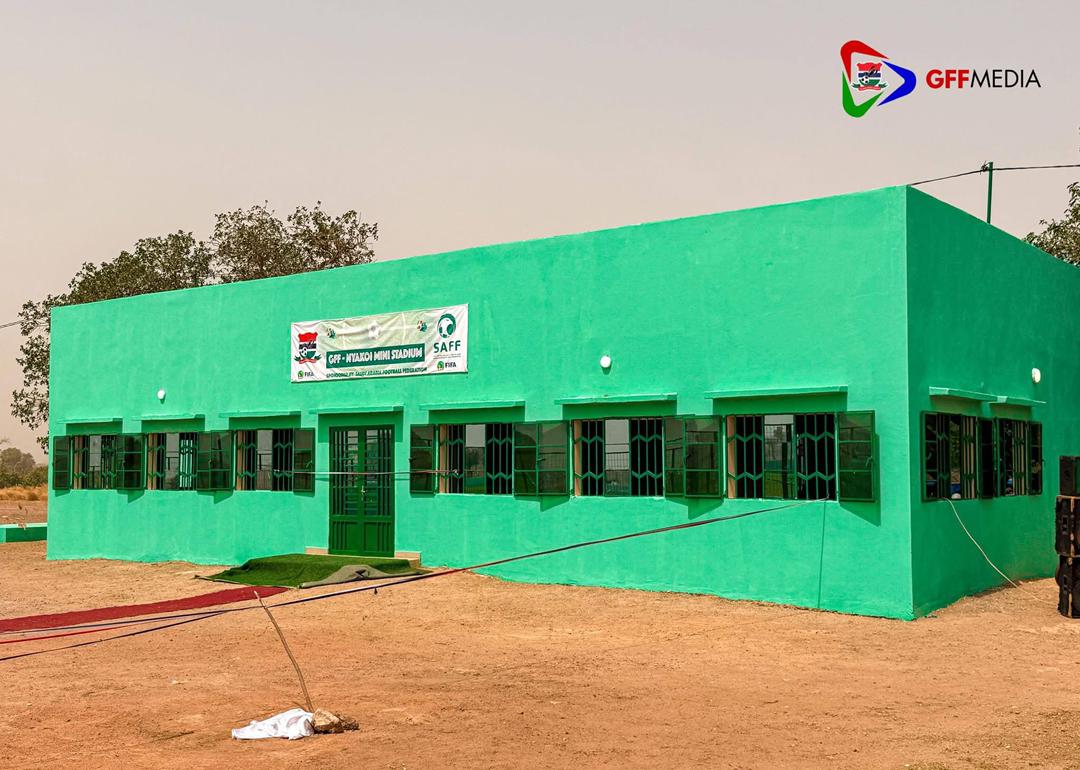
Yet what now stands in Nyakoi is a modest grass pitch without pavilions, technical benches, or spectator stands — has left many natives, residents, activists, pundits, and football enthusiasts questioning the scale of investment relative to the outcome.
Community Contribution Raises Eyebrows
In a twist that has further fueled the dispute, multiple local sources confirmed that natives of Nyakoi reportedly planted the grass themselves — voluntarily and without payment. For some observers, this revelation has deepened scrutiny over the project’s total expenditure while they ask where exactly the money meant for the planting went.
The Electricity Extension Controversy
One of the most troubling findings relates to the electrification of the facility.
Investigations indicate that the electrical extension may have been carried out without following due procedures set by the National Water and Electricity Company (NAWEC). The regional NAWEC office confirmed it was unaware of any formal engagement with the GFF regarding the work.
Electrician Sambujang Suwareh was named by sources as having facilitated the electrical extension. Allegations surfaced suggesting the arrangement could have opened avenues for financial kickbacks.
When contacted, Suwareh confirmed partial involvement, despite the fact that the act was confirmed illegal, he denied wrongdoing.
“I was only involved in the purchase of the electric meter. There were no meters available at the time and they needed one urgently. I knew someone selling a meter and connected them,” he said.
He stated that meters at the time cost around D8,500 but declined to disclose how much the project paid. In a later clarification, he acknowledged providing extension measurements and service advice — for which he was paid — but insisted he was not involved in the installation, adding that it was carried out by private individuals, not NAWEC.
According to regulatory guidelines, a private company or individuals may legally undertake NAWEC pole extensions only if registered and formally approved by the site engineer and the Planning Department after required assessments. In this case, NAWEC maintains it was unaware of any such process involving the Nyakoi project.
Based on advice reportedly given by Suwareh, four to five electric poles were installed. He estimated each pole had cost more than D50,000 — though independent verification suggests the price range for such areas is likely between D40,000 and D45,000 per pole.
Silence From Key Stakeholders
Efforts to secure clarity from key actors have yielded limited responses.
Project consultant Ronald Brown of Masterplan (Architects & Engineers) and contractor Abdoulie Bayo of Kalifa Bayo & Sons Jula Kunda Constructions Co. declined to comment, referring inquiries to the GFF. In a brief exchange, the contractor stated he was contracted for a single phase and executed his mandate as required — a statement that appears to contradict suggestions of a possible second phase, which some RFA members reportedly say they were unaware of.
However, neither the consultant nor the contractor could clarify whether their respective agreements with the Gambia Football Federation included any confidentiality or “secrecy clause” restricting them from publicly commenting on the project.
Mattar Jobe, the GFF Supervisor and Project Officer for the Nyakoi Mini Stadium, also declined to provide detailed comments, referring inquiries to the GFF General Secretary, Lamin Jassey. Jobe, however, noted that rising construction costs and inflation make the project expenditure justifiable and open to scrutiny.
Subsequent attempts to reach Jassey resulted in a referral to the GFF Communications Director, Baboucarr Camara, who, at the time of this report was unavailable to respond to our request.
Expert Opinion: “Common Sense Valuation”
Adding to the controversy, a senior government valuation officer who inspected the facility described the situation as a matter of “common sense.”
“I have seen the facility. If you look at the fence and the natural grass pitch, is it worth D14 million? If we are honest, it does not,” the officer said.
He explained that even a basic estimation — calculating cement usage per meter of fencing and factoring workmanship — would make it difficult to justify such a figure.
“Valuation requires evidence-based assessment of resources used. But by common sense, with what we have seen, it cannot be D14 million. Perhaps if there were one or two pavilions, one could understand.”
Also speaking to a welder familiar with the project, he compared the perimeter fence to that of the Soma Mini Stadium, noting that the iron rods used in Nyakoi have a shorter lifespan. He expressed concern that in the event of overcrowding by fans, the fence could be easily damaged. He further argued that the Soma Mini Stadium uses a stronger type of iron rod, locally known as “Uba,” which is more durable and long-lasting.
A Facility Under the Spotlight
What was meant to signal a new era for football in the Upper River Region has instead sparked calls for transparency and accountability.
The Nyakoi Mini Stadium stands completed — grass planted, fence erected, borehole installed. But beyond the physical structure lies a deeper issue: public confidence.
Until a detailed financial breakdown is provided, the D14.6 million question may continue to overshadow the very purpose the facility was built to serve — the development of football in one of The Gambia’s most underserved regions.