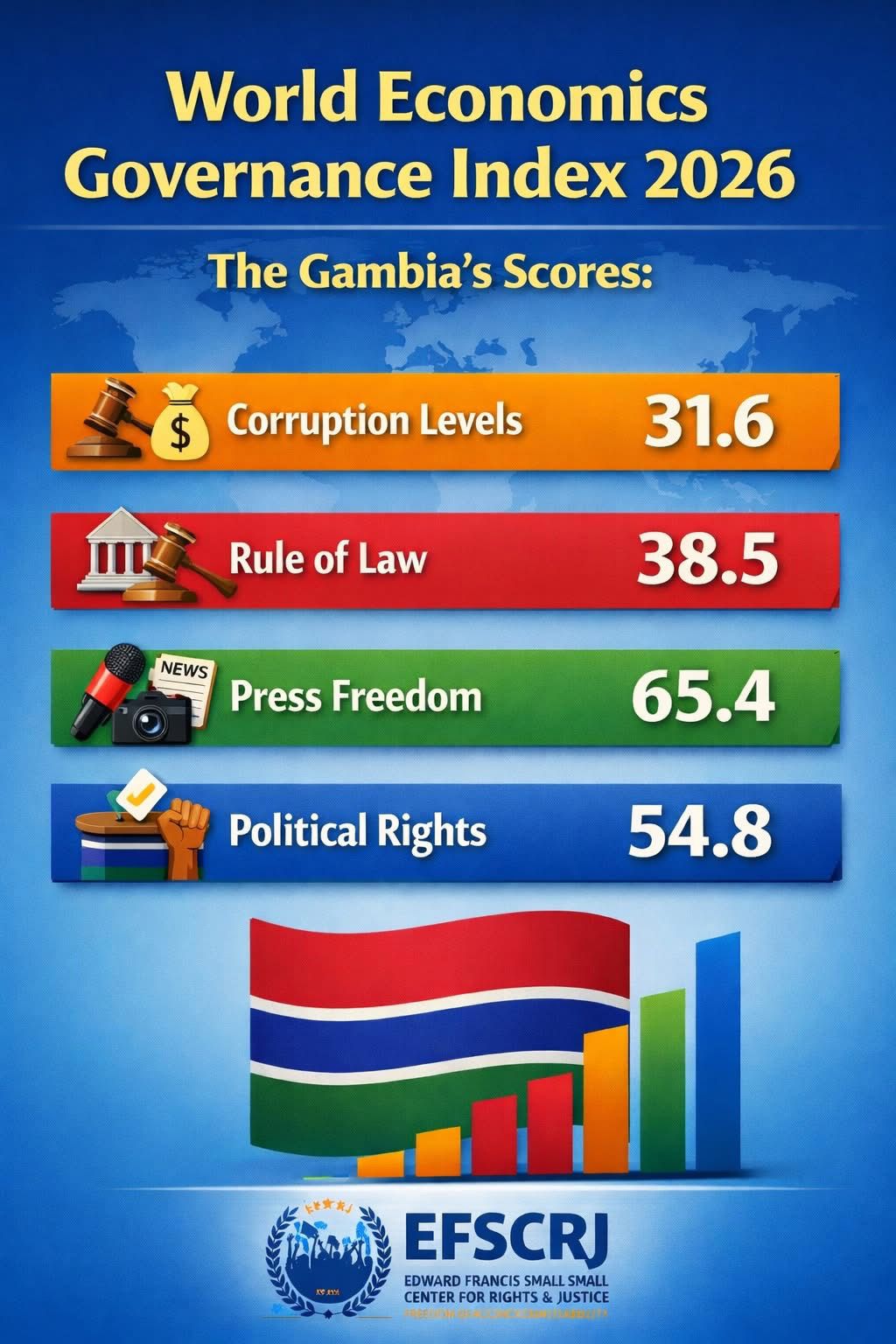
The Edward Francis Small Centre for Rights and Justice (EFSCRJ) has issued a stark warning about the state of governance in The Gambia following the release of the World Economic Governance Index 2026, which assigned the country an overall score of 47.6 out of 100—earning a middling grade of C (Average).
While the report acknowledges moderate progress in press freedom (65.4) and political rights (54.8) since the 2017 democratic transition that ended former President Yahya Jammeh’s 22-year rule, EFSCRJ described the extremely low scores in corruption control (31.6) and rule of law (38.5) as “deeply alarming” and a direct threat to democratic consolidation.
“A country cannot sustain democracy where corruption is pervasive, and the law is applied selectively,” the organization stated in a strongly worded statement. It pointed to what it called a “governance paradox”: expanded civic space coexisting with persistent abuse of power, weak institutional accountability, and widespread indiscipline.
EFSCRJ argued that these institutional failures help explain why poverty, inequality, and public frustration remain entrenched despite the country’s shift to multiparty democracy and visible infrastructure improvements.
The centre directly called on President Adama Barrow to treat the index as a serious governance red flag and to take immediate, decisive action. “Democracy is not only about elections,” the statement read. “Development is not only about roads and electricity. Rather, democracy and development are about disciplined institutions, transparent leadership, and accountable governance.”
EFSCRJ vowed to intensify its monitoring, advocacy, and public accountability efforts “to ensure that power serves the people, not the other way around.”
The 2026 index ranks The Gambia 74th globally and places it among the top ten best-governed countries in Africa, yet domestic observers say the low marks in rule of law and anti-corruption reflect long-standing public complaints about impunity, patronage, and uneven application of justice.