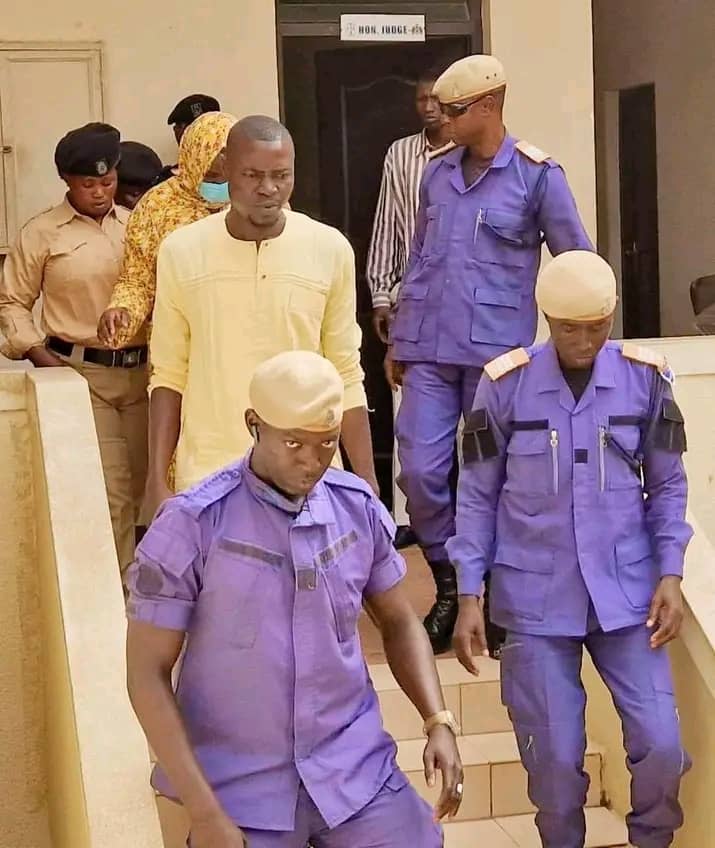
The High Court in Banjul today adjourned the murder trial of Ousainou Bojang and Amie Bojang after the prosecution failed to file its written final address on time.
Justice Ebrima Jaiteh granted the State 14 more days to submit its brief—by March 12, 2026—with no further extensions allowed. The defense will then have four days to respond on points of law. Judgment is now scheduled for Monday, March 30, 2026.
Ousainou Bojang faces two counts of murder over the 2023 killing of PIU officers Sang J. Gomez and Pateh Jallow, plus attempted murder and grievous harm charges. His sister, Amie Bojang, is charged as an accessory after the fact.
Ousainou Bojang, the first accused, faces five serious counts: two counts of murder, attempted murder, causing grievous bodily harm, and related offenses. He has consistently pleaded not guilty. His sister, Amie Bojang, the second accused, faces a single count of being an accessory after the fact to murder, for allegedly assisting her brother in fleeing to Senegal. She, too, has pleaded not guilty.
The prosecution, led by Director of Public Prosecutions A.M. Yusuf alongside F. Touray, appeared in court but informed Justice Jaiteh that it had not yet filed its final written address. DPP Yusuf argued that the 28-day period previously allowed was still running, claiming the defense’s brief had been served only recently.
Counsel for the second accused, A. Sillah, strongly objected, asserting that further delays violated the defendants’ constitutional rights to a fair and speedy trial. Counsel J. Jeng appeared for Ousainou Bojang.
Referencing the High Court Practice Direction of 2013—which typically allows 14 days per party for filing written addresses—Justice Jaiteh acknowledged delays in preparing full court records that had affected timelines. He varied the schedule, ordering the State to file its address by March 12, with the defense given four days thereafter to respond on points of law only.
“No further extensions will be granted,” Justice Jaiteh emphasized, underscoring the need to conclude the long-running matter.
The trial has featured extensive evidence from both sides. The prosecution called 13 witnesses and tendered 33 exhibits, while the defense presented 11 witnesses and 43 exhibits.
In his final oral submissions, defense counsel Lamin J. Darboe, for Ousainou Bojang, urged the court to acquit his client, arguing that the prosecution had failed to prove guilt beyond a reasonable doubt.
Darboe highlighted the absence of any positive eyewitness identification placing Bojang at the scene as the shooter. He pointed to contradictory witness statements and noted that, upon being taken to Sukuta Police Station shortly after his arrest, all seven alleged eyewitnesses reportedly stated they had never seen him before.
A central pillar of the defense was Bojang’s alibi. Exhibit D38, containing WhatsApp messages between Bojang and his employer, Kathleen McGee (defense witness DW11), showed continuous communication from 8:18 p.m. until after midnight on the night of the shooting, placing him at his workplace in Brufut. Multiple family members and associates (DW2 to DW5) corroborated seeing him in Brufut between 9:00 p.m. and 11:00 p.m.
The defense criticized the police for failing to investigate this alibi adequately.
The prosecution’s case leaned heavily on the testimony of PW3, Mama Jabbie, a marabout based in Senegal, who alleged Bojang confessed to the killings and sought spiritual protection (“juju”) and funds to escape. She claimed to have recorded the conversation, but said the audio was lost after uninstalling WhatsApp.
The defense countered by tendering an audio recording (also part of Exhibit D38) purportedly from the same interactions, which they said showed only discussions of personal matters with a “white lady” and no confession.
Darboe further alleged bias in PW3’s testimony, noting she received a one-million-Dalasi bounty promised by President Adama Barrow and was interviewed at the home of the President’s sister, Korka Barrow, where she reportedly said she acted “for the president.”
Forensic shortcomings were also emphasized: no DNA or fingerprint evidence linked Bojang to the recovered Makarov pistol, found 10 days later and exposed to the elements. The weapon was sent to the army disassembled for ballistic testing but returned assembled, raising chain-of-custody concerns. A pair of combat boots allegedly worn by the shooter did not fit Bojang in court but reportedly fit his brother.
The defense accused police of reformatting Bojang’s smartphone—erasing WhatsApp chats supporting his alibi—and seizing a notebook with his Google password, blocking access to potentially exculpatory data.
Senior officials, including the Government Spokesperson, Deputy Inspector General of Police, and National Security Adviser, testified as defense witnesses. They admitted under cross-examination that early public statements linking Bojang to the crime—including claims of Casamance rebel ties, long-term possession of the weapon, phone tracking, and CCTV footage—were based on no personal knowledge or direct evidence. The defense labeled this “trial by media,” that prejudiced fair hearing rights.
For Amie Bojang, Counsel A. Sillah argued her charge depended entirely on a proven case against her brother. He contended she assisted with a personal matter involving a “white woman” and had no knowledge of any murder. With the prosecution’s evidence against Ousainou allegedly weakened by the alibi, contradictions, and forensic gaps, Sillah said the accessory charge could not stand.
The adjournment leaves the fate of the siblings in the hands of Justice Jaiteh, with the nation awaiting the March 30 judgment in a case that has gripped public attention since the tragic 2023 shooting.