By Fatou Dahaba
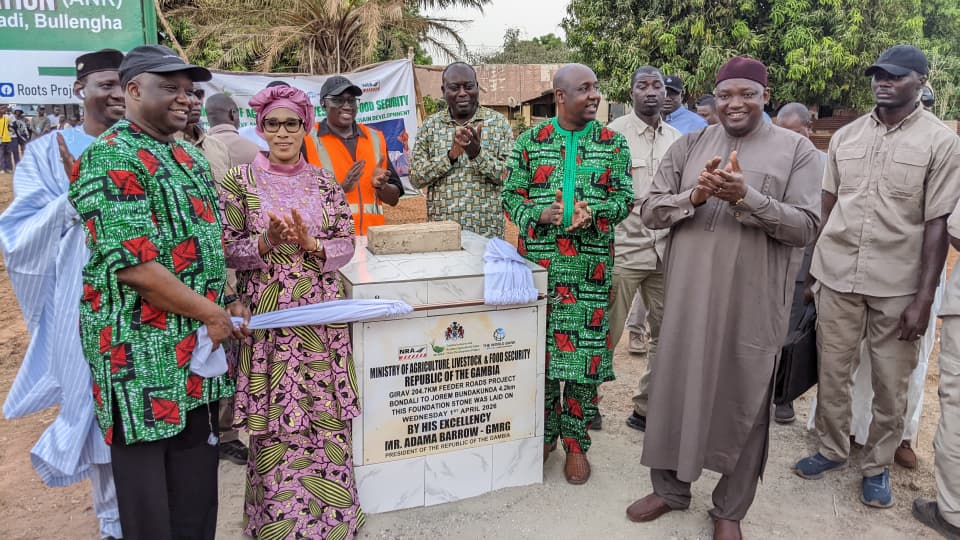
President Adama Barrow on Wednesday, April 1, 2026, laid the foundation stone for a 45.3-kilometer feeder roads project under the Gambia Inclusive and Resilient Agricultural Value Chain Development (GIRAV) initiative, spanning the Lower River Region (LRR) and West Coast Region (WCR).
The ceremony in Foni Nyamtempo highlighted the government’s broader nationwide rollout of agricultural roads aimed at enhancing rural connectivity, easing farmers’ access to markets, and improving livelihoods in farming communities. The project, supported by the World Bank, forms part of a larger 204.7-kilometer feeder roads program across the country.
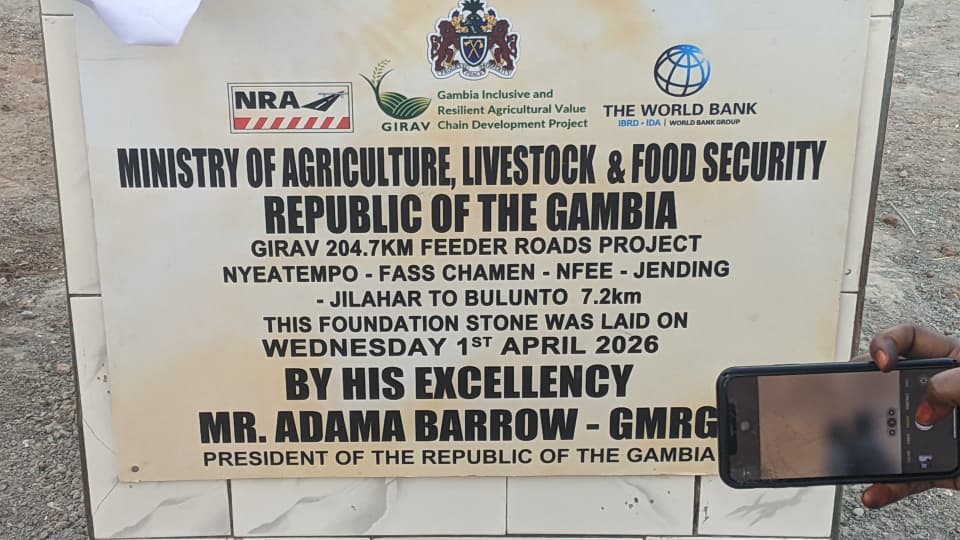
The 45.3km network is divided into six sections: Sare Jamma to Minna (4.5km in Jara West, LRR); Gjonkil–Kewel–Kangmamudu–Kansambu to Kampassa (4.3km in Foni Jarrol, WCR); Wasadou–Adullay–Fass Chabai–Kangiramba Busary to Bulengant (7km in Foni Jarrol, WCR); Burambang–Bulengant–Tibat–Kankurang to Bambara (7.5km in Foni Bondali, WCR); and Nyeatempo–Fass Chamen–Nfee–Jending–Jilahar to Bulunto (7.2km in Foni Jarrol, WCR). Construction has already progressed, with the contractor completing 3.7km of subgrade and 2.5km of subbase.
Speaking to residents, President Barrow reaffirmed his administration’s commitment to equitable development, declaring that projects would benefit all communities irrespective of political affiliation, region, or support base. “Anything you are supposed to benefit from my government, you will benefit. My development is not based on politics, region, or affiliation,” he said.
Barrow noted that Foni stands to receive a significant share of the roads—approximately 38km out of the 204km nationwide total—emphasizing that the region benefits most from the current phase. He contrasted this with past administrations, promising that Foni would now receive the infrastructure it had been denied under former presidents Dawda Jawara and Yahya Jammeh.
The president highlighted visible improvements, including new electricity connections and roads that were previously unavailable. He stressed his commitment to peace and stability: “I have never arrested anyone, no one has gone to exile, I have never killed anyone, nor brought witchcraft to Foni as happened before.” Barrow added that national progress depends on peace, especially as the country prepares for presidential elections in December 2026.
Youth representative Gallo Gagigo welcomed the developments, pointing out that many villages that were once without electricity are now connected. He urged the government to equip young people with skills to curb irregular migration, often referred to locally as the “back-way syndrome.” Women’s representative Kaddy Jamanka encouraged women to participate in the upcoming supplementary voter registration and support President Barrow. She praised the Ministry of Agriculture for providing rice and millet processing machines, which have reduced manual labor, and appealed for additional tractors while noting that the district has already received four gardens.
West Coast Region Governor Ousman Bojang recalled that fewer than five villages in Foni had electricity under the previous regime, which reportedly treated the area as an opposition stronghold. He described the current inclusive approach as a break from that past and called on communities to preserve peace ahead of the 2026 polls.
Mamour Alieu Jagne, project coordinator for the Central Projects Coordination Unit (CPCU), explained that numerous feeder roads have already been built under GIRAV to help farmers reach their fields and markets more easily. He confirmed that a substantial portion of the 204km will be constructed in Foni District.
The GIRAV feeder roads initiative is expected to boost agricultural trade, reduce transportation challenges, and contribute to broader economic resilience in rural Gambia. Officials described the project as a key step towards transforming farming communities and ensuring that development reaches every corner of the country.