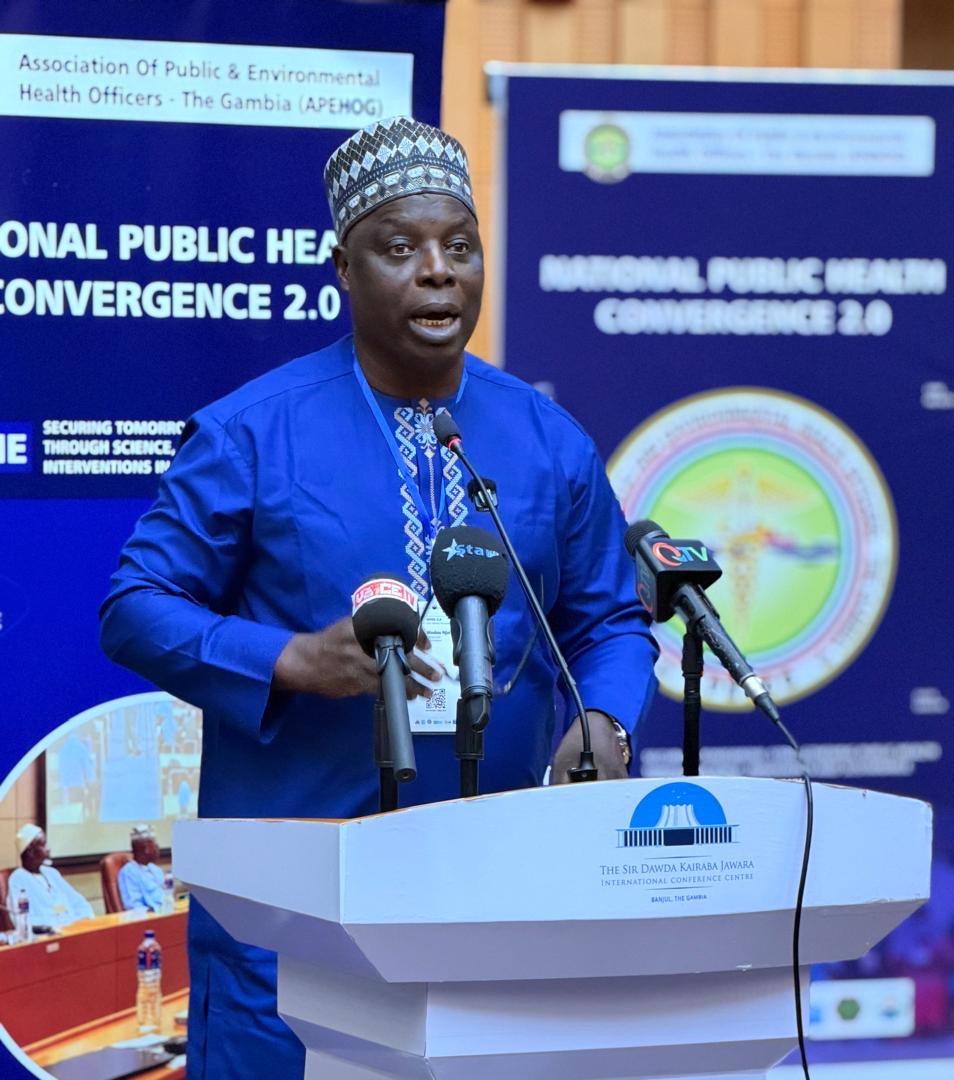
Mr. Modou Njai, a public health expert with the Africa Center for Disease Control and Prevention (Africa CDC), has called for increased domestic investment in healthcare, stronger disease surveillance, youth-led innovation, and sustainable public health interventions to strengthen The Gambia’s health system and safeguard the country against emerging health threats.
Delivering the guest speaker address at the National Public Health Convergence 2.0 on Wednesday, October 7, 2026, Njai emphasized that Africa must move away from excessive dependence on external assistance and build resilient health systems anchored in local expertise, scientific research, innovation, and sustainable financing.
The convergence, organized by the Association of Public and Environmental Health Officers of The Gambia (APEHOG), was held under the theme, “Securing Tomorrow: Strengthening Public Health through Science, Innovation, and Sustainable Interventions in The Gambia.”
Njai, who works with the Africa CDC Regional Coordinating Center for West Africa in Abuja and previously served as Director of Health Promotion and Education at The Gambia’s Ministry of Health, described the gathering as an important platform for addressing the country’s public health challenges.
He warned that recent outbreaks of Ebola, cholera, diphtheria, and mpox across parts of Africa demonstrate the urgent need for stronger preparedness, coordinated responses, and sustainable health security systems.
Central to his address was the Africa Health Security and Sovereignty Agenda (AHSS), which promotes stronger national ownership of healthcare systems, predictable domestic financing, digital transformation, continental preparedness, and local manufacturing of essential medical products.
According to Njai, Africa’s health sovereignty depends on governments strengthening their institutions, mobilizing domestic resources, and reducing reliance on unpredictable international funding.
He urged The Gambia in particular to work toward the Abuja Declaration’s target of allocating 15 percent of national budgets to healthcare.
“External funding is valuable, but it is not permanent. The future of The Gambia’s public health system depends on domestic investment,” he stated.
Njai also highlighted the importance of innovative financing mechanisms, including The Gambia’s Tobacco Control Levy introduced in 2024, which he said could provide critical resources to prevent and manage non-communicable diseases.
He urged the Ministries of Health and Finance to ensure that proceeds from the levy support nationwide interventions against diseases such as cancer, diabetes, and cardiovascular conditions.
Citing national tobacco-control efforts, Njai noted that smoking prevalence among students aged 13 to 15 declined from 10.8 percent in 2008 to 6.5 percent in 2017, according to Global Youth Tobacco Survey findings.
Beyond financing, Njai celebrated Gambian public health professionals’ contributions to scientific research, community health education, disease prevention, nutrition, and healthcare delivery.
He recalled introducing community diagnosis field exercises at the former School of Public and Environmental Health of Gambia College in 2008, enabling students to conduct practical research in rural communities.
The initiative, he explained, subsequently evolved into a structured Community Outreach Program, strengthened in 2019 by Dr. Amadou Barrow, Solomon P. S. Jatta, Musa Nget, and their colleagues.
Their work, he said, contributed to more than seven scientific publications in international journals, demonstrating the growing potential of Gambian-led public health research.
Njai also highlighted a youth-led innovation by Lamin Sambou, a program officer with the National Hepatitis Control Program, under the Africa CDC BingwaPLUS initiative.
The project addressed gaps in timely hepatitis B birth-dose vaccination by improving coordination among midwives, vaccinators, and public health officers, and by introducing a simple newborn tracking system.
According to Njai, the intervention increased timely hepatitis B birth-dose vaccination coverage at the pilot health facility from 15 percent to 86.7 percent.
He described the achievement as evidence that meaningful improvements in healthcare do not always require expensive technology or substantial financial resources.
“Sometimes they are about coordination. Sometimes they are about visibility,” he explained, emphasizing the importance of effective systems and accountability.
Njai further called for stronger collaboration between the Ministry of Health and the Food Safety and Quality Authority to improve food inspection, surveillance, and consumer protection.
He stressed that public health officers must remain actively involved in food safety regulation, environmental sanitation, and disease prevention.
Addressing the wider determinants of health, Njai urged government ministries responsible for education, finance, transport, environment, employment, and gender to incorporate health equity into their policies and budgetary decisions.
He also encouraged greater professional development, stronger cross-border collaboration, improved digital health information systems, and meaningful participation by young professionals in decision-making.
In his concluding remarks, Njai challenged public health officers to strengthen teamwork, uphold professional ethics, deepen community engagement, and ensure that scientific research translates into tangible improvements in people’s lives.