By: Kebba Ansu Manneh
Former Nigerian President Goodluck Jonathan has called for urgent regional collaboration to address the multifaceted crises gripping the Sahel, describing the region as facing a “convergence of complex challenges” including insecurity, food instability, climate threats, youth unemployment, and governance deficits.
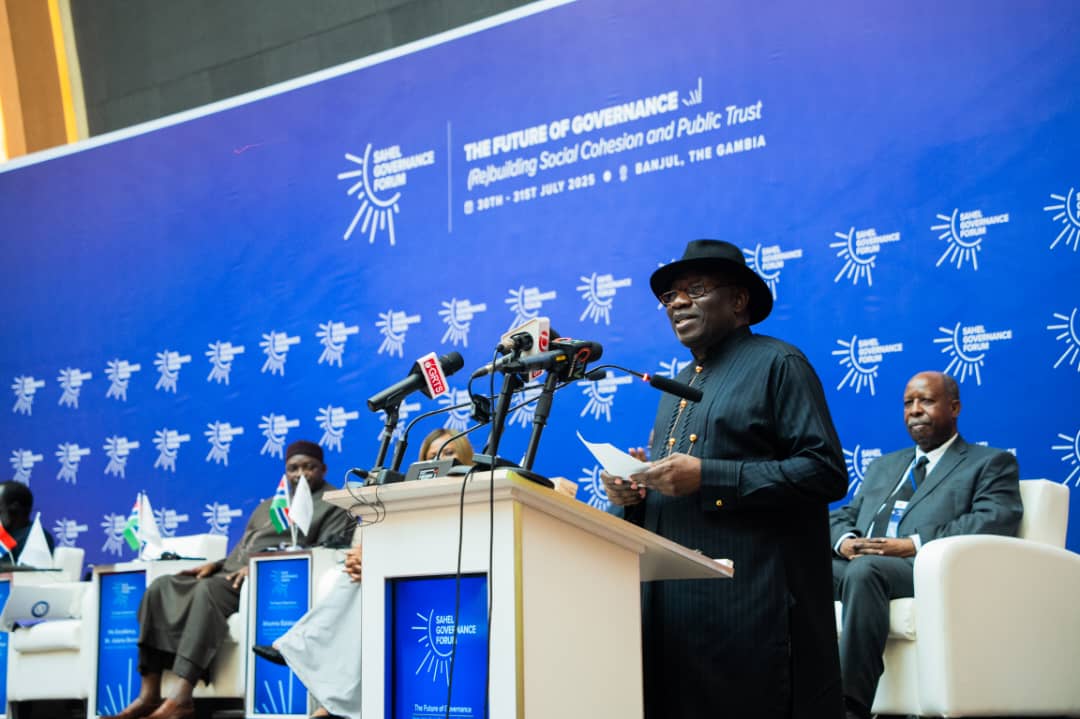
Speaking at the inaugural Sahel Governance Forum held at the Sir Dawda Kairaba Jawara International Conference Center in Banjul on Wednesday, Jonathan emphasized that the Sahel’s potential can only be unlocked through collective action, good governance, and investment in its youth.
The forum, organized by the Gambian Government, the United Nations Development Programme (UNDP), International IDEA, and the Goodluck Jonathan Foundation for Peacebuilding, brought together leaders, policymakers, civil society representatives, and private sector stakeholders to chart a path forward for the Sahel. In his opening address, Jonathan underscored the critical timing of the event, noting that the region stands at a crossroads between crisis and opportunity.
“Today’s forum could not have come at a more critical time. Our region—the Sahel—is facing a convergence of complex challenges: insecurity, food instability, climate threats, youth unemployment, and governance deficits. But we are also a region full of potential, talent, and untapped opportunities,” Jonathan declared.
The former president, now a prominent peace advocate across Africa, stressed that good governance is the cornerstone of addressing these challenges. He argued that democracy extends beyond elections, requiring a commitment to service, dialogue, and accountability. “Governance is not merely about institutions; it is about people. It is about building trust between leaders and citizens. It is about ensuring that public resources are used judiciously, transparently, and for the benefit of all,” he said.
Jonathan highlighted the interconnected nature of the Sahel’s challenges, warning that no single country can tackle them in isolation. He called for regional mechanisms to combat terrorism, promote climate-resilient agriculture, and create economic opportunities for the youth to curb desperation-driven migration. “We must build mechanisms that allow us to jointly combat terrorism, promote climate-resilient agriculture, and provide real economic opportunities for our youth—so that they see hope in our soil and not desperation in migration,” he urged.
A key focus of Jonathan’s address was the Sahel’s youth, whom he described as the region’s greatest asset rather than a burden. He advocated for significant investments in education, digital access, entrepreneurship, and civic participation to harness the region’s demographic dividend. “Our youth are not a burden; they are our greatest asset, but for them to rise, we must invest in their potential,” he said.
The Sahel, stretching across countries like Mali, Niger, Burkina Faso, Chad, and Mauritania, has been plagued by escalating violence from extremist groups, severe food insecurity exacerbated by climate change, and high unemployment rates among its rapidly growing youth population. These challenges have been compounded by governance issues, including corruption and weak institutions, which have eroded public trust and hindered development efforts.
Jonathan, reflecting on his ongoing work as a peace advocate, reiterated his commitment to strengthening democratic values across the continent. “Peace cannot be sustained where injustice, exclusion, or corruption persist,” he noted, emphasizing that regional collaboration is essential for lasting solutions.
In his closing remarks, Jonathan called on Sahelian leaders and stakeholders to view the Sahel Governance Forum not as a mere conference but as a platform for actionable change. “Let us see this forum not as a conference of speeches, but as a platform of action,” he said, urging participants to make the forum a “beacon of commitment, courage, and collaboration” that could inspire the rest of Africa.
As the Sahel grapples with its complex challenges, Jonathan’s call for unity, good governance, and youth empowerment sets a hopeful tone for the region’s future. The forum is expected to foster ongoing dialogue and concrete strategies to address the Sahel’s pressing issues, with the potential to serve as a model for regional cooperation across the continent.