By Sainabou Sambou
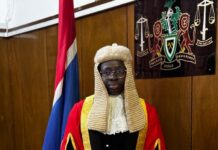
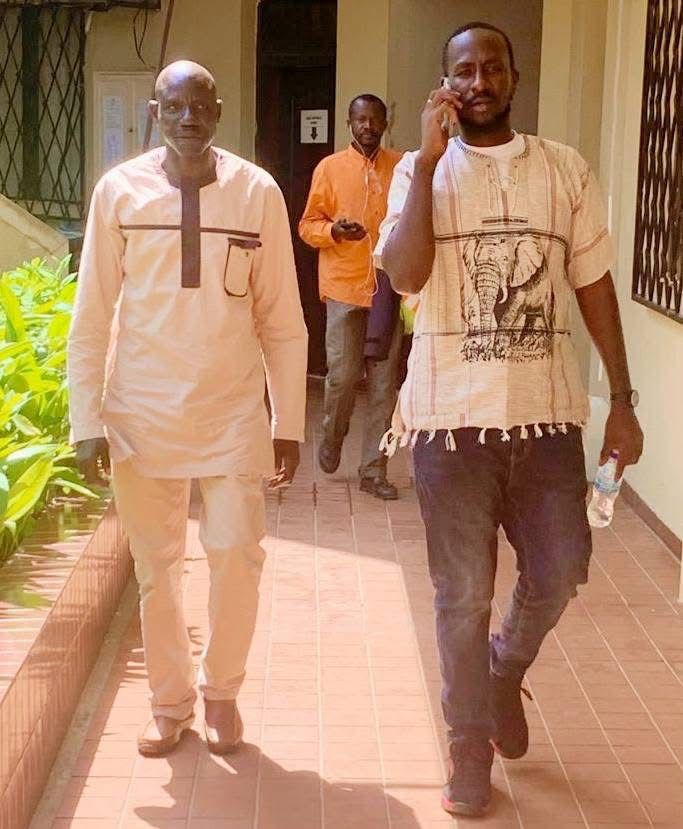
In a landmark ruling, the High Court of The Gambia acquitted Mansa Sumareh, former Chief Driver to President Adama Barrow, and Ebrima J.S. Sanneh, a Protocol Officer at the Ministry of Foreign Affairs, on all eight counts in the high-profile diplomatic passport scandal. Justice Ebrima Jaiteh, presiding, declared the prosecution’s case to be riddled with inconsistencies, uncorroborated claims, and unreliable witnesses, thereby failing to meet the legal threshold of proof beyond a reasonable doubt.
The duo faced charges filed on June 3, 2020, including forgery of official documents, conspiracy to commit a felony, uttering false documents, and making documents without authority. The case stemmed from allegations that Sumareh and Sanneh facilitated the issuance of an illegal diplomatic passport for Bakary Susso using a forged approval letter from the Office of the President. Prosecutors claimed Susso paid Sumareh $3,400 for the document.
Defense Counsel S. Gaye argued the prosecution failed to prove any agreement between the accused for conspiracy and urged the court to strike out counts 7 and 8, noting the alleged victim, Abdoulie Bah, was never called to testify. Justice Jaiteh agreed, highlighting critical flaws in the prosecution’s evidence.
Key prosecution witnesses crumbled under scrutiny. Momodou Sowe (PW4), a Protocol Officer, admitted to drafting the forged letter and accepting $300 from Sumareh, but claimed he did so to expose the driver. Jaiteh dismissed this as an “implausible post-facto rationalisation,” labeling Sowe’s actions a “grave breach of official duty and integrity.” His testimony was deemed unreliable.
Kebba Drammeh (PW6), Principal Records Officer, admitted to stamping the forged letter (Exhibit P6) without verifying its authenticity, an act Jaiteh described as “gross negligence” and a “reckless disregard for institutional safeguards.” Drammeh’s contradictory statements further weakened the case.
Bakary Susso (PW8), the passport applicant, alleged he paid Sumareh $3,400 in cash. Jaiteh rejected this as “inherently fragile,” noting the absence of receipts, bank records, or witnesses to corroborate the transaction. “Uncorroborated assertions are unsafe for conviction,” the judge ruled.
Citing the seminal ‘Woolmington v DPP’ (1935), Jaiteh reaffirmed that the prosecution bears the burden of proving every element of an offense. Regarding forgery and document-making (Counts 1 and 5), he found no evidence that either accused had prepared or signed the letter, which Sowe admitted he had created. For uttering false documents (Count 3), Sanneh was merely performing his duties, with no evidence that he knew the documents were fake. Conspiracy charges (Counts 2, 4, 6, 8) were dismissed for lack of evidence of collusion, as the accused were strangers to one another before the investigation.
Jaiteh’s verdict rested on four findings: the prosecution failed to prove essential elements, offered no credible evidence of forgery or conspiracy, relied on inconsistent witnesses, and presented tenuous evidence overall. Sumareh and Sanneh were acquitted and discharged.