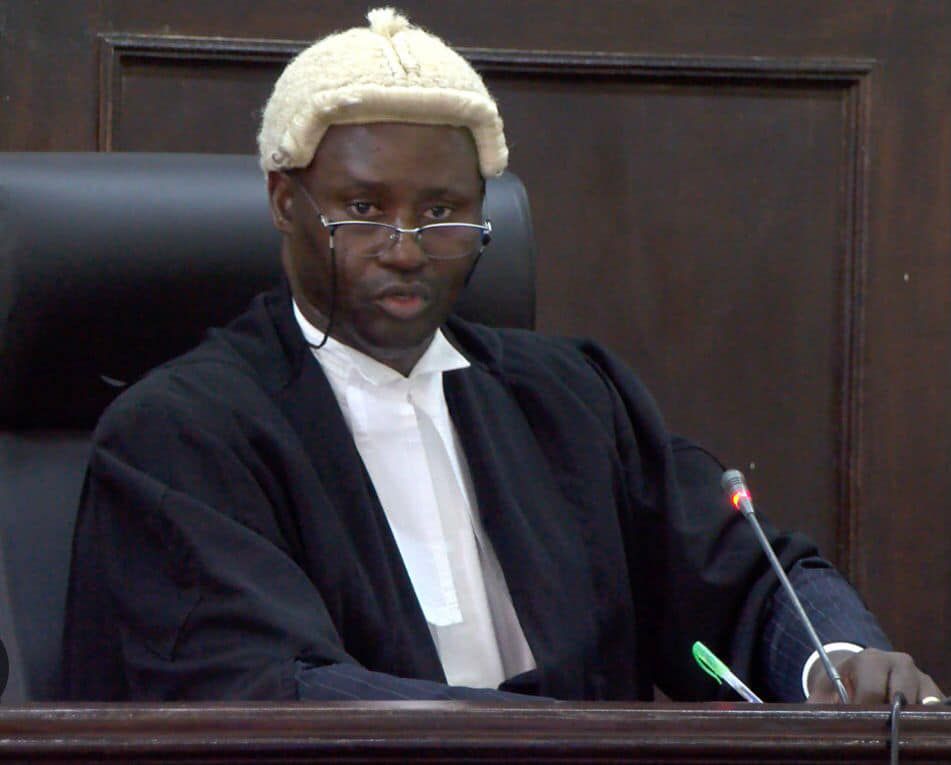
By Sainabou Sambou
In a landmark ruling delivered today at the High Court in Banjul, Justice Ebrima Jaiteh firmly dismissed the State’s appeal against the acquittal of three men accused of fraudulently transferring ownership of Plot No. 66 at Old Yundum through alleged forgery and deception.
The respondents—Banta Jaiteh (first accused), Bakary Bojang (second accused), and Ensa E.K. Badjie (third accused)—faced charges of conspiracy, fraud, obtaining by false pretence, and forgery related to a Deed of Assignment purportedly used to transfer the disputed plot.
The saga began years earlier, when the State prosecuted the trio, alleging they had used forged documents to claim the land unlawfully. After a full trial, Her Worship S.K. Jobarteh, then of the Banjul Magistrates’ Court, acquitted all three on January 28, 2022, ruling that the prosecution had failed to prove the charges beyond a reasonable doubt.
Unsatisfied, the State—represented by Senior State Counsel S.L. Jobarteh—appealed to the High Court, raising seven grounds. These included claims that the magistrate erred in assessing handwriting evidence, improperly resolved doubts in the accused’s favor, placed excessive reliance on a related civil judgment from the Brikama High Court, overlooked an affidavit by the third accused, and failed to conclude that forgery had occurred despite suggestions that a key witness had fled the country.
The respondents were defended by Counsel L.K. Mboge, who stood firm against the appeal.
Justice Jaiteh, in a meticulously reasoned judgment, rejected every ground. He reaffirmed a core appellate principle: courts must exercise great caution in overturning acquittals, intervening only if the decision is perverse, legally misdirected, or unsupported by evidence. None of these thresholds was met here.
Addressing the forgery allegation head-on, Justice Jaiteh explained that while the Evidence Act permits courts to compare handwriting, forgery cannot be inferred without strong, cogent proof. The prosecution had not called a handwriting expert, and the witness whose signature was disputed had himself confirmed its authenticity. The judge stressed that mere suspicion—even if compelling—cannot replace proof beyond a reasonable doubt.
On the State’s complaint about the magistrate’s consideration of the Brikama High Court’s civil judgment, Justice Jaiteh clarified that although civil and criminal proceedings operate under different proof standards, the magistrate was entitled to view the civil outcome as part of the broader factual context—without treating it as conclusive of criminal guilt.
The appeal’s reliance on a newspaper report claiming a witness was “on the run” fared no better. Justice Jaiteh held that newspapers may prove their own publication but not the truth of their contents absent independent corroboration, such as immigration records. No such evidence materialized.
Finally, dismissing claims of factual errors and inadequate evaluation of evidence, the judge commended the magistrate for thoroughly reviewing the record, weighing witness credibility, and correctly applying the high standard of proof required in criminal cases.
With no misdirection, improper evaluation, or miscarriage of justice established, Justice Jaiteh dismissed the appeal in full and affirmed the 2022 acquittal.
In a brief but tense post-ruling moment, State Counsel orally applied under section 325 of the Criminal Procedure Act, 2025, to remand the respondents in custody or grant bail pending a potential further appeal. Defense counsel vigorously opposed, highlighting the respondents’ double acquittal (at trial and on appeal), their long compliance with court processes since the case’s inception around 2013, and their lack of any flight risk.
Justice Jaiteh declined remand, emphasizing that while the State retains a constitutional right to appeal, it must not wield that right oppressively to curtail the liberty of those twice cleared by the courts. No formal notice of further appeal had yet been filed.
Balancing procedural fairness, the judge admitted the respondents to self-bail. Each must deposit a valid national ID card with the Principal Registrar of the High Court for 30 days. Should the State fail to lodge a written petition of appeal within that window, the self-bail lapses automatically, and the respondents stand fully discharged.
In closing, Justice Jaiteh issued a pointed caution to prosecutors: announcing appeal intentions without first reviewing the judgment risks eroding public trust in the criminal justice system.