By: Sainabou Sambou
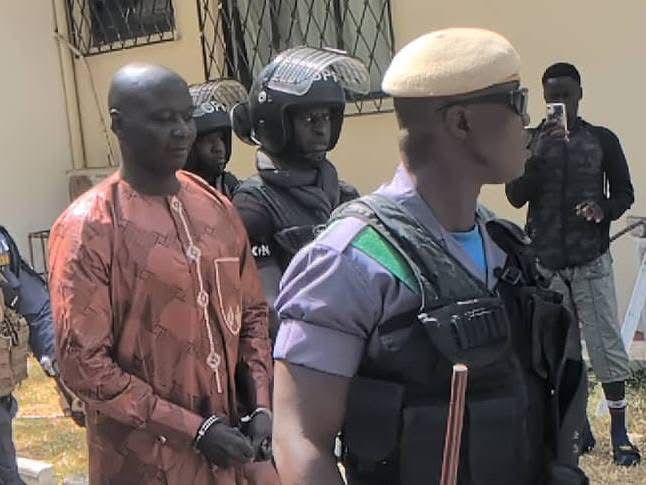
In the high-profile murder trial of former “Jungler” Sanna Manjang, a police officer testified about obtaining statements from the accused and inspecting an alleged detention site in Kanilai linked to the 2006 killings of Kajali Jammeh and Samba Wurry.
The trial, presided over by Justice S. K. Jobarteh at the High Court in Banjul, resumed with testimony from Police Officer Samba B. Sowe, attached to the Kairaba Police Station. Sowe appeared as the second prosecution witness (PW2) in the case against Manjang, a former member of ex-President Yahya Jammeh’s notorious paramilitary death squad known as the Junglers. Manjang faces two counts of murder under Section 187 of the Criminal Code for allegedly unlawfully causing the deaths of Kajali Jammeh (also known as “Le Cock”) and Samba Wurry in Kanilai, West Coast Region, around 2006.
Sowe, an investigator, told the court he first encountered Manjang in November 2025. He was assigned by his supervisor, Demba Bah, to join a multi-agency investigation panel probing the alleged killings of Kajali Jammeh, Bai Dam, and Samba Wurry. His primary role was to secure cautionary and voluntary statements from the accused.
On January 8, 2026, Sowe obtained two voluntary statements from Manjang in the presence of an independent witness. According to his testimony, Manjang refused to provide or sign any statement without his lawyer present. The independent witness endorsed the documents, which Sowe identified in court by his own name, rank, and signature. The statements were admitted as Exhibits B1 and B2.
Sowe further described a January 27, 2026, visit by the panel to Kanilai to inspect the alleged crime scene. A witness, Esa Keita (also referred to as Ensa Keita in related proceedings), guided them to a location in Bondali village. Keita identified a two-room structure—with a parlor and living room—as a detention center where he claimed to have been held. He alleged that Manjang killed Kajali Jammeh with a long knife (described in some accounts as beheading or nearly beheading) and stabbed Samba Wurry in the chest. Keita pointed out a window in one room and a former tap location that had since been relocated.
Crime Records Officer Sub-Inspector Jammeh photographed the site during the inspection.
Under rigorous cross-examination by defense counsel Jobe, Sowe acknowledged several limitations in his knowledge and involvement. He confirmed that Manjang did not join the Kanilai visit and that, as a junior officer, he was not responsible for inviting him.
The investigation panel comprised senior figures, including a Police Commissioner, the Director of the State Intelligence Services (formerly NIA), a Major and Sergeant from the army, and others. However, Sowe admitted he did not know or ask for the names of some senior members, such as the Police Commissioner and NIA Director.
Only a subset of the panel traveled to Kanilai, and Sowe could not specify the total number of investigators. As a native of Foni, he was familiar with the area and described the structure as occupied by soldiers. He distinguished it from a typical guard room but, based on Keita’s account, maintained that it functioned as a detention center. Sowe said his supervisor spoke to guards to gain access, but he did not overhear the conversation or interact with them himself.
He testified that he spoke only to Keita in Kanilai, did not independently verify the witness’s claims, and limited his role to joining the panel and handling statements. Division of labor assigned him the task of statement-taking, while others handled photography. All panel members asked questions during the visit, though he was unsure whether everyone recorded the details.
Sowe revealed he had visited both Kanilai and Mile 2 prison in connection with the probe, but could not speak for other investigators’ actions.
In a key admission under further questioning, Sowe stated he had never seen Kajali Jammeh or Samba Wurry alive, viewed no identification documents for them, knew nothing of their origins or families, and had not seen bodies or graves attributed to them. He confirmed prior acquaintance with the accused.
Regarding documentation, an investigation report—signed by Mr. Senghore—was prepared and forwarded to prosecutors.
The testimony highlighted challenges in the prosecution’s case, including reliance on a single eyewitness account from the scene visit and the witness’s limited personal verification of key allegations.
Representing the accused was Lawyer S.K. Jobe, while State Prosecutor E. R. Dougan appeared for the prosecution.
The case was adjourned to March 10, 2026, at 12:00 p.m. for continuation.