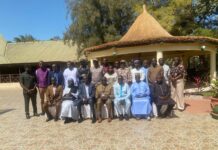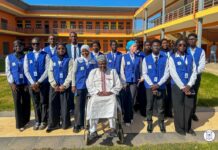
The National Livestock Owners Association (NaLOA) has strongly refuted claims by Lawyer Essa Mbye Faal, leader of the APP-SOBEYAA Party, who alleged on a local television talk show that the Gambia government’s $26.81 million Small Ruminant Production Enhancement Project (SRPEP) has failed and that all ruminants purchased under the initiative have died.
NaLOA’s National President, Ebrima O. Jallow, described Faal’s statements as “unfortunate” and “far from the realities on the ground,” asserting that the project has achieved significant success and transformed the lives of farmers and stakeholders in the agricultural value chain.
Jallow expressed deep disappointment over Faal’s remarks, emphasizing that the SRPEP, funded primarily by the Islamic Development Bank with contributions from the Gambian government, has made tangible contributions to livestock production and poverty alleviation. “When we heard Mr. Essa Mbye Faal say that all the animals under the small ruminant project have died, we consulted among our members, and we were all disappointed,” Jallow stated. “For Mr. Faal to sit on a television talk show and make such a statement is uncalled for. We are the farmer leaders, and we can confirm that his statement is false and misleading.”
NaLOA’s leadership recently conducted visits to 17 schemes involved in breeding and fattening under the SRPEP, reporting zero mortality among the distributed animals. “In each of these 17 schemes, the small ruminant project built structures and provided 70 sheep at no cost to the farmers,” Jallow explained. “Throughout our visits, we have not encountered any farm where all the animals distributed through this project are dead. What Mr. Faal said is simply not true.” He challenged Faal to name a single farm where all project-funded animals had died and called for a public apology, urging him to refrain from spreading misinformation that could incite unrest.
Jallow further highlighted the project’s successes, noting that the SRPEP has significantly enhanced livestock production and processing across the country. The initiative has constructed markets, dug boreholes for livestock farmers, established veterinary clinics, and developed pastoral farms, among other achievements. “The Small Ruminant Project is one of the best projects that has already changed the lives of value chain actors,” Jallow said, emphasizing that the project is ongoing and continues to benefit communities nationwide.
The SRPEP, launched to boost small ruminant production, improve livelihoods, alleviate poverty, and enhance food security, has been a cornerstone of the Gambia government’s agricultural development efforts. Jallow argued that it is premature to label the project a failure, given its ongoing interventions and measurable impact. “We are saying no to Mr. Faal’s statement because it is not true that all the ruminants have died,” he reiterated. “The project is still active and delivering results.”
NaLOA’s rebuttal comes amid growing political discourse in The Gambia, with Faal’s remarks drawing attention to the SRPEP’s performance. The association’s firm stance underscores the need for accurate representation of agricultural initiatives, particularly those critical to rural economies. Jallow’s call for accountability aims to protect the project’s reputation and maintain public confidence in its contributions to food security and economic growth.
The association’s leadership urged stakeholders to focus on the project’s achievements and work collaboratively to address any challenges, rather than resorting to unsubstantiated claims that could undermine its impact.