By Sainabou Sambou
In a vibrant ceremony brimming with hope and green promise, the Rokosan Organic Fertilizer and Agricultural Materials Project was officially launched on Thursday in Yundum, ushering in a new era of sustainable agriculture and women’s empowerment for The Gambia.
Organized by Jabangjobe & Associates in partnership with Rokosan and Reavia, the event celebrated the culmination of a Slovak Aid-funded initiative designed to revolutionize farming practices. Promoting organic fertilizers, the project targets healthier soils, bolstered food security, and climate-resilient agriculture—critical needs in a nation where farming sustains over 70% of the population.
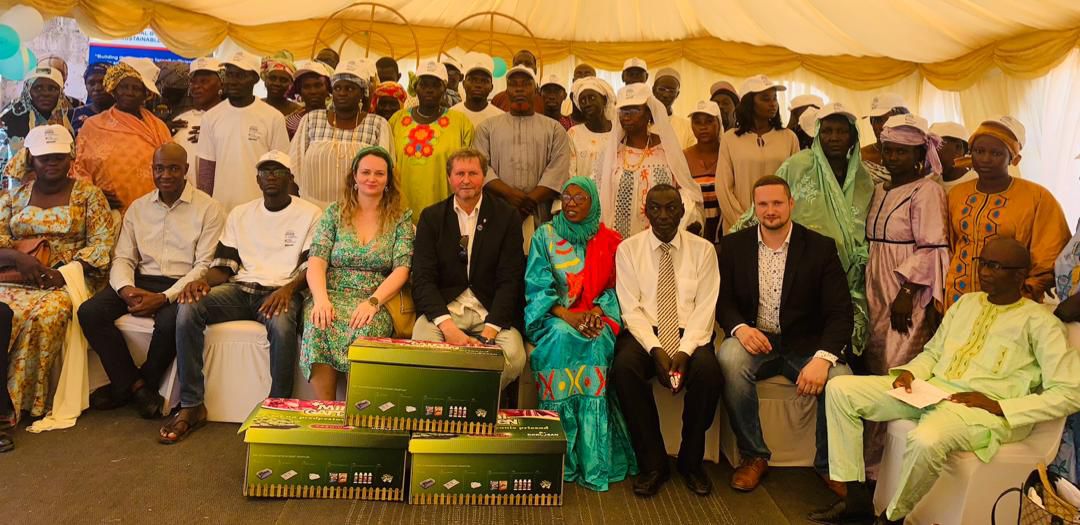
The launch capped months of rigorous trials, with Rokosan’s organic fertilizer earning certification from the National Agricultural Research Institute (NARI). Nationwide training programs had already equipped hundreds of farmers with the skills to transition from chemical-dependent methods to eco-friendly alternatives. Thursday’s event peaked with the presentation of certificates to 100 dedicated product ambassadors and the distribution of 100 mini-garden agricultural sets to women gardeners nationwide, symbolizing hands-on empowerment.
Adam Szoke, Director for Business Strategy at Reavia, took the stage to deliver stirring remarks, framing the project as a transformative milestone. “Our project is built on a simple but powerful belief: when women prosper, families grow, and entire communities rise,” Szoke declared, his voice echoing across the gathered crowd of farmers, officials, and supporters.
He painted a vivid vision: “We envision a future where every woman has the tools, knowledge, and voice to shape her own destiny.” Szoke extended heartfelt thanks to the Slovak and Gambian governments for their unwavering partnership, noting how the initiative dovetails seamlessly with President Adama Barrow’s blueprint for a self-sufficient, food-secure Gambia. He reserved special praise for Gambian farmers, whose trust and eagerness to adopt organic products had been the project’s beating heart. “Your participation has been central to our success,” he affirmed.
Representing the Ministry of Agriculture, Deputy Permanent Secretary Fatou Jammeh-Touray hailed the Rokosan project as nothing short of “life-changing.” She passionately urged the audience to embrace organic farming as a combatant against climate change. “Agriculture is the most affected sector by climate change,” she stated firmly. “Going organic means going green—it ensures sustainable practices, healthier food, and environmental protection.”
Jammeh-Touray spotlighted the ministry’s bold commitments, including the government’s recent nationwide procurement and distribution of organic fertilizers. This aligns directly with The Gambia’s Nationally Determined Contributions (NDCs) under the Paris Agreement, aiming to slash greenhouse gas emissions and fortify climate resilience. She dispelled old myths, “We must move away from the false belief that only chemicals can guarantee bumper harvests. Organic farming can yield both abundance and health.”
Badara Jobe, Managing Director of Jabangjobe & Associates, rounded out the key addresses by unveiling the selection of 100 business ambassadors. These individuals, he explained, emerged from a rigorous, participatory process involving partners and stakeholders to ensure transparency and inclusivity. “We are not alone in identifying these ambassadors,” Jobe said. “We involved our partners to make it credible. They’ve shown real dedication in raising awareness and helping fellow farmers grasp the benefits of organic farming.”
The ceremony’s highlight unfolded as Jobe oversaw the distribution of 100 mini-garden sets—compact kits containing Rokosan fertilizers, seeds, and tools—to women gardeners from across the country. “Our goal is for people to see the results for themselves because we believe that seeing is believing,” Jobe enthused. He noted that these sets will enable farmers to demonstrate tangible improvements in crop yields and sustainability in their communities.
Jobe emphasized women, who often shoulder unique burdens in vegetable cultivation and small-scale farming. “This initiative will help women farmers enhance their productivity and achieve higher standards in vegetable production,” he said, underscoring how the project tackles gender disparities head-on.
With climate threats looming—erratic rains, soil degradation, and rising temperatures—The Gambia’s pivot to organics couldn’t come soon enough. Experts estimate organic methods could boost yields by 20-30% while cutting carbon footprints. As ambassadors fan out and mini-gardens bloom, the ripple effects promise to nourish crops and an entire nation’s future.
The Rokosan launch stands as a beacon: collaboration across borders can turn adversity into abundance. In The Gambia, where women till the soil that feeds millions, this project ensures their hands—and harvests—grow stronger.