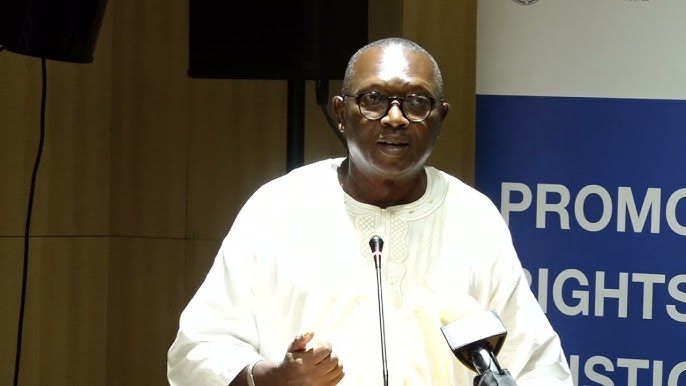
Professor Abdoulaye Saine, Executive Director of the Nyang-Sanneh Institute for Social Research and Justice, has issued a stark and impassioned statement condemning The Gambia’s persistent failures in governance and development six decades after independence.
In an Interview with The Alkamba Times, Professor Saine declares that “The Gambia has lost its soul” and is “bewitched,” with even divine observation turning to amusement at the nation’s plight. He calls for an urgent “resurrection” of the country—not through prayers alone, but through decisive, collective affirmative action.
Saine, a prominent Gambian-born political scientist and former professor at Miami University in Ohio, who leads the Banjul-based institute established in 2022 to honor scholars Sulayman Nyang and Lamin Sanneh, paints a grim picture of widespread corruption, misuse of public funds, and deepening social deprivation. He highlights allegations of billions of dalasi misappropriated by high-ranking officials and politicians, with minimal accountability, describing this as one of The Gambia’s most profound development dilemmas.
To underscore his critique, Saine draws a stark comparison between The Gambia and Botswana—two nations that began independence in the mid-1960s under similarly challenging conditions of poverty and underdevelopment. Both were endowed with agricultural potential, cattle herds (with The Gambia reportedly having more cattle than people at independence), small populations, and natural resources—diamonds in Botswana’s case, and the fertile Gambia River promising food self-sufficiency and exports.
Yet, over 60 years later, the trajectories have diverged dramatically. Botswana has achieved “middle-income” status, often hailed as an African “miracle,” with per capita income soaring from around $100 in 1966 to over $7,000 by 2007 (and continuing upward trends). The landlocked, arid nation has sustained remarkable growth through political stability, the absence of coups, and a leadership focused on bureaucratic excellence and citizen welfare.
In contrast, The Gambia languishes among the world’s lowest-ranked nations in social and economic development indicators, with per capita income stuck at around $500 or less. Saine attributes this chasm to the absence of good leadership and good governance in The Gambia. While Botswana built institutions dedicated to progress, The Gambia’s post-independence path under Sir Dawda Jawara featured modest, conservative growth hampered by slow reforms. The 1994 coup, led by Yahya Jammeh and initially popular for promising to address economic woes and inequality, devolved into 22 years of misrule marked by killings, economic stagnation, and limited infrastructure gains—despite some improvements.
Jammeh’s regime was ousted in the 2016-2017 elections, ushering in President Adama Barrow amid widespread hope for renewal. Saine argues that this optimism has faded: Barrow’s administration blends quasi-democratic elements from the Jawara era with lingering authoritarian tendencies from the Jammeh period, allowing basic political rights while maintaining repressive elements.
Saine identifies deeper structural issues fueling stagnation: a conservative electorate influenced more by ethnicity than by policy or merit; low levels of political education and awareness; and a political culture that prioritizes personal enrichment over national progress. He describes Gambian elites—political and bureaucratic—as driven by short-term, personalist goals: enter office, accumulate wealth quickly, and often exit for better opportunities abroad. Low salaries, poor working conditions, and governance failures exacerbate brain drain, leaving the vulnerable behind as the nation loses its talent.
The professor warns that without transformative change, The Gambia risks further instability and entrenched poverty. He urges a shift to open, honest, forward-looking, and progressive leadership committed to popular democracy, gender equality, and upliftment of the poor.
With the 2026 presidential and 2027 National Assembly elections approaching, Saine views them as a pivotal opportunity for Gambians to select leaders who can reverse decades of decline. Failure to do so, he cautions, could deepen suffering and foreclose hopes for genuine prosperity.