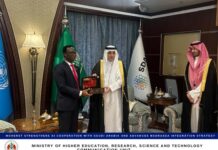
The Islamic Development Bank (IsDB) has approved a $32.2 million funding package to establish the School of Medicine and Allied Health Sciences (SMAHS) at the University of The Gambia’s Faraba Banta Campus, marking a significant step toward addressing the country’s critical shortage of healthcare professionals. The announcement, made by the Ministry of Higher Education, Research, Science, and Technology (MoHERST), follows the 361st meeting of the Board of Executive Directors of the IsDB.
The new medical school aims to transform healthcare training and service delivery in The Gambia by providing a modern, well-equipped facility to train doctors, nurses, and public health experts locally. The project’s primary objective is to enhance the quality, accessibility, and sustainability of medical education while boosting research and public health capacity. This initiative directly tackles the acute healthcare workforce shortage that has long challenged the nation’s health system.
The project is structured into four key components. The first involves constructing five schools with shared facilities to create a robust academic environment. The second component focuses on supervising construction and equipment installation to ensure high standards. The third includes procuring sixteen advanced medical and laboratory equipment sets, along with telemedicine technology, to equip the school with cutting-edge tools. The final component emphasizes academic and faculty development, including curriculum enhancements and international training opportunities for educators.
The IsDB expressed confidence that the SMAHS will build a sustainable pipeline of skilled healthcare professionals, strengthening The Gambia’s national health system. By training professionals locally, the initiative reduces reliance on foreign-trained personnel and fosters resilience in healthcare delivery. The project aligns with the government’s National Development Plan and its Higher Education Transformation Agenda, which prioritizes education as a catalyst for economic growth.
Under the leadership of President Adama Barrow, MoHERST is leveraging higher education to drive transformative change across the country. The ministry highlighted that the SMAHS project represents a milestone in this vision, positioning The Gambia to meet its healthcare needs while fostering innovation and research. The establishment of the medical school is expected to produce graduates who are equipped to address pressing public health challenges, ranging from infectious diseases to maternal and child health.
The Ministry of Higher Education, Research, Science, and Technology extended its gratitude to the IsDB for its unwavering support. “This funding is a testament to the strong partnership between The Gambia and the IsDB,” the ministry said in a press statement. “It will have a lasting impact on our nation’s healthcare and education sectors.”
The SMAHS project is poised to become a cornerstone of The Gambia’s development strategy, promising improved access to healthcare and a brighter future for its citizens. As construction and implementation progress, the University of The Gambia’s Faraba Banta Campus is poised to become a hub for medical excellence in the region, training the next generation of healthcare leaders.