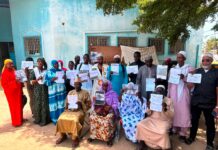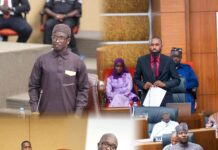
The Tabax Reewmi Movement, led by Ahmadou MH Kah, has issued a scathing condemnation of the National Assembly’s recent decision to pass amendments drastically increasing nomination fees for political candidates, labeling it a deliberate assault on democracy and the rights of ordinary Gambians.
In response, the movement has announced plans for a historic nationwide protest, dubbed the “Equality March,” to rally citizens against what they describe as an elitist and exclusionary policy.
The amendments, passed by the National Assembly, significantly raise the financial requirements for individuals seeking to run for public office, a move the movement argues is designed to exclude ordinary citizens—particularly the youth and emerging political voices—from participating in the democratic process.
Ahmadou MH Kah, in a fiery statement, accused the Barrow administration and its legislative allies of betraying promises of inclusivity and youth empowerment. “This is a shameful attack on the rights of Gambians to shape their country’s future,” Kah declared. “By making it financially impossible for the average citizen to contest for office, they are saying only the rich and connected have the right to lead.”
The movement’s statement highlighted the government’s justification for the fee hikes as particularly egregious. The Minister of Justice defended the amendments, claiming they align with “international best practice” and reflect “evolving needs and aspirations.” Kah dismissed these as “senseless and shameful excuses” meant to mask discriminatory intent. “Gambians are not laughingstocks,” he said, accusing the National Assembly of prioritizing self-interest over the people’s welfare.
The fee increases are only the latest in a series of controversial decisions by the National Assembly that have sparked public outrage. The Tabax Reewmi Movement cited a recent law that shields only the president, ministers, and legislators from insults, while excluding religious leaders, traditional authorities, and ordinary citizens, as evidence of a pattern of self-serving governance. “They have weaponized legislation to shield themselves and silence opposition,” the movement stated. “This act insults every poor family by declaring their children unworthy of leadership because of poverty.”
The movement’s call to action represents a bold escalation in response to what it describes as a “war against democracy” waged by the Barrow administration. The “Equality March” is envisioned as the largest political protest in Gambia’s history, aimed at mobilizing citizens across the country—from Banjul to Basse—in a peaceful but resolute show of resistance. The movement is reaching out to opposition parties, independent candidates, youth-led organizations, and all Gambians committed to justice to join the effort. “This is our moment to reclaim the soul of our democracy,” Kah emphasized. “We march because democracy belongs to the people, not the elite. Poverty should never disqualify anyone from leadership.”
The Tabax Reewmi Movement framed the protest as a direct response to the government’s challenge to the resilience of Gambian youth. “The National Assembly has tested our strength,” the statement read. “It is now time to respond. This country must mean something to us, and we must defend it.” The movement warned that allowing the fee hikes to stand unchallenged would signal the “death certificate of our weak democracy.”
Kah’s leadership has positioned the Tabax Reewmi Movement as a vocal advocate for democratic reform and youth empowerment in The Gambia. The movement’s call for mass mobilization underscores growing frustration with a political system perceived as increasingly disconnected from the needs of ordinary citizens. By framing the nomination fee hikes as an attack on the poor and a barrier to political participation, the movement seeks to galvanize a broad coalition of Gambians to demand change.
The “Equality March” is expected to draw significant attention in the coming days, with organizers urging citizens to prepare for coordinated action nationwide. The movement’s message is clear: The Gambia belongs to all its people—rich or poor, urban or rural, connected or unknown. As the nation braces for what could be a defining moment in its democratic journey, the Tabax Reewmi Movement has issued a rallying cry: “The time to act is now.”