By: Sainabou Sambou
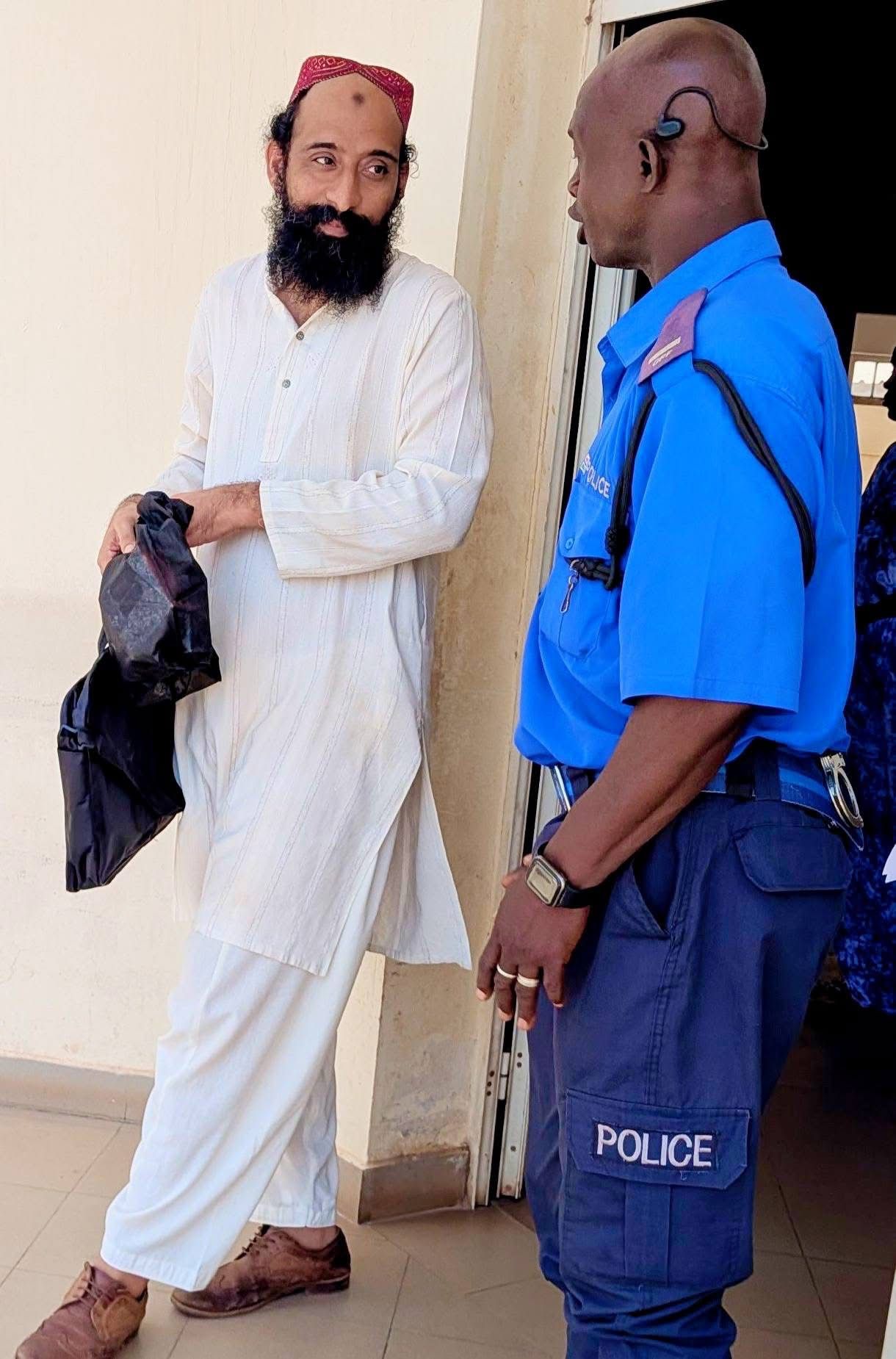
A Pakistani national, Atif Amin, was arraigned before Magistrate Krubally at the Banjul Magistrates’ Court on Monday, facing seven criminal charges, including impersonation, forgery, obtaining money by false pretence, issuing false cheques, and false assumption of authority. The charges, prosecuted by Assistant Commissioner A. Manga and Sergeant M. Jammeh, stem from alleged offences committed between 2022 and 2024 in Banjul and other parts of The Gambia.
According to the prosecution, Atif Amin falsely presented himself as a Pakistani diplomat and chairman of the Pakistani community in The Gambia to various government officials, including representatives from the Banjul City Council, the Executive Director of Lands, Internal Audits, and Information Technology. The first count of impersonation alleges that Amin used these false representations with the intent to defraud. In a related charge, he is accused of using diplomatic vehicle number plates—1 AV4 ICD, 1 AV4 2CD, and Pakistan I.C.D.—on his vehicles to further his impersonation scheme, misleading authorities and the public.
The third count charges Amin with forgery for allegedly creating fraudulent vehicle number plates bearing the same diplomatic identifiers. Additionally, Amin faces two counts of obtaining money by false pretence. In one instance, he allegedly obtained D100,000 from Muhammed Ousman under the guise of sending the funds to Ousman’s family in Pakistan, a promise he reportedly failed to fulfill. In another, he is accused of taking D15,000 from Lamin Kinteh by falsely promising to develop a website, which was never delivered.
Further compounding the charges, Amin is accused of issuing false cheques. He allegedly issued a Zenith Bank Gambia Ltd. cheque (no. 00302230) for D100,000 to GACH GLOBAL Company and another (no. 00302219) for D71,000 to Basamba Drammeh, knowing there were insufficient funds in his account to cover these payments. The final charge, false assumption of authority, alleges that Amin misrepresented himself as the Pakistani Ambassador to The Gambia to various government agencies, further exploiting his fabricated diplomatic status.
Amin pleaded not guilty to all seven counts. Assistant Commissioner Manga requested a short adjournment to present prosecution witnesses but strongly opposed granting bail, citing Amin’s prior history of absconding. Manga revealed that in May 2024, Amin had been granted bail with two Gambian sureties, Saihou Jarjou and Musa Dumbuya, each providing D300,000 and their national IDs. However, Amin allegedly fled to Guinea-Bissau, leading to the arrest of his sureties. The prosecution later employed tactics with assistance from the Criminal Investigation Department (CID) to locate him. Amin was found hiding in his toilet in The Gambia, despite his wife’s claim that he was out of the country.
In his defense, Amin argued for bail, claiming his trip to Guinea-Bissau was for a charitable donation of 600 bags of rice, supported by photographic evidence. He further stated he had visited the Vice President’s office and was a known figure in The Gambia, regularly contributing columns to a local newspaper. Amin also noted that the police had held his five mobile phones, five laptops, and five cheque books for over a year, asserting his willingness to cooperate with the trial.
Magistrate Krubally, after considering both the prosecution’s objections and Amin’s defense, acknowledged that bail is a discretionary matter to be exercised judiciously. Noting that the charges are bailable offences, he granted Amin bail in the sum of D500,000, with strict conditions. Amin must provide two responsible Gambian sureties, who are either genuinely employed or engaged in business. The sureties are required to submit valid contact details, addresses, and unexpired national IDs to the court registrar’s office, as well as swear an affidavit of means. They must also ensure Amin’s appearance at subsequent hearings, with the risk of forfeiting the bail sum if he absconds.
The court adjourned the matter to July 27, 2025, for a full hearing, where the prosecution is expected to present its witnesses and evidence.